
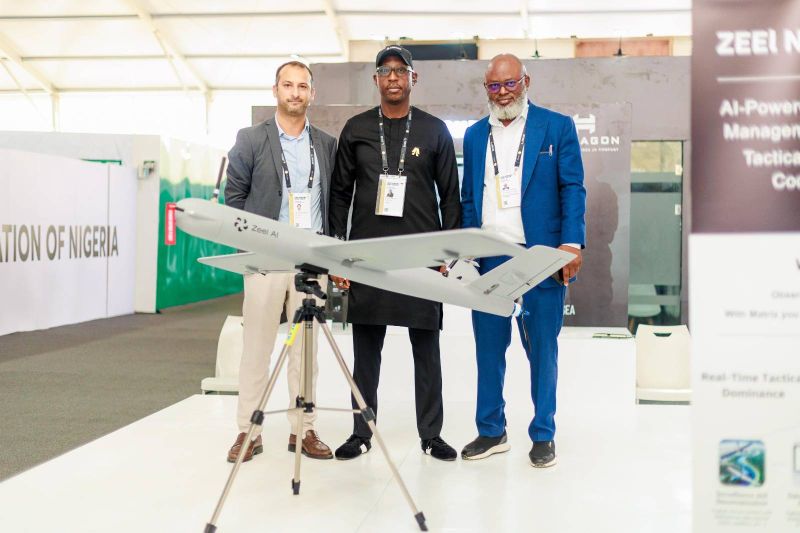
Armenia’s Zeel AI partners Nigeria’s Arridex on local drone production
Armenian defence technology company Zeel AI has entered a strategic partnership with Nigerian industrial group Arridex, formalised at the Africa International Defence Exhibition (AFRIDEX) 2026 in Lagos, where the two companies exhibited side by side. Zeel AI Chief Executive Officer Paruyr Abrahamyan announced the agreement after the exhibition, which ran from 26 to 29 October at Eko Atlantic.
Under the arrangement, Zeel AI’s autonomous systems and artificial intelligence (AI) capabilities join the Arridex portfolio, with production to take place in Nigeria. Abrahamyan said the partnership brings Zeel AI’s technology together with “Arridex’s two decades of industrial delivery, manufacturing base, professional local teams and strong market network in Nigeria and beyond.”
“Africa’s security challenges call for capabilities that are smart, scalable and built close to the end user. This partnership is designed to deliver exactly that,” he said. “AFRIDEX brought together defence and military leaders from across Africa and partner nations. I believe it was the right moment and the right place to take this step together.”
Abrahamyan described local production in Nigeria as a way of building sovereign capability and skills in the country, and said Nigeria would become a hub “from which Zeel AI can serve the large demand across West Africa”, where he said interest in the company’s technology “is growing quickly.” Neither company has disclosed the legal form of the agreement, its value, which products will be built first or a production timeline.
What Zeel AI Brings
According to its website, Zeel AI was set up in 2020 as a research and development effort and had become “one of the leading domestic defense contractors” by 2022. Its main product is the ZEEL A5 PRO loitering munition, which the company says can strike targets moving at up to 60 km/h with a circular error probable (CEP) of less than one metre. It quotes a flight time of 50 to 90 minutes, a range of up to 120 km in its extended-range form, camera-based navigation when satellite positioning is jammed or spoofed, and launch readiness in under 15 minutes from a pneumatic launcher.
The company describes the A5 PRO as “combat-proven” and says thousands have been fielded, but it does not name the operators or the conflicts. Alongside the munition it offers ZEEL NET, a command, control, communications, computers, intelligence, surveillance and reconnaissance (C4ISR) software package that places sensor feeds, imagery and reports on one shared tactical map using NATO’s MIL-STD-2525D symbology, with AI detections confirmed or rejected by human analysts. A low-cost interceptor drone is in prototype development, and the firm also lists intelligence, surveillance and reconnaissance (ISR) drones in its range.
The company’s origins are closely tied to Armenia’s post-2020 drive to build its own drone industry. Abrahamyan has appeared at international forums as CEO of Zeel AI, Armenia, and in July 2026 Yerevan-based EVN Report noted that Zeel AI’s A1 and A5 munitions appear to be the same models shown by Armenian manufacturer Aerodynamics as the Meghu-1 and Meghu-5 at a military parade on 28 May. EVN Report gave the Meghu-1 a 60 km range with a truck launcher carrying six rounds, and the Meghu-5 a strike range of 40 km, and said the relationship between the two companies was unclear.
This is not Zeel AI’s first approach to African customers. Military Africa reported in October 2023 that the company attended the 2nd African Air Force Forum, where it presented loitering munitions with a range of up to 250 km, a payload of up to 10 kg and endurance of up to 2.5 hours, as well as its MR20 air surveillance radar with a 50 km radius and the ability to track more than 100 air targets. At the time it pitched its systems as an affordable option for African forces working with limited defence budgets.
Arridex and the Helagon Route into Nigerian Defence
Arridex was founded in 2005 as RusselSmith, an asset integrity company serving Nigeria’s oil and gas sector, and took its new name on 19 May 2026. Led by Group Chief Executive Officer Kayode Adeleke, it now works across oil and gas, maritime, defence, construction and aerospace. In June it commissioned its Omnifactory in Lagos, described as West Africa’s first multi-technology additive manufacturing plant, combining laser powder bed fusion, cold spray, fused filament fabrication and selective laser sintering. The group signed a memorandum of understanding (MoU) with the Defence Industries Corporation of Nigeria (DICON) in October 2025 to bring additive manufacturing into DICON’s production lines.
Its defence platforms are delivered through Helagon, a joint venture between Arridex and DICON. At AFRIDEX, Senate President Godswill Akpabio, representing President Bola Tinubu, unveiled the Arridex ADX-Barra 200 autonomous surface vessel on 26 October, alongside the smaller ADX-Barra 100. Arridex said both boats were designed, built and integrated in Nigeria.
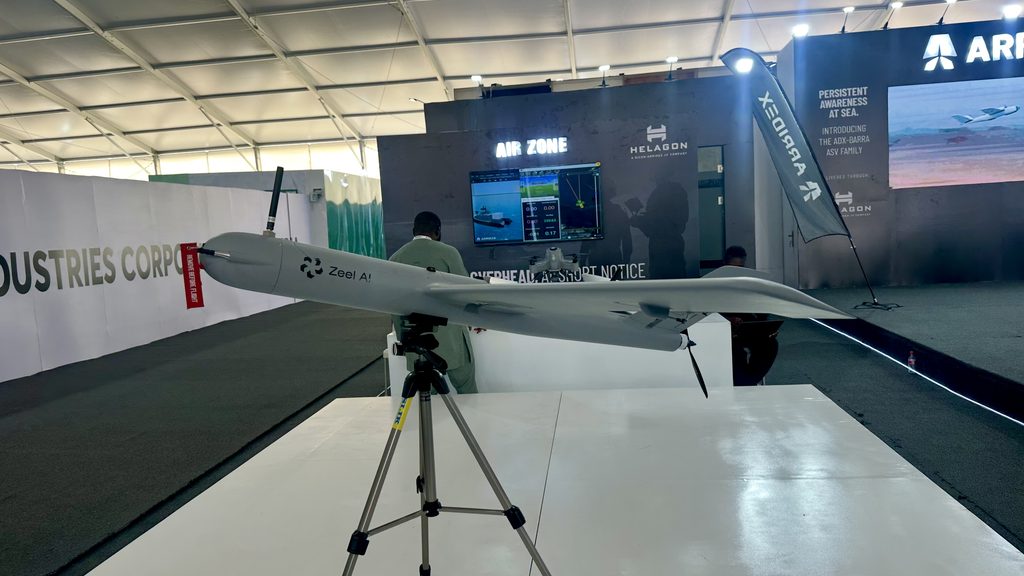
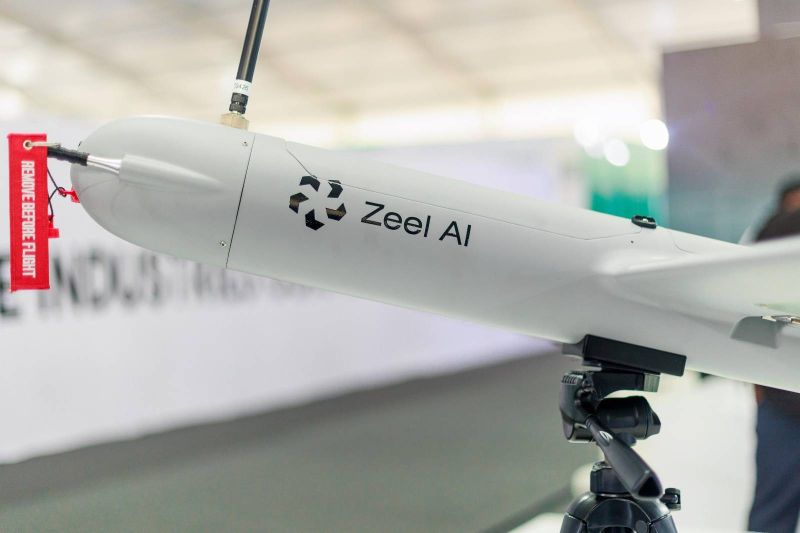
At the exhibition, a Zeel AI fixed-wing drone stood directly in front of the Helagon “Air Zone” on the Arridex stand, which suggests the Armenian systems will sit within the same aerial portfolio. The companies have not said whether Zeel AI products will be produced and marketed through Helagon, and therefore with DICON involvement, or through Arridex directly.
Local Production and the West African Market
The agreement fits the pattern of AFRIDEX 2026, where foreign suppliers sought Nigerian partners to meet Abuja’s demand for in-country manufacturing. Tinubu told the exhibition that Africa must become more self-reliant in defence and that partnerships should leave lasting capability behind. During the same week, Spain’s EM&E signed an MoU with Nigus Tactical Systems and India’s Airbornics Defence and Space partnered Nigus Hercules on armoured vehicle maintenance, while Nigeria and Türkey have been moving from direct purchases to joint manufacturing.
Zeel AI will also meet local competition. Abuja-based BabaSky Technologies showed what it called Africa’s first fibre-optic guided loitering munition at the Africa Land Forces Forum in July, and Nigerian firms are increasingly offering drones built at home. The demand is clear: Nigeria’s armed forces are fighting jihadist groups in the north-east and armed bandits in the north-west, while neighbouring Sahel states face their own insurgencies, and loitering munitions and small ISR drones have become a common part of these campaigns.
An Armenian Drone Maker’s West African Bet
For Zeel AI, a Nigerian production partner offers a route into a West African market crowded with Turkish, Chinese, Israeli and Emirati suppliers, and a way to meet buyers’ demands for local content. For Arridex, it adds an aerial strike and surveillance line to the autonomous boats and additive manufacturing it showed this year. The next indicators will be the first product chosen for Nigerian assembly, the share of work done locally, any Armenian export approvals required and, above all, whether the Nigerian Army, Navy or Air Force places an order. Military Africa will follow up as the two companies release details.
