
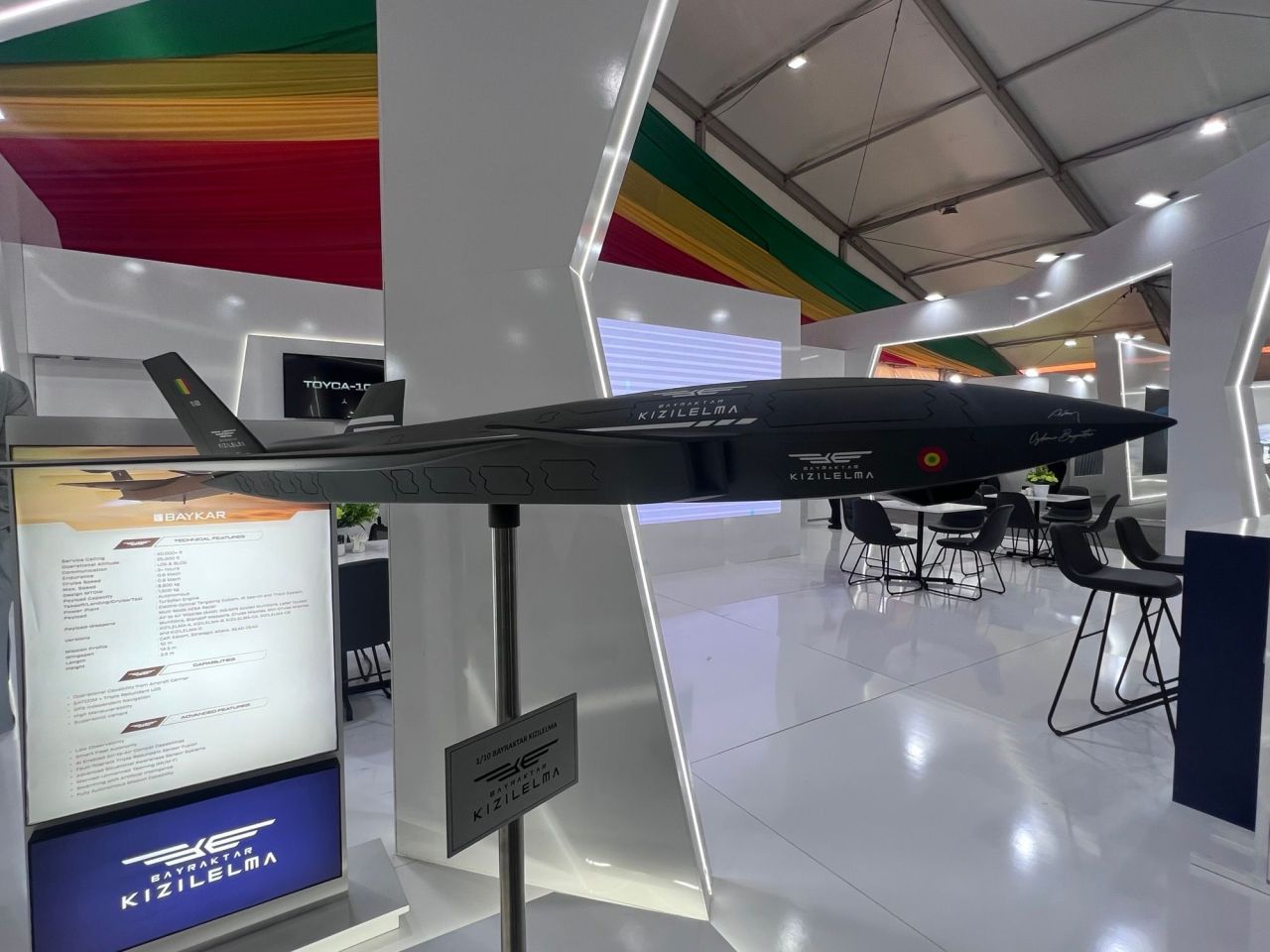
Baykar shows Mali-flagged KIZILELMA at BAMEX 2026
Turkish drone maker Baykar is displaying its Bayraktar KIZILELMA unmanned combat aircraft in Malian national flag markings at the second Bamako International Defence and Security Exhibition (BAMEX), which opened in Mali’s capital on 9 November 2026. The flag livery is a pitch aimed at the host country, which already flies Baykar’s Bayraktar TB2 and Akinci drones and is the most active Turkish drone customer in the Sahel.
Neither Baykar nor the Malian government has announced an order. Unmanned Africa has not seen any contract, letter of intent or official statement linking Mali to the type. A flag on a display aircraft does not mean a purchase has been agreed.
From scale model to centre stage
The display is a step up from the first BAMEX in November 2025. At that show, Baykar brought scale models of the Bayraktar TB2, Akinci, TB3 and KIZILELMA, according to Hürriyet Daily News. As Military Africa reported at the time, a Baykar representative presented a KIZILELMA model to a Malian official during that edition.
This year Baykar is one of more than 20 Turkish companies at the Bamako Exhibitions Park (Foire Exposition de Bamako, or FEBAK). It exhibits alongside ASELSAN, Roketsan and Skydagger. The show runs until 13 November and will end with two days of live demonstrations at Koulikoro, north-east of the capital. BAMEX chairman Harun Saraç told Military Africa in September that the event would be judged by the procurement, training and maintenance agreements that follow it.
The KIZILELMA
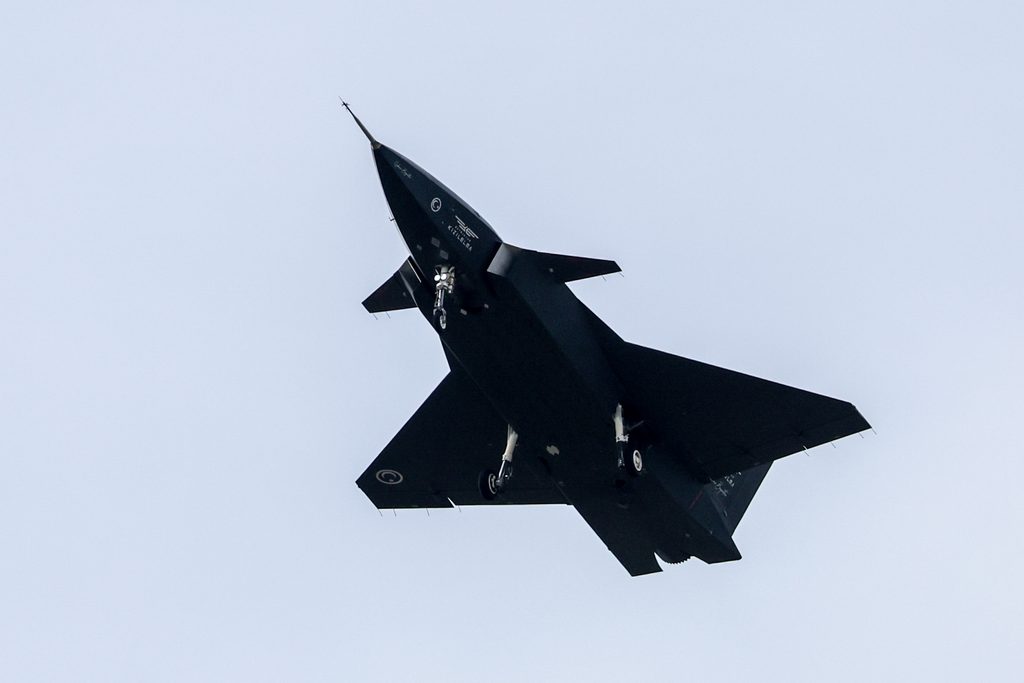
The KIZILELMA is Baykar’s jet-powered unmanned combat aircraft. It has a low-observable shape and an internal weapons bay, and is designed to fly alongside crewed fighters as well as on independent strike missions. Baykar’s published specifications give a maximum take-off weight of 8,500 kilogrammes and a payload of 1,500 kilogrammes, a length of 14.5 metres and a wingspan of 10 metres. It cruises at Mach 0.6, reaches Mach 0.9, operates at 25,000 feet and has a service ceiling of 45,000 feet.
Its sensors include an active electronically scanned array (AESA) radar developed by ASELSAN, an electro-optical targeting system and an infrared search-and-track system. It can carry laser-guided munitions, missiles and a long-range cruise missile.
The aircraft first flew in December 2022. In October 2025 it was flown for the first time with its AESA radar installed, and released two Turkish-developed air-to-surface weapons in trials, FlightGlobal reported. Baykar chairman Selçuk Bayraktar’s brother, chief executive Haluk Bayraktar, said in May that the company aimed to make its first serial deliveries to the Turkish military in 2026, Daily Sabah reported. He added that KIZILELMA had become the first unmanned combat aircraft to hit an aerial target with an air-to-air missile, using a weapon developed by TÜBİTAK SAGE. Baykar’s first export contract for the type is with Indonesia, for 12 aircraft, with deliveries targeted for 2028.
Mali’s Turkish drone fleet
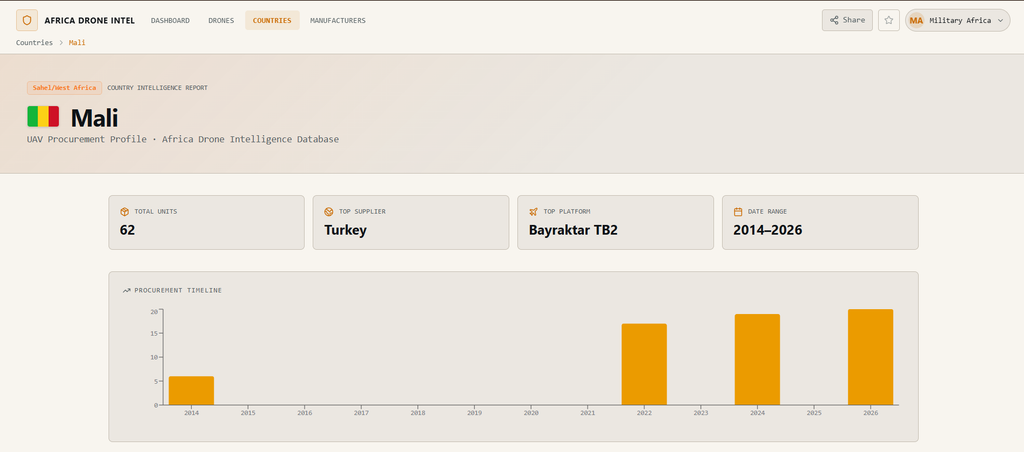
According to the Africa Drone Intelligence database, Mali has built up the largest Turkish-supplied drone fleet in the Sahel. The Malian Armed Forces (Forces Armées Maliennes, FAMa) first received Bayraktar TB2s in late 2022. They added the heavier Akinci in late 2024 and took a further batch of Akincis at Sévaré Air Base on 30 July 2026. The Akinci flies alongside Russian-supplied systems, including the Kronshtadt Orion drone sighted over Bamako and Shahed-136-type loitering munitions used by Malian and Russian forces in July.
That fleet is under heavy pressure. Jama’at Nusrat al-Islam wal-Muslimin (JNIM) and the Azawad Liberation Front (FLA) have repeatedly targeted Mali’s air assets. Militants attacked Sévaré airbase, and the FLA has downed or captured Mi-24P attack helicopters. Mali’s forces retook Kidal on 6 October with heavy use of air power.
The database records 62 military drones for Mali, a mix of Turkish long-endurance aircraft and Russian and Iranian strike munitions. The backbone is the Bayraktar TB2: 17 aircraft, more than a quarter of the fleet, used for surveillance and laser-guided strikes. Seven heavier Akincis add range and payload.
More than half of the recorded fleet is expendable. Mali has 12 Russian Kub-BLA loitering munitions, 10 ZALA Lancets for hunting vehicles and 10 long-range Shahed-131 strike drones from Iran’s HESA. Six French Hawker Q800X multirotors, bought in 2014, cover close-range reconnaissance. Together, the Turkish aircraft and the Russian and Iranian munitions have extended the army’s reach into the far north. The heavy use of pre-programmed strike weapons still raises concerns about target verification and civilian safety in disputed areas.
What a jet drone would mean for Mali
Mali’s air force flies slow, propeller-driven drones over vast desert distances. A jet-powered combat drone would respond much faster, and would be harder to hit with the anti-aircraft guns and portable air defences armed groups use. It would also cost more to buy and support, and it would need runways, maintenance skills and secure basing that Mali’s current drones do not.
Whether the Malian flag on Baykar’s stand turns into an order will depend on funding, Ankara’s export approvals and Bamako’s priorities in a war still dominated by ground convoys and drone strikes against fighters in the open. For now, the KIZILELMA in Malian markings shows how directly Turkish industry is courting the Alliance of Sahel States (AES) market as BAMEX moves to its Koulikoro demonstrations later this week.
