
Ghana acquires French Cavok CK 23 VTOL drones
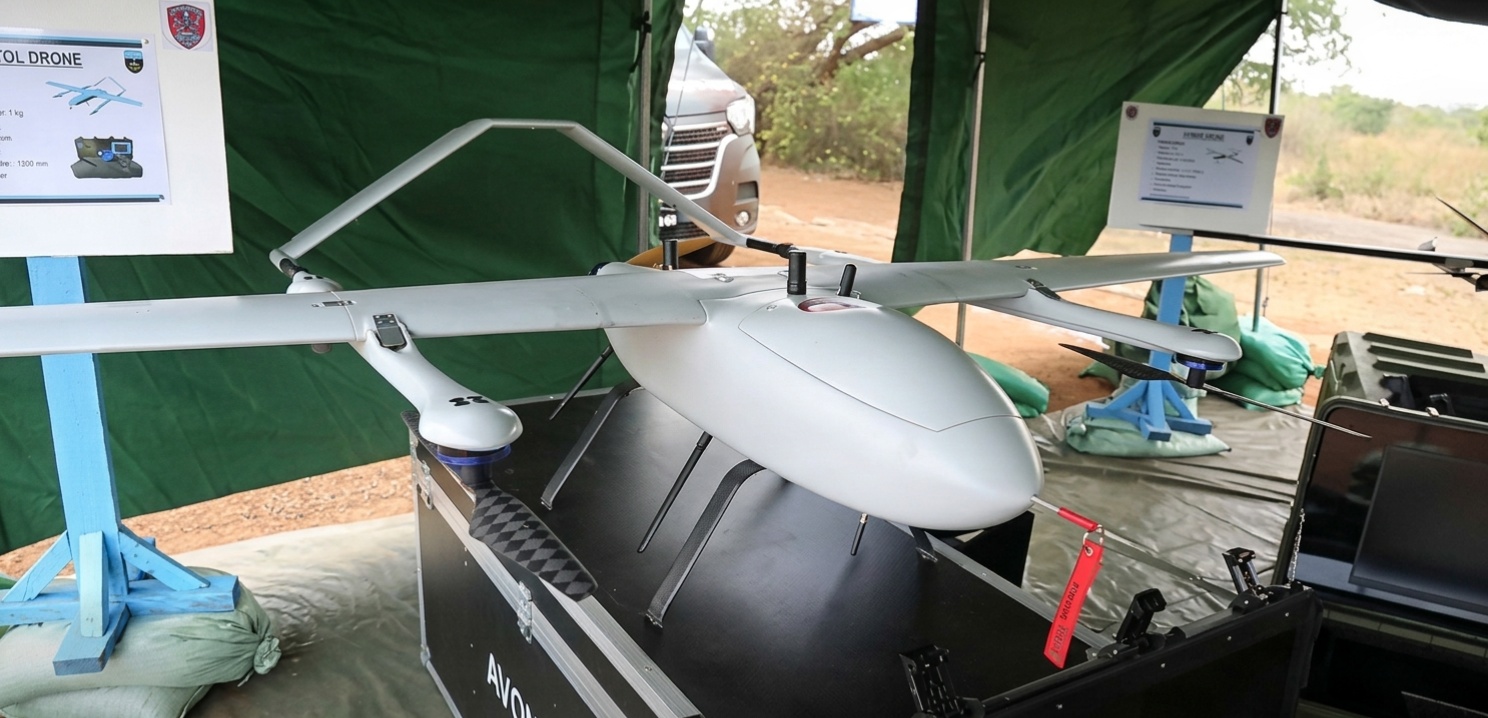
The Ghana Armed Forces (GAF) have acquired CK 23 vertical take-off and landing (VTOL) drones from French manufacturer Cavok UAS. The new type was shown at the 2026 Land Combat Fire Demonstration, held on 30 October at the Bundase Battle Training Camp in the Greater Accra Region.
The CK 23 is a fixed-wing unmanned aerial system (UAS) that takes off and lands vertically like a multirotor, then flies efficiently on its wing for long-range missions. Cavok UAS builds it for professional, military and civilian users. The army has not disclosed how many systems it has bought, which units will operate them, or the value of the contract.
Shown at Bundase
The Land Combat Fire Demonstration is an annual live-fire and tactical field exercise run by the GAF. It is designed to bridge classroom theory and battlefield practice for students of the Ghana Armed Forces Command and Staff College (GAFCSC). This year’s edition was held for the college’s Senior Division Course 48.
The Fifth Infantry Battalion led and hosted the exercise. It was joined by the First and Second Infantry Battalions, the 16th Artillery Brigade, the 15th Armoured Brigade, the 14th Engineer Brigade, the 17th Army Signal Brigade and the Army Special Operations Brigade, with the Ghana Navy and Air Force also taking part, DailyGuide Network reported. The programme combined live firing, battle drills and tactical manoeuvres, with small arms, rocket-propelled grenades and artillery on show.
Brigadier General Edward Awaribey, General Officer Commanding the Southern Command, said “this demonstration is not merely a training routine”. He described it as a forum for cross-service learning and capability demonstration that helps develop the next generation of operational commanders, with objectives including integrating fire support across deep, close and rear operations. Peter Toobu Lanchene, Vice Chairman of Parliament’s Defence and Interior Committee, told the gathering that “the sovereignty of this nation, the defence of this nation, is in the hands of the Ghana Armed Forces”, adding: “Ghana is a no-go area.”
The CK 23 Drone
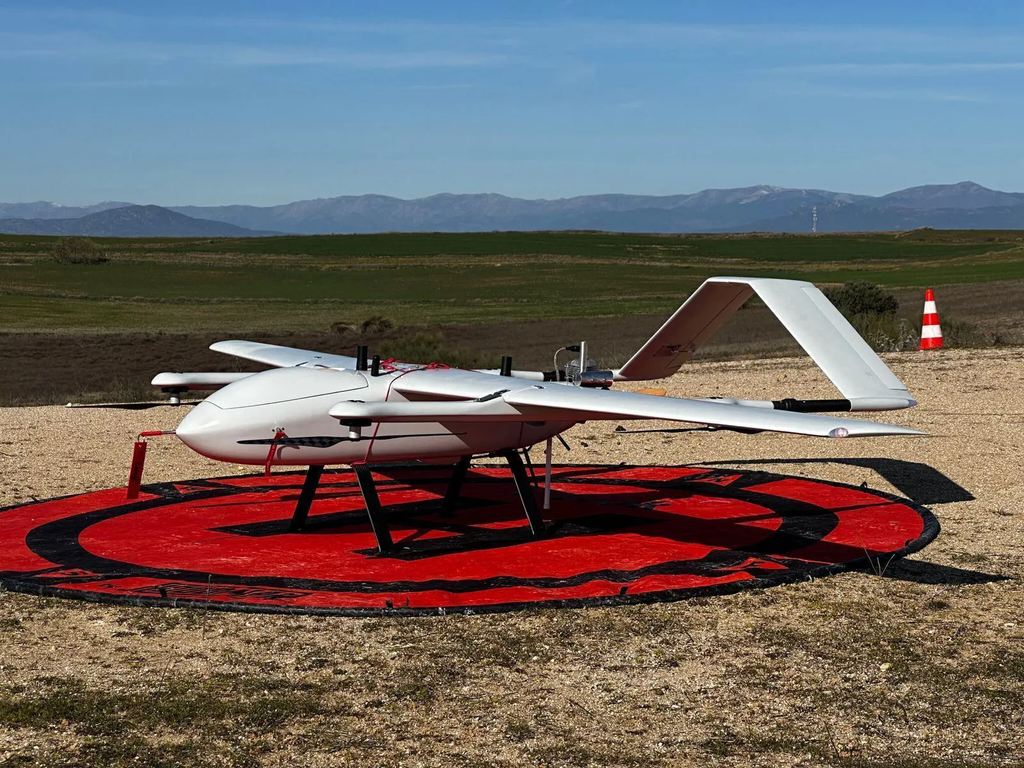
The CK 23 is built around a modular carbon-fibre composite airframe with a maximum take-off weight of 25 kilogrammes. It has a wingspan of 3.2 metres and a length of 1.85 metres. Cavok UAS says the system is designed for rapid deployment and can be fully set up in under ten minutes, and that it is produced and assembled in France, according to the manufacturer’s brochure.
The drone comes in two propulsion configurations. The all-electric CK 23 VE offers up to three hours of endurance. The CK 23 VH uses a thermal hybrid engine to extend endurance to between six and seven hours; Cavok’s own brochure quotes up to six. Both versions carry up to 5 kilogrammes (11 lb) of payload and cruise at 80 to 100 kilometres an hour (about 25 metres a second). They operate at up to 3,500 metres, or 5,000 metres with an optional propeller. The standard line-of-sight data link reaches 40 kilometres, extendable to 140 kilometres, with 3G, 4G, 5G, Iridium and satellite communications (SATCOM) options for beyond-line-of-sight control.
Payloads can be swapped for different missions. For intelligence, surveillance and reconnaissance (ISR), the CK 23 carries imagery intelligence (IMINT) sensors, including electro-optical and infrared (EO/IR) cameras with night vision for real-time tracking, surveillance and civil defence. High-resolution mapping sensors allow it to survey terrain, and a CK23 Cargo Medical variant is optimised for time-critical delivery of medical supplies, flying for 2.5 hours with its maximum payload, Cavok UAS says.
Flight is fully automatic, including take-off and landing, and the drone has dual Global Navigation Satellite System (GNSS) receivers for redundant navigation. Its safety systems include an emergency parachute, an integrated flight termination system (FTS), redundant power and autopilot, an optional ADS-B (Automatic Dependent Surveillance-Broadcast) transponder, and an “explosafe” fuel tank on the hybrid variant. The system is built to European aerospace standards. Its US distributor Barfield markets it as compliant with the US National Defense Authorization Act (NDAA), the rule that bars certain foreign-made components from systems sold to the US defence market.
Building Ghana’s drone fleet
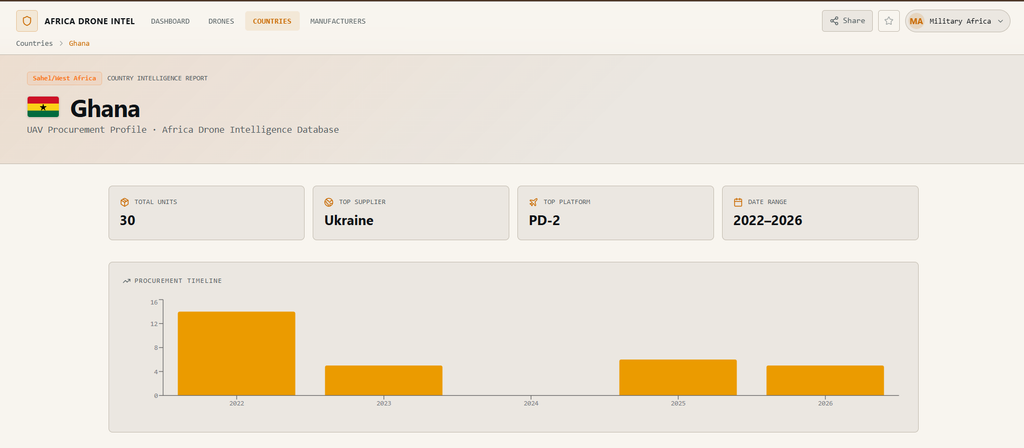
According to African Military Drone Procurement Database, the CK 23 joins a growing mix of small drones in Ghanaian service. The Ghana Navy gained a drone surveillance capability in 2023, and later that year Estonian firm Fixar delivered VTOL drones to the GAF. In January 2026, Ghana deployed locally built AeriusPro VTOL drones for northern border security. The drones are part of a wider re-equipment drive that Military Africa recently covered, as the Ghana Armed Forces retool with new vehicles, ships and helicopters.
Eyes over the northern frontier
A hybrid VTOL drone with six or more hours of endurance and no need for a runway suits the GAF’s main concern. Ghana must watch a long northern border with Burkina Faso, where Jama’at Nusrat al-Islam wal-Muslimin (JNIM) and other armed groups operate, and where forward bases and patrol posts often lack airstrips. If the CK 23 enters regular service, the army will be able to watch border crossings and smuggling routes for longer stretches and cue ground patrols with live video. Its demonstration at Bundase suggests the drone is being integrated into the land forces’ fire support and command training rather than held as a standalone surveillance tool.
