
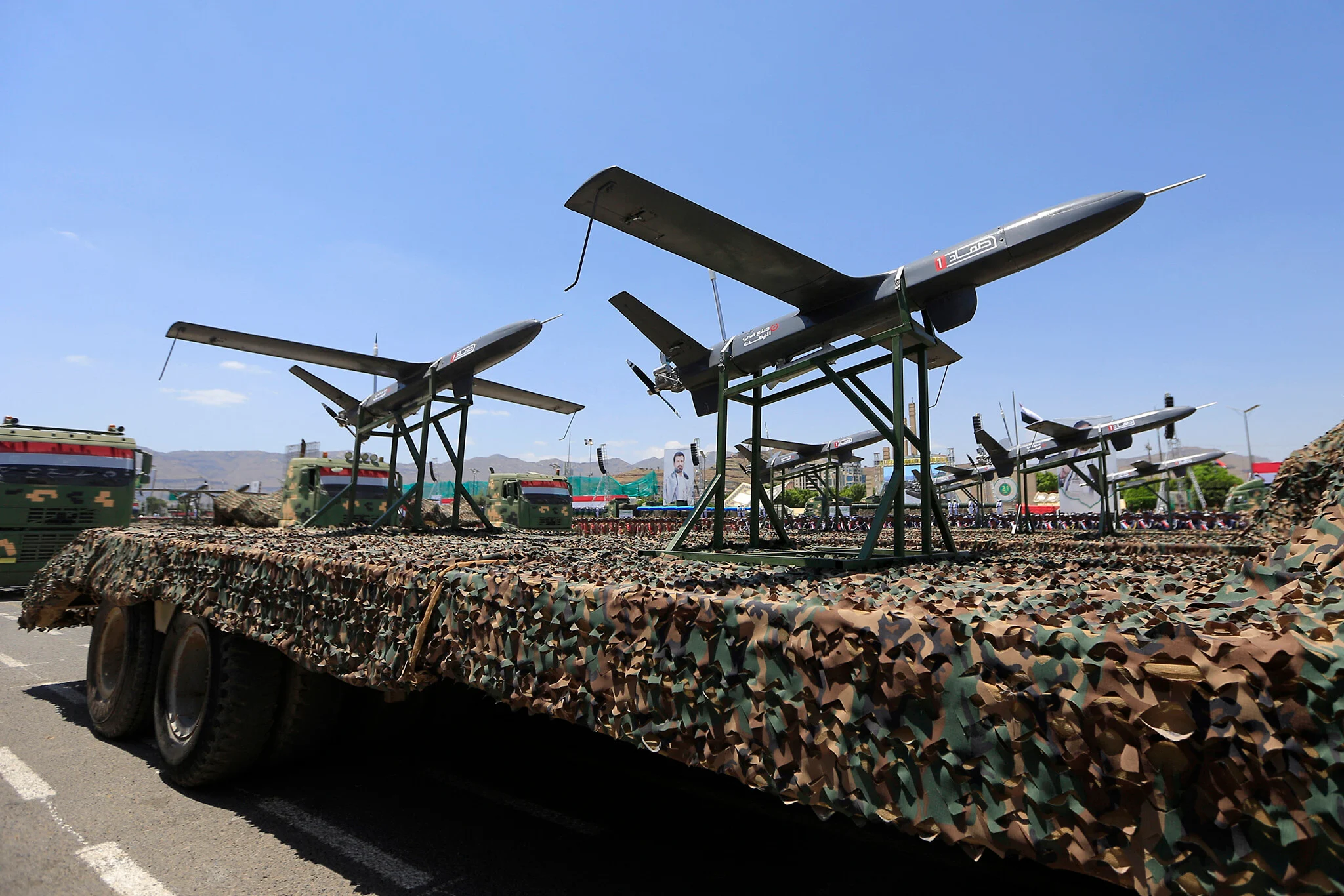
Houthi engineers train al-Shabaab in drone modification in Somalia
Two Houthi military engineers travelled to Jilib, al-Shabaab’s stronghold in Somalia’s Middle Juba region, to teach its fighters to modify drones and maintain weapons, according to the United Nations Panel of Experts on Yemen. Other accounts of the same visit add training in making explosives. The panel’s final report was presented to the Security Council on 15 October 2025. The visit is a shift from al-Shabaab sending fighters abroad to learn from the Yemeni movement to Houthi instructors teaching inside Somalia. Local crews can then diagnose faults, repair equipment and adapt drones to their own missions without the cost and risk of travel to Yemen.
The training runs in both directions. A November 2025 UN report described four groups of about 30 al-Shabaab fighters, about 120 in total, sent to Yemen. One group left the Lower Shabelle coast in late October 2024 and spent about two months in Hodeidah training on machine guns, anti-aircraft weapons and explosive devices, Africa Defense Forum reported. Other estimates are higher. A facilitator told the Panel of Experts on Yemen that he had arranged travel for nearly 400 Somalis to Houthi-controlled areas for military and ideological training, though the UN did not establish that all of them belonged to al-Shabaab. Matt Bryden, former head of the UN monitoring group on Somalia, has estimated that up to 1,500 fighters from al-Shabaab and other Somali factions have trained with the Houthis, Arab News reported.
A transactional partnership
The Houthis, a Zaydi Shia movement backed by Iran, and al-Shabaab, al-Qaeda’s Sunni affiliate in Somalia, are ideological opposites. “Ideologically, the Houthis and Al-Shabab are like oil and water,” said Lesley Anne Warner, a visiting scholar at the Carnegie Endowment for International Peace. As drones become a priority for armed groups everywhere, the two have found practical reasons to cooperate across that divide.
Their cooperation is a quid pro quo. The Houthis likely want access to recruits and a foothold in Somalia, and earn hard currency from arms sales. UN reporting identified 2024 meetings in which al-Shabaab sought advanced weapons and training in exchange for increasing piracy in the Gulf of Aden and off the Somali coast. “For the Houthis, it’s hard currency to pay for their operations. For Al-Shabab, it’s an upgrade in military materiel,” Warner said. Hussein Sheikh-Ali of the Saldhig Institute described the arrangement in February 2026 as “no longer ad hoc, it is a functional strategic partnership governed by mutual utility rather than formal treaties.”
The partnership rests on established smuggling routes. Weapons travel on traditional dhows between Somali ports such as Qandala, Alula and Ras Asir and Yemen’s Hadramout and Shabwa coast, and the Panel of Experts described Somalia as “increasingly becoming a transit hub for weapons destined for the Houthis.” Somali security forces have seized explosives and drones on their way from Yemen.
Catching up with rivals
Regional dynamics, including rivalry between armed groups, shape these decisions. Until now al-Shabaab has relied on surveillance drones alongside ground attacks and improvised explosive devices (IEDs), and has used drones to film raids such as its attack on the Manda Bay airfield in Kenya. Its slower move to armed drones probably reflects different priorities and the effort needed to build strike teams.
Its direct rival has moved faster. The Islamic State in Somalia (IS-Somalia) used explosive-laden commercial quadcopters against Puntland forces in the Cal Miskaad mountains in January 2025, killing at least two soldiers. Puntland forces later said they had killed a foreign IS drone commander in the area. That gives al-Shabaab a local reason to acquire the same skills from outside.
Elsewhere in Africa, armed groups are moving faster still. In Mali, Jama’at Nusrat al-Islam wal-Muslimin (JNIM) and the Azawad Liberation Front (FLA) are refining their armed-drone use through battlefield experimentation and foreign knowledge-sharing. They have shot down Malian helicopters and struck air bases, and Ukrainian drone operators have reportedly worked alongside fighters in northern Mali.
What Houthi know-how buys
Training inside Somalia should save time and money. But access to components could become a bottleneck that limits how many drones al-Shabaab can field. That makes Houthi smuggling networks valuable to the group, and gives the Houthis leverage over its resupply.
Al-Shabaab does not need finished Houthi attack drones to pose a threat. With basic modification skills, it can build simpler local versions with smaller payloads and shorter ranges that still threaten bases and supply convoys. The Jamestown Foundation’s Luke Zakedis has estimated that a Houthi-style attack drone could cost as little as $10,000 to produce. The Somali National Army, the African Union Support and Stabilisation Mission in Somalia (AUSSOM) and their partners are themselves using drones such as the Turkish Akinci against al-Shabaab. They would face a new threat from above at forward operating bases that were built to stop ground assaults and car bombs.
The maritime risk is just as serious. Gulf of Aden traffic heading to and from the Red Sea passes close to Somalia’s northern coast. Drones flown from easily reached coastal sites could support vessel surveillance and piracy. Armed drones would add another threat layer, forcing naval escorts and ships’ security teams to cover more approaches, a challenge Military Africa examined in African naval air defence in the drone era. It would also give the Houthis, and through them Iran, another source of maritime pressure, though their influence will depend on al-Shabaab’s own interests and how long it needs outside support.
Signs of a drone war in southern Somalia
Two developments would show the training is taking hold. The first is explosive drones joining ground assaults. Repeated drone attacks on Somali and AUSSOM bases would suggest al-Shabaab is building drone crews into its assault teams, as JNIM has done in the Sahel. The second is local assembly. Houthi instructors are likely to pass on some basic production processes, both to build capability and to build trust. That could mean cheap commercial FPV drones turned into simple strike weapons in workshops around Jilib. Daniele Garofalo, an intelligence and terrorism analyst, has described the relationship as “limited but deepening, transactional but increasingly organized”. For the forces still fighting in Somalia, the gap between those two descriptions may soon be measured in drone strikes.
