
Unmanned Waters: Drones, USVs and the Next Leap for African Navies
African navies face a simple imbalance: vast exclusive economic zones (EEZs) and thin fleets. Nigeria’s EEZ covers more than 200,000 square kilometres, Seychelles polices about 1.4 million square kilometres of ocean with a handful of patrol boats, and most coastal states in the Gulf of Guinea can keep only a few hulls at sea on any given day. Navies are closing that gap with more patrol ships and with systems that do not put sailors on every watch. Unmanned aerial vehicles (UAVs), unmanned surface vessels (USVs) and autonomous underwater vehicles (AUVs) are becoming the most practical way for coastal states to see farther, stay longer and respond faster.
The shift is visible from Lagos to Saldanha Bay and from Douala to Victoria. It is uneven, often donor-assisted and still small in scale, but it is changing how African navies think about presence at sea.
Nigeria moves first
Nigeria has moved first. In January 2024 the Navy received two SwiftSea Stalker USVs from the American shipbuilder Swiftships, handed over at the Presidential Villa in Abuja by the Minister of State for Defence, Bello Matawalle. The Stalker is built for intercept and multi-day surveillance: Swiftships quotes a speed of more than 45 knots, a range of 400 nautical miles and an endurance of 40 hours, with object recognition, tracking and anti-collision systems. The boats were earmarked for the Niger Delta, the Lake Chad region and Nigeria’s offshore waters.
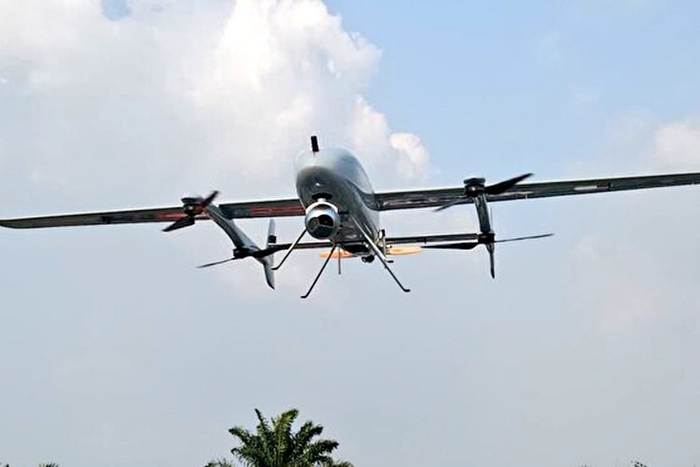
In January 2026 the Navy integrated Turkish AYBARS-2 vertical take-off and landing (VTOL) drones built by BMS Defence Technologies for night and day coverage of the oil-theft corridors of the Gulf of Guinea. The AYBARS-2 has a 3.9-metre wingspan, a maximum take-off weight of 35 kilogrammes, an endurance of seven to eight hours and an operating radius of about 100 kilometres. Because it lifts off vertically on electric motors before switching to a petrol engine for cruise, it can fly from a patrol vessel’s deck or an unprepared coastal site. Nigeria’s Defence Space Administration has opened a licensed production line for a local version, the AYBARS-II. The Navy also operates Chinese AR-500B shipborne VTOL drones, Tekever AR3 drones and Comstrac Ovation UAVs.
These platforms sit inside a wider architecture. The Integrated National Security and Waterways Protection Infrastructure, better known as the Deep Blue Project, launched by the Nigerian Maritime Administration and Safety Agency (NIMASA) with the armed forces in June 2021, combines special mission aircraft, helicopters, UAVs, special mission vessels, interceptor boats and a shore-based command, control, communications, computers and intelligence (C4i) centre in Lagos. Local industry is now entering the field: at the Africa International Defence Exhibition (AFRIDEX) 2026 in Lagos, the Arridex Group unveiled the ADX-Barra 200 autonomous surface vessel, Nigeria’s first home-grown USV.
The lesson is not that robots replace warships. It is that a handful of persistent sensors can cue scarce manned vessels to the right place. A drone that spots an illegal bunkering barge at night turns a speculative patrol into a targeted interdiction, and that is how the Navy’s technology-driven modernisation strategy, set out at its 70th anniversary, is meant to work.
Different paths across the continent
Others are following different paths. Egypt has unveiled a locally developed armed USV for coastal patrol: at the Egypt Defence Expo (EDEX) 2025, Arab International Optronics showed the USV-AIO-001 fitted with its Eagle-2 remote weapon station, which takes 5.56mm, 7.62mm or 12.7mm machine guns, for surveillance and force protection in coastal waters, Army Recognition reported. Morocco has gone abroad for specialist roles, ordering two Dutch-built USVs for mine countermeasures and anti-submarine warfare under a €13 million export licence.
South Africa is testing home-built autonomy. Legacy Marine, Icarus Marine and Noble Concentric Solutions built a 9.2-metre AI-navigated surface craft, first known as Prowler, that achieves International Maritime Organization (IMO) Level 4 autonomy with radar, AIS and camera fusion, and delivered it as the Sea Serpent to a Saudi Arabian client in February 2026. The South African Navy has also returned to mine warfare with REMUS autonomous underwater vehicles: during Exercise Phoenix in Saldanha Bay in 2025 it put its new REMUS A100, a two-metre AUV with side-scan sonar that can survey to 100 metres, through its operational debut alongside navy divers, reviving a capability that had lain dormant for years.
Seychelles uses long-range drones to police illegal fishing across its huge ocean estate. Its FishGuard trial brought together the Seychelles Fishing Authority, the Seychelles Air Force and Coast Guard, the Moroccan AI drone company Atlan Space, the Norwegian fisheries intelligence group Trygg Mat Tracking and GRID-Arendal, Seychelles Broadcasting Corporation reported. Bad weather and technical faults slowed the early test flights, a reminder that tropical maritime conditions are hard on small aircraft.
Ghana, Côte d’Ivoire and Angola are pairing new patrol ships with aerial surveillance. Ghana has added the patrol ship GNS Pru alongside new Airbus helicopters, and Angola is taking delivery of BR71 Mk II corvettes from the UAE’s EDGE. At Ghana’s first African Maritime Security Forum in Accra, speakers placed drones alongside governance and the Cape route as issues for the continent’s navies.
Obangame Express treats autonomy as a shared tool
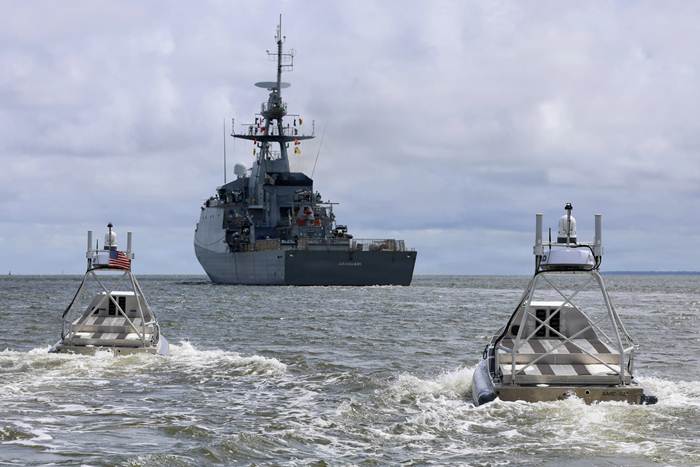
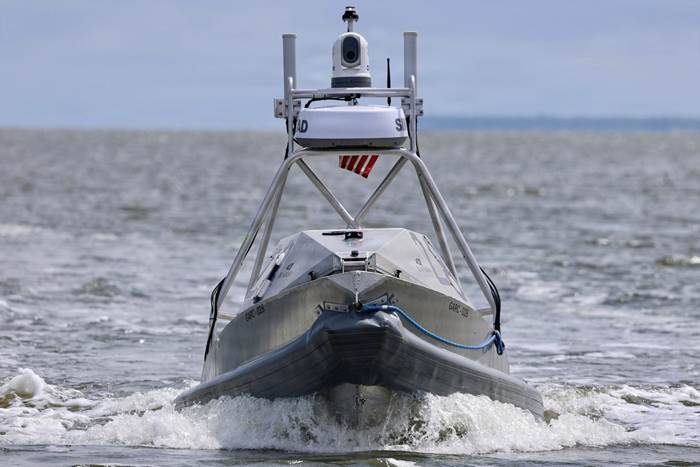
Regional exercises such as Obangame Express are already treating uncrewed systems as shared tools, not exotic extras. In 2024 the U.S. Navy tested the TRITON autonomous craft, which can operate on and below the surface, during the exercise off Ghana. At Obangame Express 2026 in Douala, Cameroon, U.S. Sixth Fleet’s Task Force 66 went further, training alongside Cameroonian forces with Lightfish and Global Autonomous Reconnaissance Craft (GARC) USVs. Shore-based operators used Lightfish to detect and identify simulated threat vessels, then sent high-speed GARC craft to intercept them.
“On short notice, USV packages can be employed with a small operational footprint to protect ports, escort high-value assets and deter threats to critical maritime infrastructure,” said Rear Admiral Kelly Ward, commander of Task Force 66. That model of detection by one cheap sensor and response by another is exactly what most African navies need, and it can be run from a port without a large warship.
Lower risk, lower cost, wider coverage
The advantages are obvious: lower risk, lower cost per hour and coverage of riverine, delta and offshore zones that frigates cannot saturate. A drone or USV can watch a pipeline corridor, a fishing ground or a creek mouth for hours at a fraction of the fuel and crew cost of a manned patrol vessel or helicopter, and it does not put sailors in the line of fire when it closes on a suspect boat. In the shallow, winding creeks of the Niger Delta, where larger ships cannot go, small USVs and VTOL drones reach places that would otherwise go unwatched. Illegal, unreported and unregulated (IUU) fishing alone costs West African states hundreds of millions of dollars a year, and persistent surveillance is the cheapest way to start recovering that revenue.
When drones become expensive ornaments
The risks are equally clear. Unmanned fleets demand reliable communications, trained operators, spare parts and rules of engagement that courts and commanders can defend. Over-the-horizon control needs satellite bandwidth, which costs money and can be jammed. Sensors and engines corrode in salt air. Operators need training that is often only available from the supplier, and spares may be held in another country. Evidence gathered by a drone must stand up in a prosecution for illegal fishing or crude oil theft, and an armed USV raises questions about who authorises the use of force.
Without those foundations, drones become expensive ornaments. Nigeria’s own experience is a warning: of the nine Aeronautics Aerostar tactical drones acquired for the Navy earlier, none is reported to be operational today. The difference between a capability and a press release is sustainment.
The next leap is integration
The next leap is integration. Unmanned systems should feed maritime operations centres such as Nigeria’s Deep Blue C4i centre and the regional centres of the Yaoundé Code of Conduct architecture, so that a contact detected by a Nigerian drone can be handed to a Beninese or Togolese patrol boat. They should support the African Union Combined Maritime Task Force for the Gulf of Guinea, which President Bola Tinubu launched in Lagos in June 2026 during the Nigerian Navy’s 70th anniversary. And they should protect fisheries, subsea cables and energy infrastructure, all of which have become targets.
Integration also means building at home where possible. Nigeria’s push for indigenous naval shipbuilding, South Africa’s autonomy start-ups and Egypt’s armed USV show that African industry can produce at least the simpler platforms, which makes spares and upgrades easier to manage. Training pipelines, operator career paths and clear legal doctrine on the use of unmanned systems in law enforcement matter as much as the hardware.
Owning more water than hulls allow
African navies that treat autonomy as a complement to ships, and build the people and doctrine to match, will own more of their waters than hull numbers alone can deliver. The tools are now affordable and proven in exercises from Douala to Saldanha Bay. What remains is the harder work of turning a few demonstrators into networked, sustained fleets that operate every day, exercise or not.
