
Africa Corps runs Mali’s long-range drone war with Russian munitions
Russia’s Africa Corps is running much of Mali‘s long-range drone campaign in the north of the country, flying Russian-made Shahed-type one-way attack drones and ZALA Lancet loitering munitions against Tuareg separatists, jihadist fighters and, according to rights researchers, civilians. The Africa Defense Forum (ADF), a US Africa Command publication, set out the case on 10 November 2026, drawing on four months of open-source investigations by Bellingcat, Jeune Afrique, The Sentry, France 24 Observers and Human Rights Watch.
Under its agreement with Bamako, the Africa Corps operates the aircraft and drones Russia has supplied. A report by the investigative group The Sentry, published in mid-September 2026 under the title “Who Is Responsible for Mali’s Air War?”, attributed some drone strikes directly to the force’s Russian commanders. “While Bamako describes a sovereign counterterrorism campaign, targets are in fact approved by a foreign power,” The Sentry’s researchers wrote. Bellingcat and Jeune Afrique supported that finding with satellite imagery and drone footage.
The findings add a new layer to the picture Unmanned Africa drew of how Turkish and Russian drones transformed Sahelian aerial warfare. Until this year, Mali’s unmanned strike capability rested on Turkish medium-altitude long-endurance (MALE) aircraft flown by the Malian Armed Forces (FAMa). Expendable Russian munitions, operated by Russian crews, now sit alongside them.
Gerans over Inafarak and Talahandak
The clearest evidence of Russian long-range drones came in July. Bellingcat and Jeune Afrique geolocated a strike on Inafarak, a settlement near the Algerian border, on 12 July 2026, and a second on Talahandak, about 160 kilometres to the south-east, on 17 July. Satellite imagery from 15 July showed several buildings destroyed at Inafarak, where the strike appears to have hit a commercial site with a truck and fuel drums. Footage from Talahandak showed one casualty and a burning truck, with the drone descending directly onto its target and no sign of interception. Military Africa reported the deployment in August.
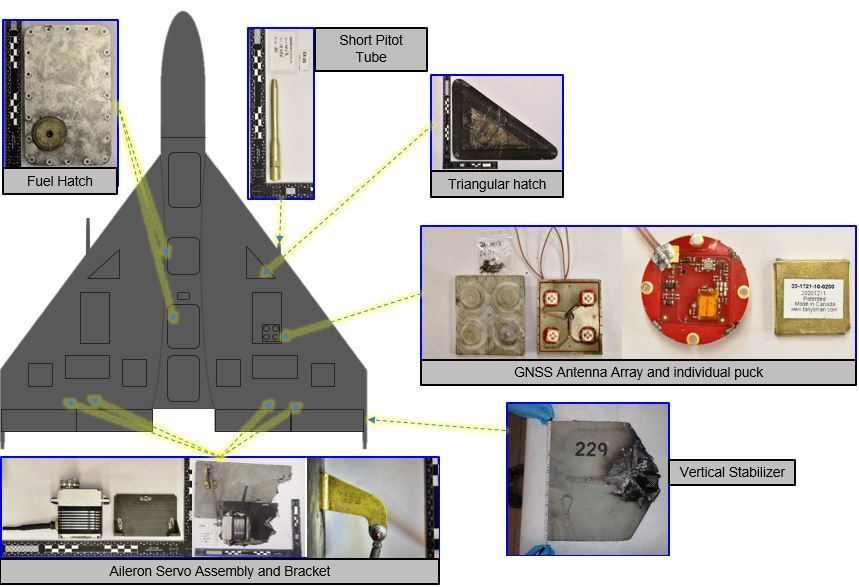
Wreckage filmed at the scene included what appeared to be an MD-550 engine, the four-cylinder, two-stroke piston engine fitted to the Shahed-136 family. Independent weapons analyst Trevor Ball and Léo Jarry, a drone specialist at Tungsten Strategies, told Bellingcat the engine was consistent with that family. The Wagner- and Africa Corps-affiliated Telegram channel “White Uncles in Africa” reposted the strike videos with the caption: “Now the Azawadi ‘khokhols’ will be seeing Gerans all the time.” Khokhol is a Russian slur for Ukrainians, applied here to the Tuareg rebels, and Geran-2 is the Russian licence-built version of the Iranian Shahed-136.
The Shahed-136 is a delta-wing one-way attack drone launched from a rail or truck and guided by satellite navigation backed by an inertial unit. Open-source estimates put it at about 3.5 metres long with a wingspan of about 2.5 metres and a launch weight near 200 kilogrammes, carrying a warhead of 40 to 50 kilogrammes in its standard form. Its range is measured in hundreds of kilometres, far beyond anything else in Mali’s inventory. The design’s path from Iran to proxy and partner forces is traced in our report on how Tehran built its African drone supply network. In Mali, the airframes arrive through Moscow instead.
Reports of Russian drones in Mali first surfaced in May 2026, when Defence Blog published photographs of wreckage near Sévaré, the central Malian air hub. ADF also reports that a second Shahed-style Russian design, the Garpiya-A1, has appeared on the Malian battlefield. The Garpiya-A1 is a long-range one-way attack drone built in Russia and reported in 2024 to use Chinese-made engines.
Lancets against pickups
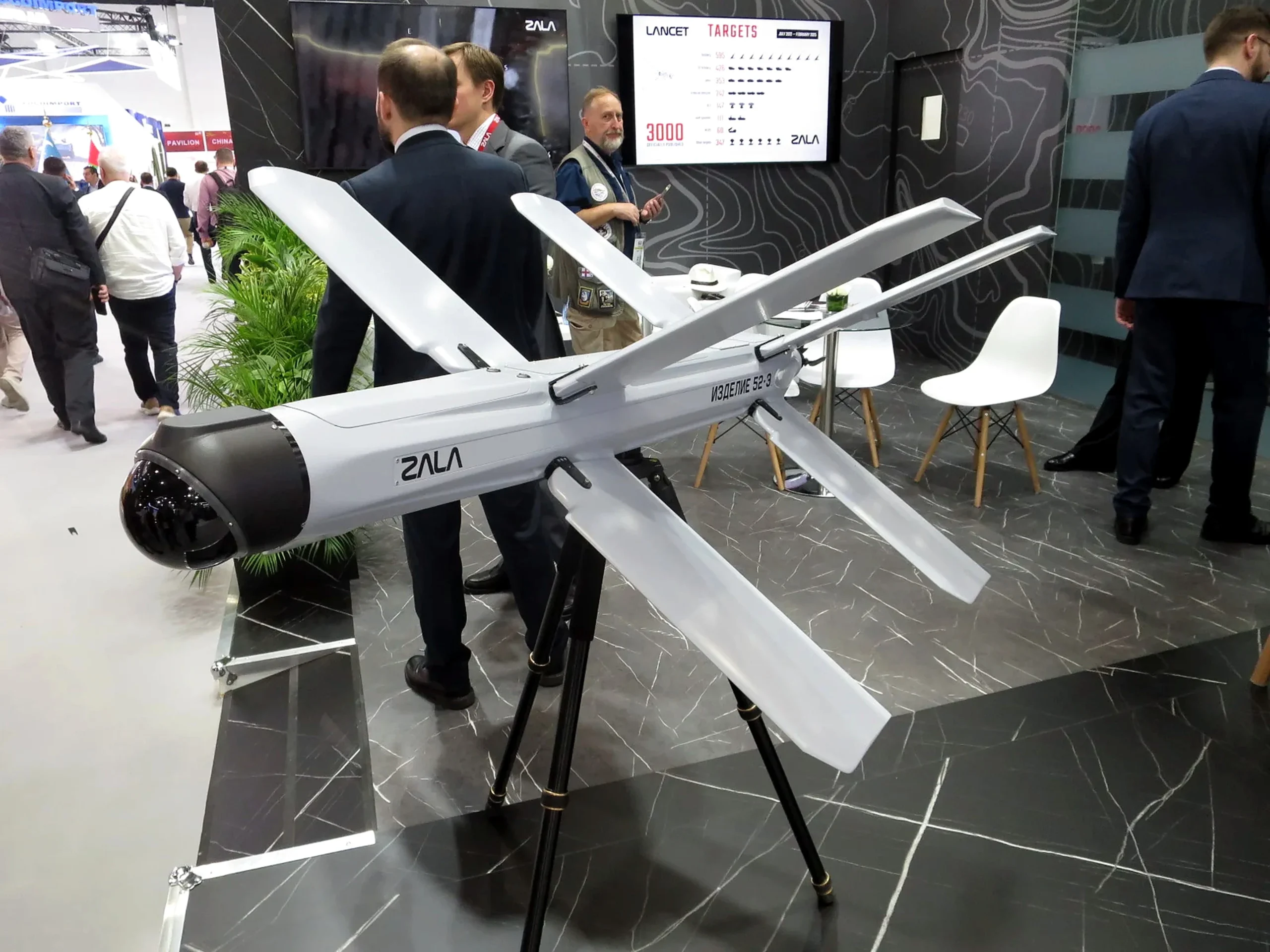
France 24 Observers confirmed images supplied by the Azawad Liberation Front (FLA) showing part of a wing from a Russian ZALA Lancet, which had been used against a civilian vehicle in the Timbuktu area in July 2026. Vincent Tourret, a researcher at the French Institute of International Relations (IFRI), told France 24 that the Africa Corps had used the Lancet, developed in 2020 and used to destroy armour in Ukraine, against the FLA’s unarmed vehicles.
The Lancet is built by ZALA Aero Group, part of the Kalashnikov Concern. Unlike the Shahed, it is pilot-guided: an electro-optical seeker relays video to its operator until impact, and its cruciform wings give it the agility to hit moving vehicles. Manufacturer figures for the Lancet-3 cite a take-off weight of about 12 kilogrammes, a warhead of about 3 kilogrammes, endurance of up to 40 minutes and a range of around 40 kilometres, with launch from a pneumatic catapult. That short reach means the operating teams must sit close to the target area, which places Russian crews near the front lines around Timbuktu and Kidal.
Jarry said the cheap one-way drones give the Malian side reach beyond the range of its Turkish-made Bayraktar TB2s. “The fact that these systems are relatively cheap and expendable changes the risk calculation for operators,” he told Bellingcat and Jeune Afrique. He added that they can be used more freely, potentially forcing insurgents in northern Mali to adapt to a new aerial threat. For a primer on the trade-offs Mali faces in sustaining its larger aircraft, see our analysis of the operational realities of African MALE drone fleets.
The civilian toll
Data from the Armed Conflict Location and Event Data project (ACLED), cited by Human Rights Watch, show that Malian forces and the Africa Corps carried out 49 airstrikes between April and August 2026, killing 89 civilians. That is more than double the 22 strikes and 44 civilian deaths recorded over the same months of 2025. Human Rights Watch says attacks on civilians in the north have increased since July, including strikes on health facilities and markets after high-profile attacks by the FLA and Jama’at Nusrat al-Islam wal-Muslimin (JNIM) in Kidal and Bamako.
A September investigation by Bellingcat and Jeune Afrique geolocated more than a dozen strikes broadcast on Malian state television as attacks on terrorists, several of them in civilian areas. Researchers described the selection method as “guilt by location”, with targets chosen by place, activity and appearance. A witness to a 2024 strike at Amasrakad told investigators it killed 13 civilians, including children, sheltering in a tent near an earlier strike on a truck, and that he later joined the FLA. Yvan Guichaoua, a senior researcher at the Bonn International Centre for Conflict Studies, described “a huge expansion in the way the Malian authorities define who is considered a legitimate target.” The Malian armed forces did not respond to Bellingcat’s questions about the strikes.
The choice of weapon matters here. A TB2 operator watches the target through the aircraft’s sensor until the munition lands. A Shahed-type drone flies to a set of coordinates and cannot confirm its target in the final seconds of flight, and its heavier warhead widens the danger area. Jarry warned that any gap between target identification and impact creates a risk of striking the wrong target.
A two-tier air war over northern Mali
The pattern points to a division of labour in Mali’s air arm. FAMa flies Turkish TB2s and the Akinci, which received a further batch at Sévaré on 30 July 2026, Military Africa reported, while Russian crews strike deeper and more cheaply with expendable munitions. Russia’s contribution goes beyond one-way munitions: Military Africa reported a Kronshtadt Orion MALE drone sighted over Bamako in June 2026. The African Military Drone Procurement Database records 17 TB2s and seven Akincis in Malian service, alongside 12 Kub-BLA and ten Lancet loitering munitions and ten Shahed-family one-way attack drones. Mali’s dependence on these two suppliers is mapped in our study of where Africa’s armies buy their drones and who they rely on.
The air is also contested from below. The FLA and JNIM have used first-person-view (FPV) drones against Malian and Russian convoys, a campaign Unmanned Africa covered in how cheap FPV drones helped Azawad rebels retake Kidal. Rebels downed a Russian-operated Mi-24P at Anefis in July and have reportedly drawn on Ukrainian drone specialists, as a CNN investigation into Kyiv’s drone operations in Africa found. The “khokhol” caption shows how pro-Russian channels frame the fight in Mali as an extension of the war in Ukraine.
Kidal, KIZILELMA and the cost of cheap munitions
Kidal has been back under junta control since 6 October 2026, and Baykar used BAMEX in Bamako to show a Mali-flagged KIZILELMA jet-powered combat drone, though no order has been announced. Bamako is therefore weighing two very different paths: high-end Turkish aircraft under Malian control, and low-cost Russian munitions under Russian control. Whether Geran and Lancet strikes keep their place alongside Turkish drones will shape how far Mali’s air war reaches into the north, who answers for it, and what it costs the civilians who live under both.
