
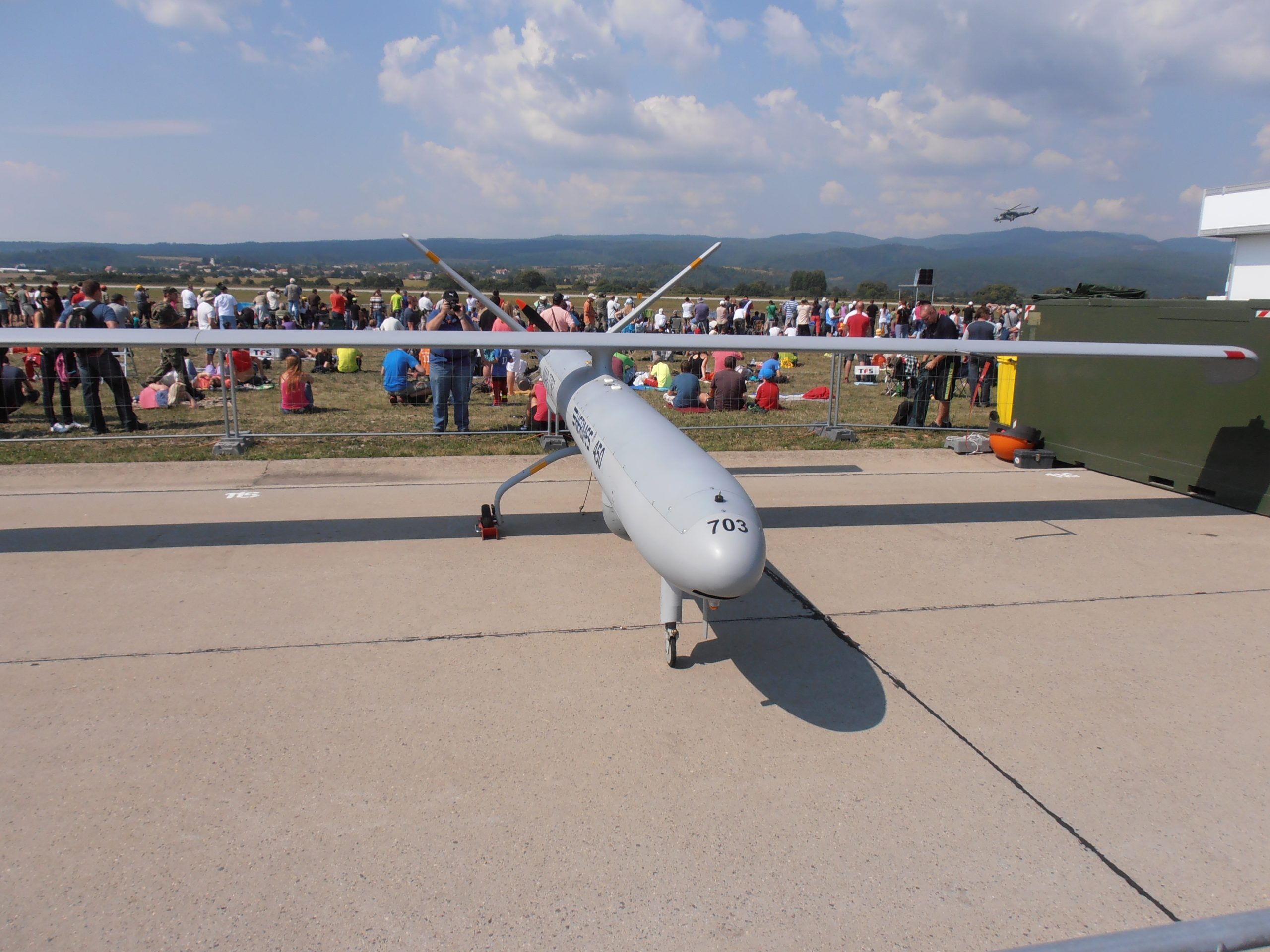
Elbit Systems has sold 61 drones to five African forces
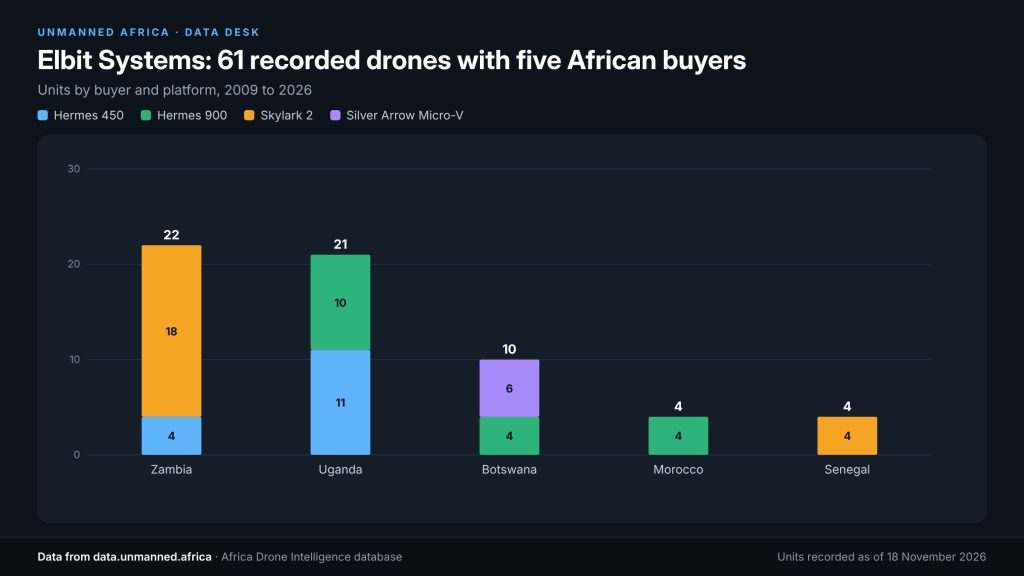
Israel’s Elbit Systems has 61 drones recorded with five African armed forces, and 43 of them belong to two customers: Zambia with 22 and Uganda with 21, the Africa Drone Intelligence database shows. Botswana (10), Morocco (4) and Senegal (4) account for the rest, across 13 deals between 2009 and 2026.
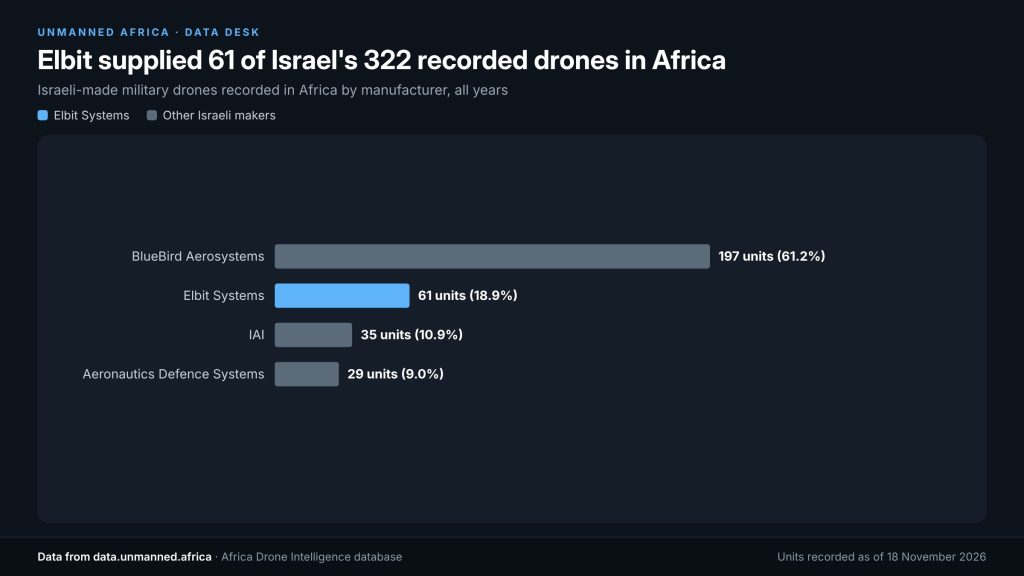
By volume, Elbit is Israel’s second drone exporter to Africa. The database records 322 Israeli-made military drones on the continent. BlueBird Aerosystems supplied 197 of them, Elbit 61 (18.9%), IAI 35 and Aeronautics Defence Systems 29. BlueBird’s lead rests on one buyer: Morocco took 166 of its aircraft, which is why Morocco holds over half of Israel’s African drone exports. Elbit’s sales run across more customers and include heavier aircraft.
Elbit’s sales came in waves. The database records 10 aircraft between 2009 and 2011, all for Botswana, then the four Senegalese Skylarks of 2016. The peak came in 2018 and 2019, when Zambia and Uganda took 32 drones between them. Since 2020 the flow has slowed to 15 units, mostly Hermes aircraft for Uganda plus Morocco’s four Hermes 900s in 2021.
Hermes for the air forces, Skylark for the armies
Four types make up the 61. The hand-launched Skylark 2 is the most numerous with 22, 18 of them delivered to Zambia in 2019 and four to Senegal in 2016. The Hermes 900 follows with 18: 10 for Uganda, four for Botswana and four for Morocco. The Hermes 450 accounts for 15, with 11 in Uganda and four in Zambia. Botswana also has six Silver Arrow Micro-V aircraft recorded for 2011.
The Hermes 900 is the largest of these. Derived from the Hermes 450, it first flew on 14 December 2009 and can stay aloft for about 40 hours, Airforce Technology records, with a maximum payload of 300 kg in its listed specifications.
The Hermes 450 is the older and more widely flown design. It is the Israel Defense Forces’ main drone, has logged more than 300,000 flight hours and was chosen as the basis of the British Army’s Watchkeeper, Airforce Technology notes. For African buyers it offered a proven medium-sized surveillance aircraft before Chinese and Turkish alternatives reached the continent in numbers.
Zambia shows how the two families split between services. At the Defence Force Day parade on 13 June 2021 the Zambian Air Force displayed three Hermes 450s and the army two Skylarks, Israel Defense reported, noting the air force had acquired its drones in 2018. Military Africa had earlier published footage of a Zambian Hermes 450 fitted with a satellite antenna for control beyond line of sight. Unmanned Africa’s Zambia profile sets those aircraft against the country’s five Chinese CH-3s.
Uganda is the only customer still taking Hermes deliveries. Its 2024 entries match a March 2024 contract worth $52.1 million for four Hermes 900s with Elbit’s SkEye wide-area sensor, and its 2026 entries match the quantities in a settlement of earlier disputes, as reported in Uganda builds its drone fleet around Elbit’s Hermes family. A UN Group of Experts identified a drone with Ugandan markings that crashed in eastern Congo in August 2024 as a Hermes 900.
Uganda’s drones fly in a live theatre. The army has operated in eastern Congo under Operation Shujaa against the Allied Democratic Forces, the context in which Military Africa reported six French Delair UX11s in service in December 2025. The Hermes fleet gives Kampala the longest-endurance aircraft it has for that campaign.

Morocco’s four Hermes 900s are recorded for 2021. Oryx reported that year that Rabat had reportedly acquired four but that none had been seen in service, in its survey of Morocco’s drone fleet.
Senegal’s four Skylarks of 2016 were its last Elbit purchase. Dakar went on to buy Spanish, French and Chinese drones in 2023, as covered in Senegal swaps Israeli drones for Spanish, French and Chinese types.
Botswana and a dating problem
Botswana’s records do not sit easily with outside reporting. The database dates its four Hermes 900s to 2009, the year the type first flew, and its Silver Arrow Micro-V aircraft to 2011. FlightGlobal reported in March 2001 that Botswana had signed for at least three short-range systems from Israel’s Silver Arrow, the name the database still uses for Botswana’s Micro-V aircraft, to watch its borders with Namibia and South Africa.
A Hermes 900 delivery in its first-flight year looks unlikely, and the 2001 contract suggests Botswana’s Silver Arrow aircraft arrived a decade before the database says. Both entries need checking before the figures are relied on.
Israel’s overall share has swung more sharply than Elbit’s. Israeli makers supplied 25.7% of Africa’s recorded drones in 2020 to 2022, largely because of BlueBird’s Moroccan orders, then only 5.0% in 2023 to 2026. Of the 25 Israeli drones recorded in the later period, Elbit delivered nine, all to Uganda. The other 16 are BlueBird SpyX aircraft for Morocco.
Drones inside bigger packages
Elbit’s African sales rarely travel alone. The same Zambian parade showed six Elbit ATMOS self-propelled howitzers and six Spear mortar systems, along with Israeli small arms. In September 2017 Globes, reported by the Jerusalem Post, said Elbit had won a $240 million contract with an unnamed African state for equipment covering an entire army’s needs. The buyer was not named.
Even so, Elbit’s share of new African business is small. Its last deliveries outside Uganda date from 2021. Since then Turkish and Chinese makers have taken most of the market, and Uganda itself added five Turkish Togan rotary drones in 2023 and six French Delair UX11s in 2025.
What to watch
Uganda’s programme is the one to follow: whether more Hermes 900s arrive under the 2024 contract, and whether the aircraft keep appearing over eastern Congo. In Morocco, the open question is still whether its Hermes 900s are in service at all, five years after they were reported. A check of the Botswana dates would also settle whether Elbit’s African sales began in 2001 or 2009.
