
Sudan’s drone war spills across the Horn, OSINT review finds
Sudan’s drone war no longer stays inside Sudan. That is the case made by the Midgard OSINT Review, an independent open-source newsletter run by analyst Graham Bunn, in a consolidated report published on 13 November. “The drone wars of the Horn of Africa used to be separate stories,” it begins. Its finding is that they have merged. A sustained campaign against Sudan‘s power grid, Khartoum’s accusations against Ethiopia, and Ethiopia’s own drone war against Tigrayan and Amhara rebels backed, Addis Ababa says, by Eritrea now feed each other, and the army’s tally of Chinese drones shot down has run past the fleet the paramilitary Rapid Support Forces (RSF) are known to have. One twist stands out. The review concludes that drones have already been used by one government against another government’s forces, but between Ethiopia and Eritrea, not between Sudan and Ethiopia.
Six days against the grid
The review starts with electricity. Between 28 October and 2 November, drones hit power infrastructure across most of the army-held east and north. The first target was the 500 MW Um Dabakir thermal plant in White Nile State, which cut power to White Nile and North Kordofan. The Al-Markhiyat station north of Omdurman followed, then stations at Shendi and Abu Hamad in River Nile State and sites in Gedaref, Gezira, Sennar and Kassala. Local sources reported a long-range drone at the Haya station near the Red Sea coast.
The counts differ by source. Anadolu Agency reported 16 stations hit in a week and Al Jazeera 18 strikes on the network. A Sudanese army source claimed more than 19 stations in seven days and more than 180 drones over two months, which the review treats as an inflated upper bound. Its assessment, at moderate confidence, is that this was “a deliberate, systematic campaign against Sudan’s power grid rather than opportunistic targeting”, carried out by the RSF or what it calls their external enablers. The RSF has never admitted to striking infrastructure with one-way attack drones.
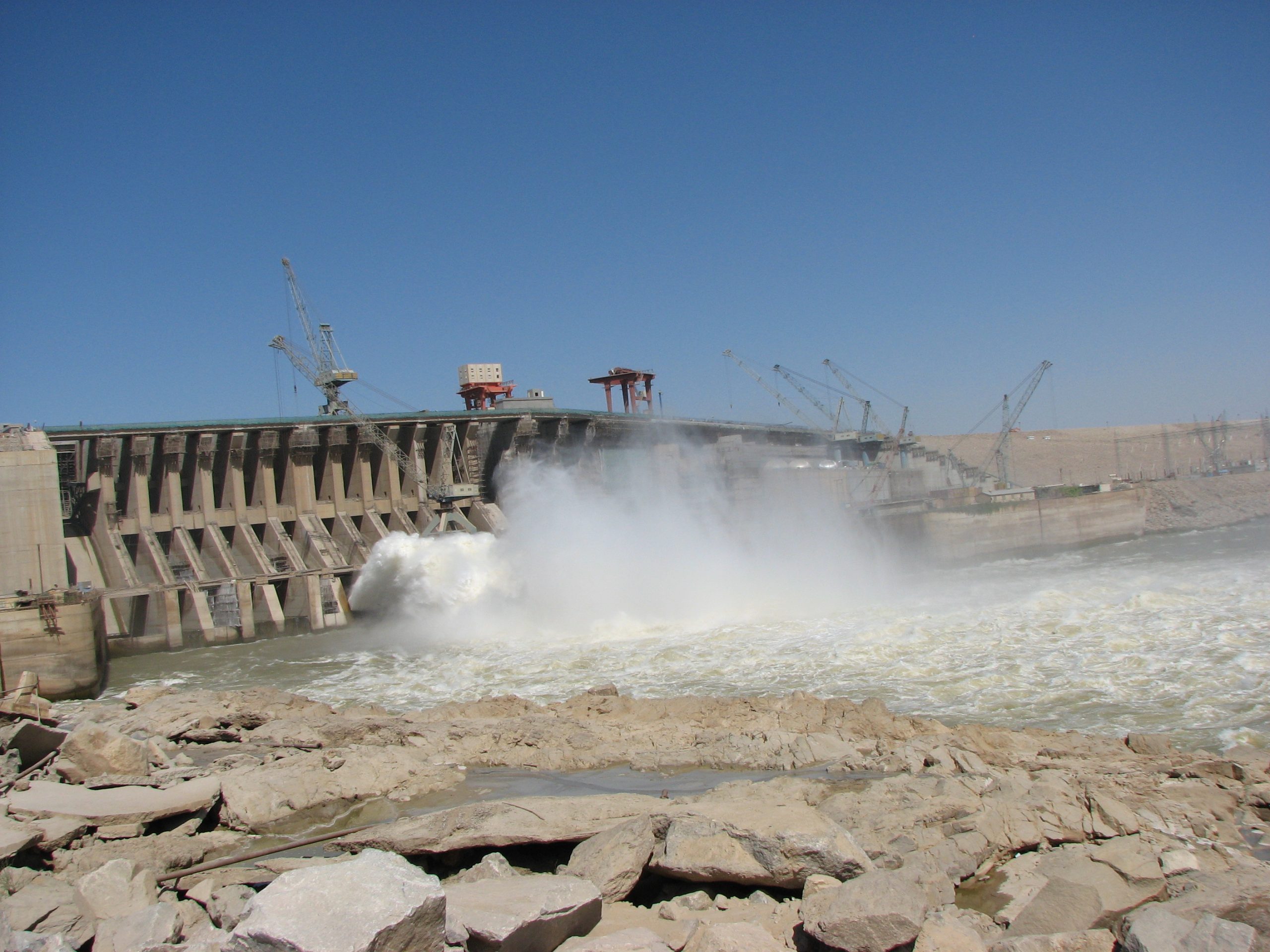
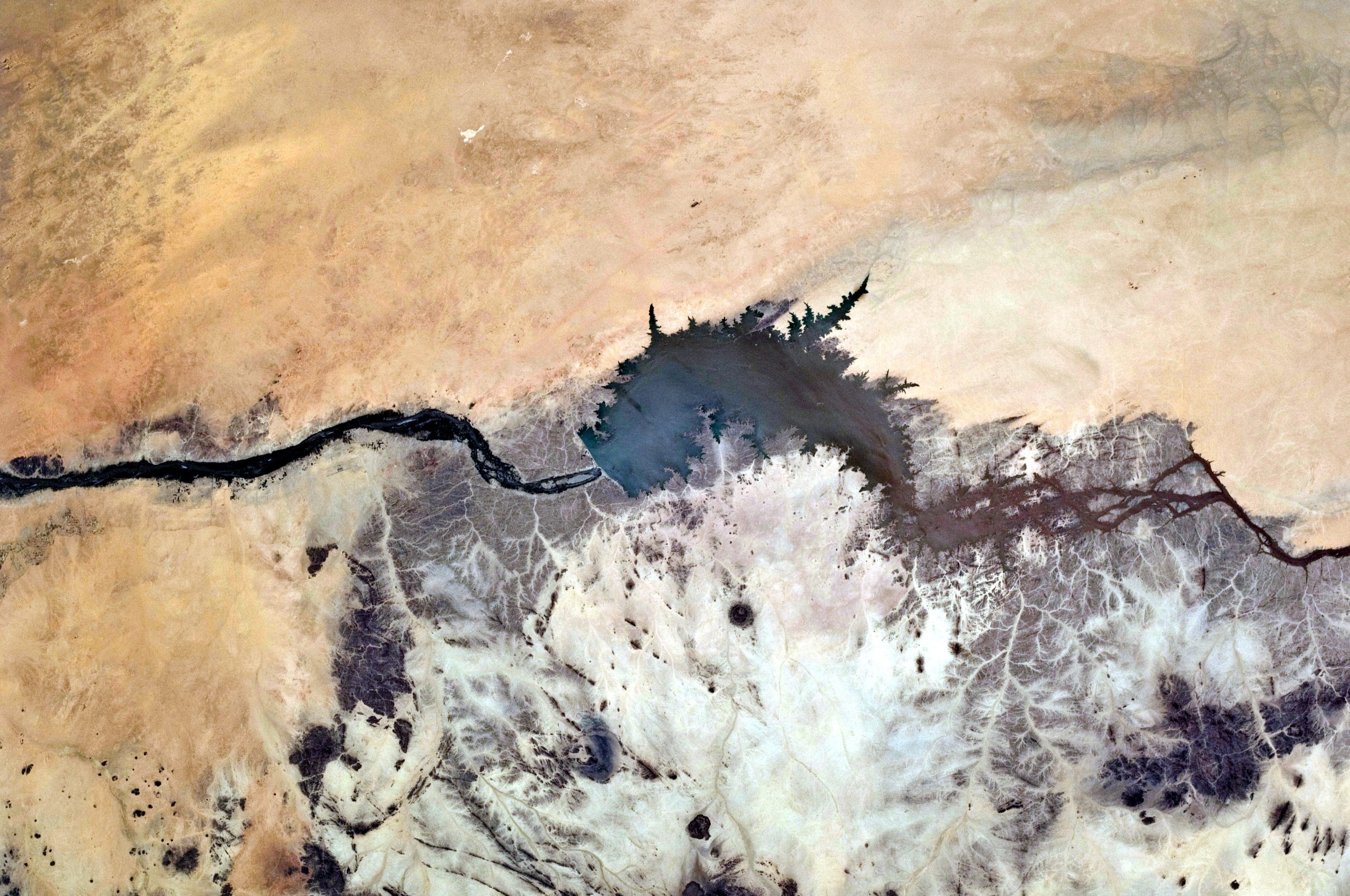
The arithmetic is stark. Sudan generated about 4,400 MW before the war and about 1,100 MW now, the review says, and the Merowe Dam supplies more than 70 percent of that. It calls the dam the grid’s single point of failure. Merowe has been hit before, in April 2025, when a strike on the transformer yard started a fire and damaged the main line to Khartoum. The review’s warning sign for a push towards grid collapse is a strike on Merowe’s switchyard, or repeated hits on the Atbara to Merowe corridor within a week. A lull on 5 and 6 November was probably a gap in reporting rather than a pause, it judged.
The case against Asosa
The grid campaign is what Khartoum took to the United Nations. On 1 November it filed complaints with the Security Council and the African Union Peace and Security Council, saying 187 one-way attack drones had been launched from Ethiopian territory in 70 attacks between February and October, as Unmanned Africa reported in Sudan says 187 drones launched from Ethiopia hit its infrastructure. It named Asosa airport, the Kurmuk to Gizen border area and Bahir Dar as launch sites.
The review’s reading of the evidence is narrower than the complaint. At the army’s 28 October press conference, Sudan showed slides, flight-path data and drone fragments. Janes reported that most of the incidents involved larger medium-altitude “strategic” drones, and that Asosa was the take-off point in every case but two. Those two came from Bahir Dar and were both shot down, on 17 and 23 May. The army also showed serial-numbered parts from two Bayraktar Akinci drones downed over Damazin and El Obeid. That does not settle who flew them. Sudan’s own army flies the Akinci, and so, by most accounts, does Ethiopia, so the type alone cannot attribute a strike. The review’s verdict is that Sudan’s case rests on Asosa, that “the Bahir Dar link is weak”, and that attribution stays at the RSF or its foreign backers.
Diplomacy moved faster than the evidence. Ethiopia closed Sudan’s consulate in Asosa and gave its six staff 48 hours to leave, and Sudan answered by closing Ethiopia’s consulate in Gedaref, Al Jazeera reported, citing Reuters and AP. “The Sudanese government remains committed to its right to defend its territory,” said Amjad Farid, an adviser to the Transitional Sovereignty Council, adding that Sudan was trying to avoid open war. Drones kept crossing the Blue Nile border all the same. The army said it downed another one from Ethiopia at Dandaro on 13 November, as Unmanned Africa reported.
Ethiopia and Eritrea, the line already crossed
The review’s sharpest point concerns Ethiopia’s northern border. Addis Ababa expelled 10 Eritrean diplomats and closed its embassy in Asmara on 1 October, and Eritrea cut diplomatic ties in response. Ethiopia accuses Eritrea, Egypt and Sudan of backing the Tigrayan-led rebel alliance it has been fighting since late September. All three deny it. A foreign security source told AFP that Eritrea had sent thousands of troops into northern Tigray, and residents of Adigrat described a 7 October drone strike on a truck carrying Eritrean soldiers and mortars, according to the review. It judges, at moderate confidence, that one government’s drones have struck another government’s forces on that axis. No Eritrean drone use has been reported.
Inside Ethiopia the strikes are continuous. Drones hit the Jari 2 camp for displaced people near Hayk in Amhara on 28 and 29 October, killing at least 15 people, five of them children, rescue sources told Reuters. The camp houses more than 1,700 people, and witnesses described repeated explosions minutes apart. On 30 October a strike at Rama in central Tigray killed at least 12 people collecting sorghum from a truck hit the night before. Nobody has claimed either attack. The review notes the re-strike pattern in both. The rebel alliance, for its part, claimed drone strikes on Addis Ababa on 1 October, which would mean a second operator in the country. Ethiopia’s Horn of Africa adviser Getachew Reda accused Sudan and Eritrea on 11 November of arming rebel groups and coordinating drone attacks, the review reports.
The FH-95 puzzle
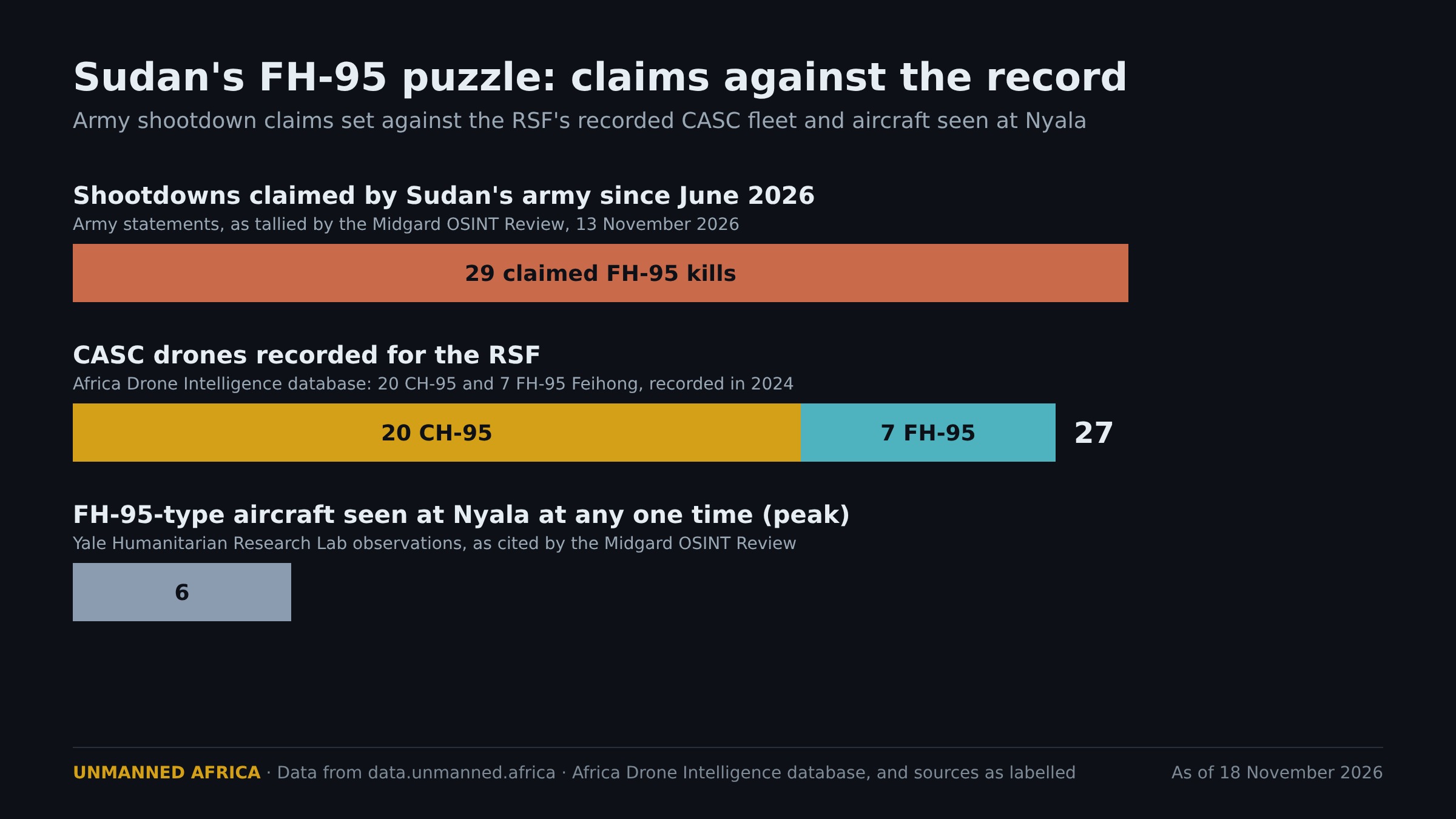
The fourth thread is a numbers problem. The Sudanese army has claimed a near-continuous run of kills against the RSF’s Chinese FH-95 medium-altitude drone since June, at Tawila, Tendelti, Omdurman, El Obeid, Bara and across West Kordofan, reaching a claimed total of 29 with two more on 11 November. The review counts at least 17 separate claims. Wreckage images were published for some earlier kills, but none for the November ones.
The fleet on the ground looks smaller. Yale’s Humanitarian Research Lab has seen between one and four FH-95-type aircraft at Nyala at a time, with a peak of six, the review says. The Africa Drone Intelligence database records 39 drones for the RSF, 27 of them from CASC: 20 CH-95 and seven FH-95, all dated 2024. Reporting often treats the CH-95 and FH-95 as one family, so the army’s claims may be counting both. Even so, 29 kills against 27 recorded aircraft would mean the RSF has lost almost its whole medium-altitude fleet and is still flying. “The claim series does not square with the observed fleet,” the review says.
Two explanations fit. Either resupply is arriving unseen, or the army is over-claiming and using “FH-95” as a generic label for any large drone. The review points to possible channels: an air corridor from N’Djamena in Chad to Nyala described in a draft UN Panel of Experts report seen by Reuters, and a United Arab Emirates-linked drone with a wingspan of about 19 metres visible at Nyala since May, reported by Sudan Tribune. It found no new Chinese supply route. What would settle it, the review says, is one readable serial number or manufacturer’s plate from a November crash. Unmanned Africa has set out the two sides’ sources in Sudan’s army traded Iranian drones for Turkish as RSF bought Chinese and the long-range threat in the proliferation of long-range delta-wing drones.
The civilian ledger
Both sides kill civilians, the review finds with high confidence, but through different targets. The RSF does it mostly through blackouts that cut water pumping and hospitals. The army’s strikes have hit markets and fuel sites. The Sudanese monitoring group Ayin has logged at least 42 drone strikes since 1 October, only one of which it coded as military. Emergency Lawyers put the toll from the 26 October strike on Nyala’s night market at more than 100, while hospital sources cited by AFP gave 21, as covered in Unmanned Africa’s report on the Nyala strikes. UNICEF figures cited in the review attribute 270 of the 410 child casualties recorded between January and September to drones. “Drones are now the main way this war kills children,” it says.
The war has also reached Abyei, the territory Sudan and South Sudan both claim. Drones struck the Amiet market on 19 October. The review gives more than 30 dead and about 59 injured, citing Channel Africa, but a South Sudanese official put the death toll at no fewer than 153, and South Sudan’s government blamed Sudan’s army. A senior Sudanese officer told AP the army had hit fuel tankers bound for the RSF. The UN condemned the attack without naming a perpetrator. The review treats every published toll as a floor. Its own Amiet figure is the lowest in circulation.
What to watch
The review sets out its own list of warning signs. A strike on Merowe’s switchyard. A formal Ethiopian reply at the Security Council, or the African Union putting the dispute on its agenda. A Sudanese strike near Asosa. On the northern axis, a drone strike on Eritrean soil, or Eritrea using drones of its own in Tigray. And on the evidence side, published Akinci serial numbers from the Blue Nile shootdowns and images of a November FH-95 wreck. The review rates the risk of near-term Sudanese and Ethiopian strikes on each other as low. On the Ethiopia and Eritrea border, it notes, that line has already been crossed.
