
Milkor lines up Sea Venom, a guided bomb and the 780
South African manufacturer Milkor has set out how it intends to turn its Milkor 380 from a surveillance aircraft into a strike platform, with European missiles, a guided bomb of its own and a much larger successor. New details published by defenceWeb on 17 November show that the memorandum of understanding (MoU) Milkor signed with European missile maker MBDA at the Africa Aerospace and Defence (AAD) 2026 exhibition was signed by Julian Durand, MBDA’s Vice President for the Middle East and Africa, and Julian Coetzee, chief executive of Milkor UAE, rather than by the South African parent. The agreement is to explore integrating MBDA missile systems and other technologies onto the 380, a medium-altitude long-endurance (MALE) unmanned aerial vehicle (UAV).
Sea Venom under the wings
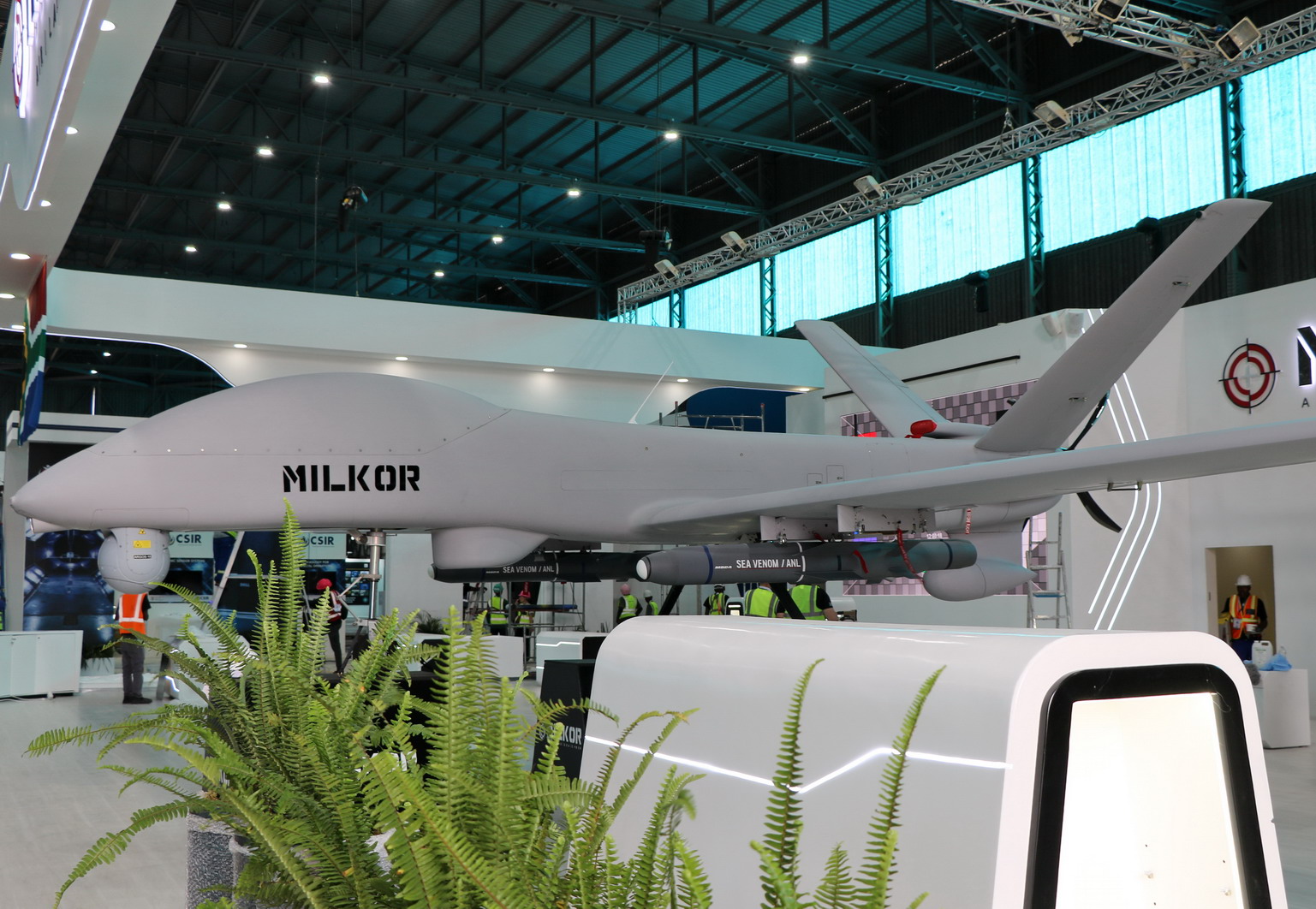
At AAD 2026, held at Air Force Base Waterkloof near Pretoria from 16 to 20 September, Milkor displayed the 380 with two MBDA Sea Venom/ANL (Anti-Navire Léger) anti-ship missiles. Each round weighs 120 kilograms and carries a 30-kilogram semi-armour-piercing warhead. defenceWeb gives a range of up to 30 kilometres using infrared guidance. MBDA’s own public material puts the range at more than 20 kilometres, so the higher figure should be read as the display claim. Sea Venom was developed for the Royal Navy and the French Navy and designed for naval helicopters such as the AW159 Wildcat. It pairs inertial navigation with an imaging infrared seeker and a two-way datalink that returns seeker imagery to the operator.
Daniel du Plessis, Milkor’s Vice President for Africa, told defenceWeb that the Sea Venom fit is part of a wider push into air-launched weapons, counter-unmanned aerial vehicle (C-UAV) systems, one-way attack drones and stand-off capabilities. The MoU is a framework. Integration work, firing trials and export approvals for the missile have not been announced.
A home-grown guided bomb
The more telling item for the South African industry was a weapon Milkor is building itself. A mock-up of the MGGB guided bomb was shown for the first time at AAD 2026. The weapon is still at prototype stage, and Milkor is aiming for production around 2027, according to defenceWeb. The company has not published its weight, range or guidance method. A domestic munition would give Milkor a weapon it controls end to end, which matters for export customers who want to avoid third-party re-export approvals on missiles.
The display aircraft also carried FZ rocket launchers, an Argos 15 electro-optical gimbal, a synthetic aperture radar (SAR) radome and an enlarged satellite communications antenna for greater range. At the same show Milkor signed a separate MoU with France’s Safran Electronics & Defense to explore integrating Safran optronics and position, navigation and timing (PNT) systems on the 380 and future platforms. That follows earlier agreements with South Korea’s Hanwha Systems for an active electronically scanned array (AESA) SAR radar, signed at the Paris Air Show in June 2025, and with Germany’s Aerodata for the AeroForce 380 maritime surveillance variant.
The 780 takes shape
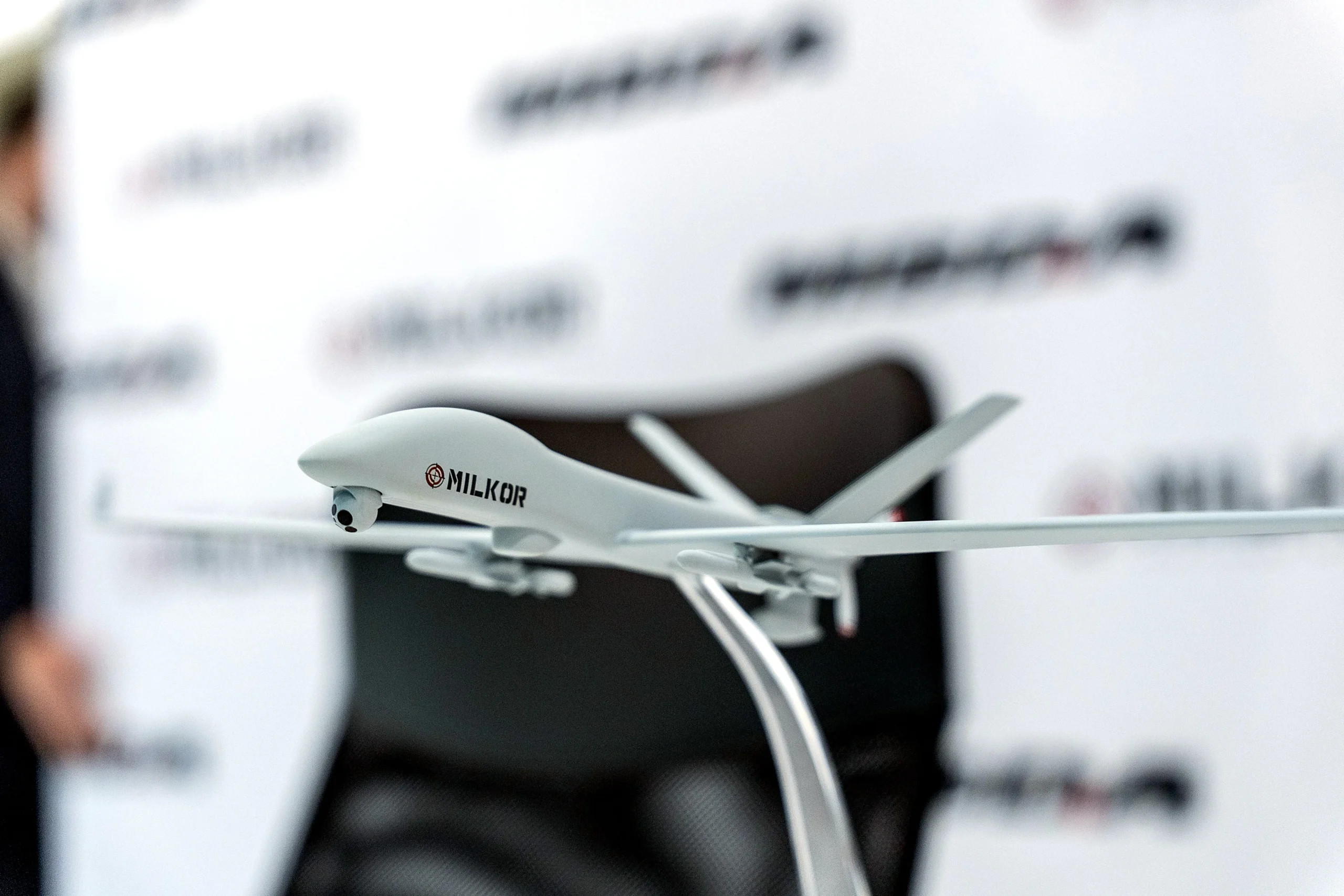
Milkor also gave the clearest figures yet for the Milkor 780, a high-altitude long-endurance (HALE) design still in development. The company says it will have a 24-metre wingspan and carry 2,700 kilograms of payload on nine hardpoints, with a flight time of 30 to 40 hours and a maximum range of 9,300 kilometres. Line-of-sight communications range is given as 250 kilometres, so long-range missions will depend on satellite links. These are manufacturer projections for an aircraft that has not been shown flying.
For comparison, Milkor quotes the production 380 at an endurance of 30 to 35 hours, a range of more than 4,000 kilometres and a payload of about 220 kilograms. The 380 is built at Milkor’s Cape Town facilities, where the company says production is being ramped up to meet demand.
Orders abroad, a stalled programme at home
The weapons roadmap is aimed at export buyers. As Unmanned Africa reported on 15 November in Milkor claims more 380 orders as SANDF purchase stalls, Milkor says an unnamed Middle East customer has operated the 380 for some time and that it expects African orders, while the South African National Defence Force (SANDF) has not bought the aircraft four years after a 2022 MoU earmarked five airframes for testing. Sister site Military Africa covered the signing itself in Milkor and MBDA sign MoU to arm the Milkor 380 drone.
Armed MALE drones in African service are overwhelmingly Turkish or Chinese, from Baykar’s Akinci to the Wing Loong II, as Unmanned Africa’s count of Africa’s medium-altitude drone fleet shows. A 380 carrying European missiles and a South African bomb would be the only African-built option in that class. South Africa’s broader industrial position is set out in Southern Africa’s drone fleets.
What to watch
Three markers will show whether the roadmap is real: a live release of Sea Venom or another MBDA weapon from a 380, a first flight of the MGGB from the aircraft ahead of its planned 2027 production, and a 780 airframe in the air. A named African buyer, or a funded SANDF line, would decide whether the weapons ever fly with an African air arm.
