
Poland’s WB Group pitches FLYEYE and WARMATE to African forces
Polish defence group WB Group is courting African armed forces with its FLYEYE reconnaissance drone and WARMATE loitering munition, and wants to set up manufacturing on the continent, a company manager said after the Africa International Defence Exhibition (AFRIDEX 2026) in Lagos. WB Group product manager Patryk Stec told defenceWeb, in an interview published on 24 November 2026, that the firm has around 20 to 30 subsidiaries worldwide but none yet in Africa.
“But as you can see, not yet in Africa. We are talking with many different partners, countries, and governments in order to produce something here, especially manufacturing,” Stec said. A local base, he argued, would let WB deliver faster and allow African engineers to adapt the systems using their own operational experience. Nigerian outlet Prime 9ja reported during the show that the company would consider producing equipment in Nigeria where commercial opportunities support the investment. “We are open to technology transfer,” Stec told the News Agency of Nigeria on 30 October, as carried by The Gazette.
Nigeria’s defence leadership at the stand
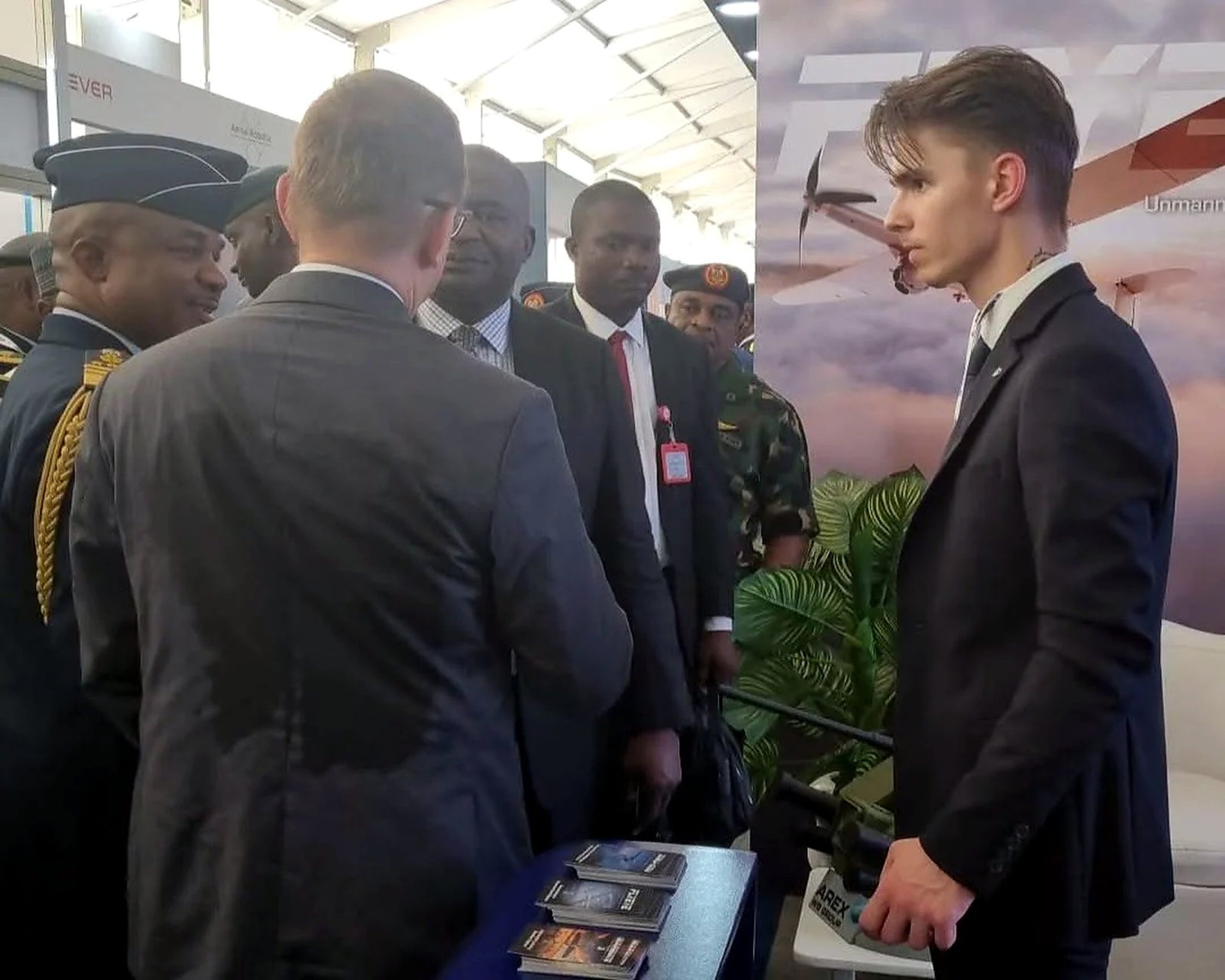
WB Group exhibited at the inaugural AFRIDEX, organised by the Defence Industries Corporation of Nigeria (DICON) at Eko Atlantic, Lagos, from 26 to 29 October. On the first day its stand was visited by Nigeria’s Minister of Defence, retired General Christopher Gwabin Musa, the Chief of the Air Staff, Air Marshal Sunday Kelvin Aneke, and Poland’s head of mission in Nigeria, Michał Cygan, the company said on social media, as reported by MILMAG. The minister was briefed on WB’s integrated systems for border and critical infrastructure protection. The same show drew other unmanned systems suppliers, among them Nigeria’s Nigus Tactical, which is taking its Sefine-backed unmanned surface vessel to demonstrations in Türkiye.
Stec said WB’s African engagement goes beyond Nigeria and that the company had also recently presented its systems at an event in Morocco. He did not name any customer or contract on the continent.
A gliding scout and a loitering munition
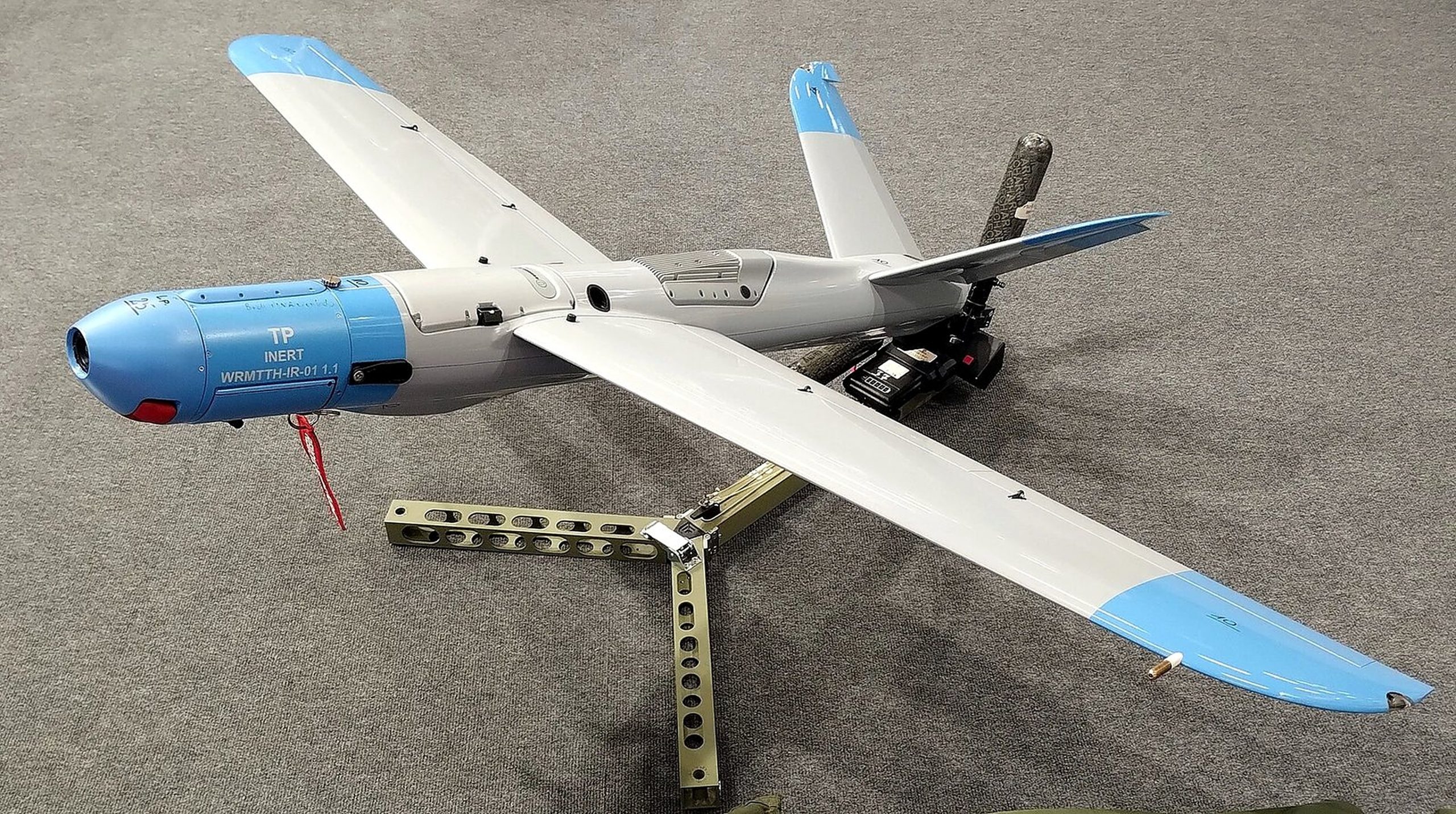
WB’s flagship FLYEYE is a hand-launched reconnaissance drone. Once it reaches altitude its engine shuts off and it glides silently, which Stec said makes it look like a bird to radar. According to WB Group’s product data, FLYEYE has an endurance of more than 2.5 hours and a standard line-of-sight data link range of 50 km.
FLYEYE is designed to work with the WARMATE loitering munition. The operator launches both, the scout finds and tracks a target, and the munition is then guided onto it, with FLYEYE staying overhead to follow moving targets. The basic WARMATE weighs 5.7 kg at take-off, has a 1.6 m wingspan, a 30 km radio line-of-sight range and attacks at up to 150 km/h with high-explosive or thermobaric warheads. Stec said WB’s munitions can carry explosive payloads from 3 kg to 10 kg or more depending on the target. In Ukraine the smaller WARMATE 3, known as FLYMATE, has been used in combat, and WB says those lessons have been fed back into its designs.
Border sensors and fire control
Beyond drones, WB is offering its AMSTA digital border and critical infrastructure system, which uses seismic sensors for early detection and can tell a person from a vehicle and pick up drones flying below radar cover. Stec described a layered response: AMSTA detects movement, a FLYEYE checks whether the intruders are armed and how many there are, and the operator decides whether to send troops or launch a WARMATE. The portfolio also includes command, control, communications, computers and intelligence (C4I) systems, turrets and fire-control equipment such as the Fonet vehicle communications module and its Topaz ballistic calculator, which Stec said were among WB’s first products adopted by both the Polish and United States armies.
WB is not new to African partnerships. In 2021 it teamed with South Africa’s Bruisertech to offer the Bruiser 212-based Combatmate armoured vehicle on export markets. Its renewed push comes as Nigeria leans on foreign partners for local production: at the same show Military Africa spoke to firms such as Terra Industries and Serbia’s Yugoimport about building and supporting equipment in Nigeria. Nigeria already operates Africa’s most diversified military drone fleet, drawn from 12 origin countries, but no Polish type is recorded in it.
A crowded field for loitering munitions
WB enters a market already shaped by Turkish, Chinese, Israeli and Emirati suppliers, and by African firms building their own small drones. Combat drones and loitering munitions made up most of Africa’s recorded drone deliveries in 2023 to 2026. Nigeria and the European Union have just finalised delivery of a €20 million European counter-drone and counter-IED package, a sign that Abuja is buying European kit for its war in the north-east. WB’s pitch rests on equipment tested in Ukraine and a willingness to manufacture locally, both of which African buyers increasingly demand. Whether Stec’s talks with “many different partners, countries, and governments” turn into a first African production line will depend on a buyer committing to a volume order large enough to justify it. Further coverage is on the loitering munitions and local production tag pages.
