
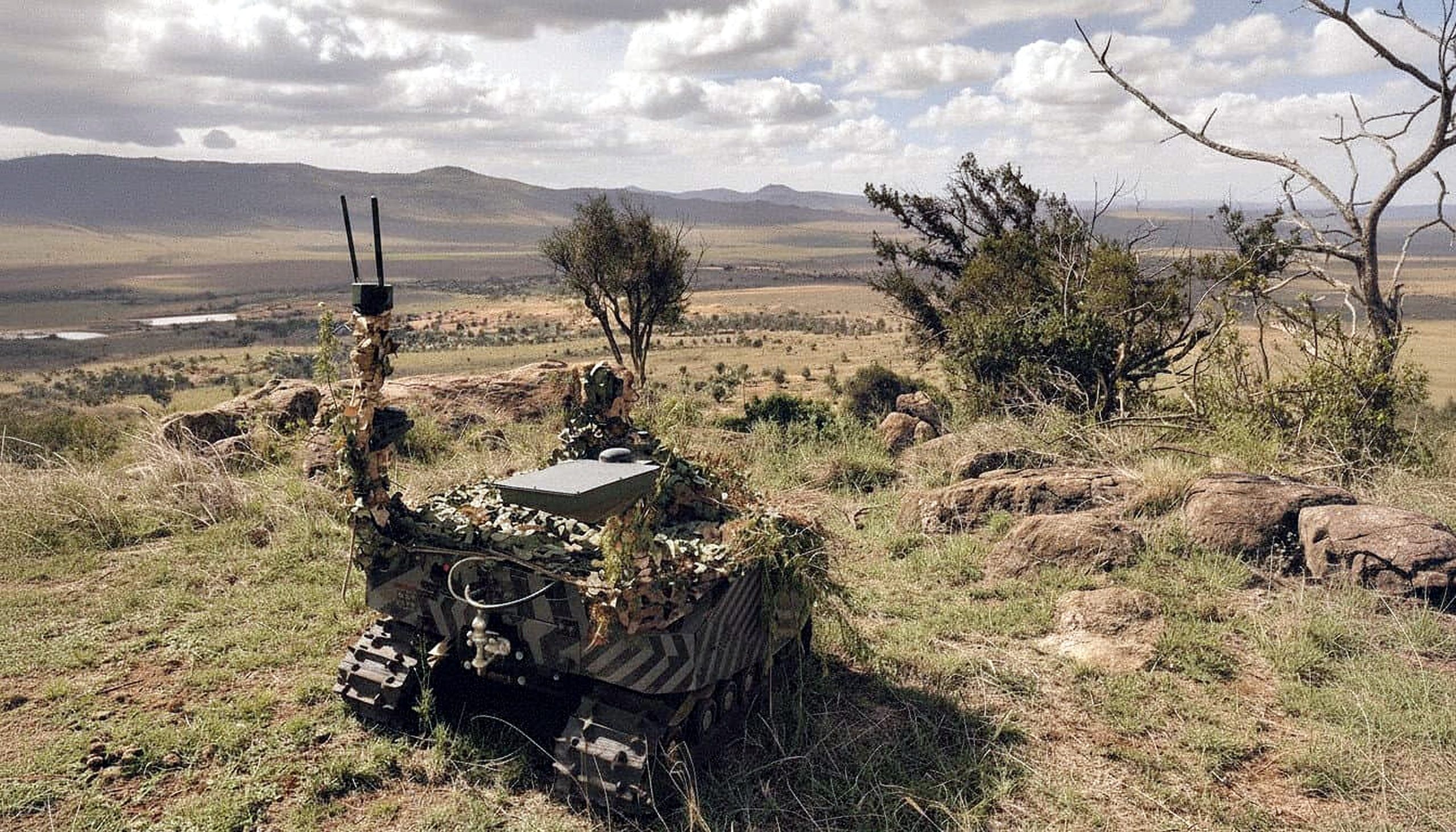
ARX GEREON robot feeds British targeting network in Kenya
A GEREON robot vehicle working with British troops in Kenya spotted targets and passed them straight into the British Army’s AI-enabled targeting network, cutting the time from detection to strike by a factor of 10, its maker ARX Robotics said on 24 November 2026. The German-founded company said it is the first to integrate an uncrewed ground vehicle (UGV) into ASGARD, the British Army’s digital targeting web, during Exercise Haraka Storm, the annual British and Kenyan training exercise in Laikipia County. Neither the “first” claim nor the tenfold figure has been independently verified, and Defence Blog said it could not confirm either.
During the exercise the robot was able to “quickly identify targets and instantly transmit the information into ASGARD,” ARX said. The company says this made the Army’s sense-decide-effect process, the cycle of finding a target, deciding what to do and striking it, “10 times faster,” according to its release carried by DroneXL.
Two robots with 4 Brigade
ARX Robotics UK deployed two GEREON vehicles with the British Army’s 4 Brigade, working alongside soldiers of 1st Battalion, The Duke of Lancaster’s Regiment (1 LANCS), and the Light Dragoons, a reconnaissance regiment. The battalion also used a GEREON as a “persistent remote sentry” to watch over a key supply route, according to the company.
“The British Army doesn’t need robots that operate in isolation. It needs battle-tested systems that make the whole force more effective,” said David Roberts, chief executive of ARX Robotics UK. “Ultimately, this is about giving soldiers better information earlier and faster, while reducing the risks they face.”
“Using equipment that has been proven on the battlefield in Ukraine and integrating it into our way of fighting is how we will continue to increase our lethality and deter our adversaries,” said Brigadier Tom Robinson, commander of 4 Brigade. The brigade is due to deploy to NATO’s eastern flank in April 2027.
What ASGARD does
ASGARD uses artificial intelligence (AI) and secure communications to give soldiers faster targeting and decision support, linking sensors and weapons so that a target found by one system can be engaged by another. The British Army first showcased the system on 20 July 2025, after contracts awarded in January 2025 produced a prototype that was used about four months later on NATO’s Exercise Hedgehog in Estonia. “ASGARD helps double our lethality and exponentially reduces the time to see, decide, and strike,” said General Sir Roly Walker, Chief of the General Staff. The Ministry of Defence (MoD) says it is part of a wider digital targeting web backed by more than £1 billion that is due across the UK armed forces by 2027.
A ground robot gives the network a sensor that can sit hidden for days on a ridge or a supply route, close to where an enemy moves, without putting a soldier there.
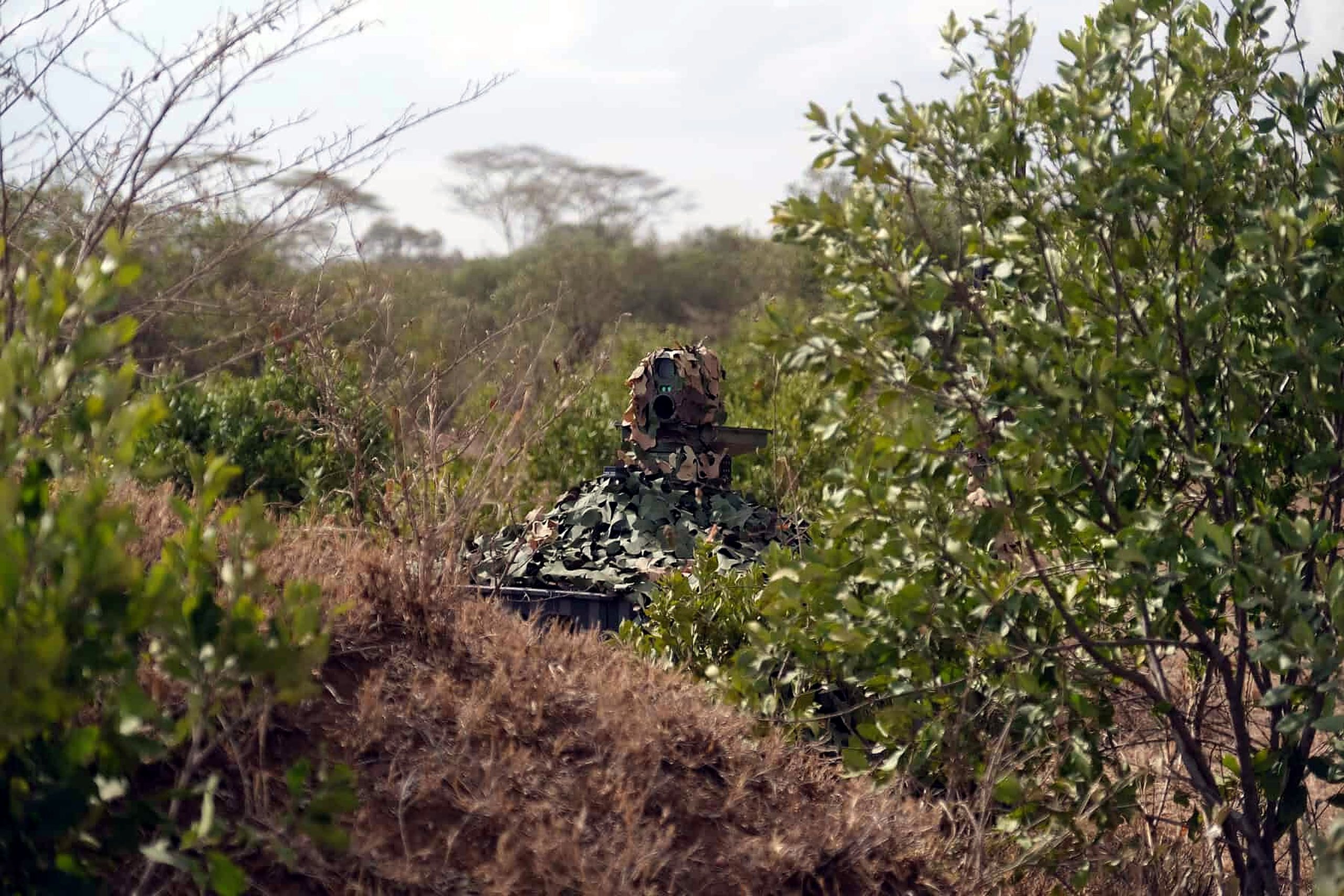
The GEREON
The GEREON is ARX’s medium-sized, tracked and modular UGV, run by the company’s Mithra OS software for remote-controlled or autonomous operation. ARX gives it a payload of up to 500 kg, a speed of 15 to 30 km/h depending on configuration, a driving range of up to 40 km, a control range of up to 4 km and up to 72 hours of stationary or sentry operation on its battery, with a full recharge taking about 2.5 hours, according to manufacturer figures reported by Times of Defence and Militarnyi. Thermal and night-vision cameras are standard. Earlier this year, during Exercise Spring Storm in Estonia, the company said it showed the vehicle could operate up to 20 km (12 miles) ahead of troops, sending back live intelligence while soldiers stayed out of exposed forward positions.
The GEREON’s record in Ukraine is a large part of its pitch. ARX, founded in 2022 and backed by the NATO Innovation Fund, is the largest supplier of Western UGVs to Ukraine, with several hundred vehicles ordered. Last month it tested a Ukrainian remote weapon station on the vehicle. In April, ARX Robotics UK began building GEREONs in Britain after winning its first British Army contract, a move Luke Pollard, Minister for Defence Readiness and Industry, called “exactly the kind of investment we want to see,” The Defense Post reported. The company says it plans £45 million of UK manufacturing and research. Its vehicles also took part in the US Army’s Project Convergence at Fort Irwin, California, this summer.
Kenya as a proving ground
Kenya is not new ground for the robot. During Haraka Storm in 2025, a GEREON working with 2nd Battalion, Royal Regiment of Scotland, found an armoured target and passed the data to battlegroup command, which then struck it with a Helsing HX-2 loitering munition. The sequence ran from detection to damage assessment using only unmanned systems. In earlier Kenyan trials the vehicle also carried out autonomous covert surveillance of simulated enemy positions up to 10 km from friendly units, Militarnyi reported.
The exercises run through the British Army Training Unit Kenya (BATUK) at Nanyuki, which lets up to six light infantry battle groups train in Kenya each year, often alongside the Kenya Defence Forces (KDF), according to the British High Commission in Nairobi. This year’s exercise nearly did not happen in Kenya. In July the UK said Haraka Storm would be held elsewhere after training licences were not issued, before Nairobi confirmed on 28 July that joint training would resume, Citizen Digital reported. Kenyan lawmakers have pressed for Kenyan jurisdiction over serious offences by visiting troops, and Nelson Koech, chair of the National Assembly Defence Committee, said “partnership must rest on equality, on respect for Kenyan law, and on genuine accountability.”
What Kenya’s hosts can take from it
For the KDF, the trials are a close view of how a NATO army is wiring ground robots into its targeting cycle. Kenya’s own unmanned fleet has shifted from American to Turkish suppliers since 2020 and is made up of aerial systems. UGVs are still rare on the continent, as Unmanned Africa found when it reported how ground robots are arriving on Africa’s battlefields, mostly for bomb disposal and route clearance. US and Moroccan troops recently tested drone-hunting robot vehicles at Tan-Tan, and Mozambique’s president has ordered research into drones and UGVs for a national defence industry.
The next test for ARX comes when 4 Brigade deploys to NATO’s eastern flank in April 2027. For Kenya the question is whether BATUK’s training ground becomes a place where the KDF itself trials this kind of sensor-to-shooter network, rather than one where it only hosts the experiments. More coverage is on the UGV and Kenya tag pages.
