
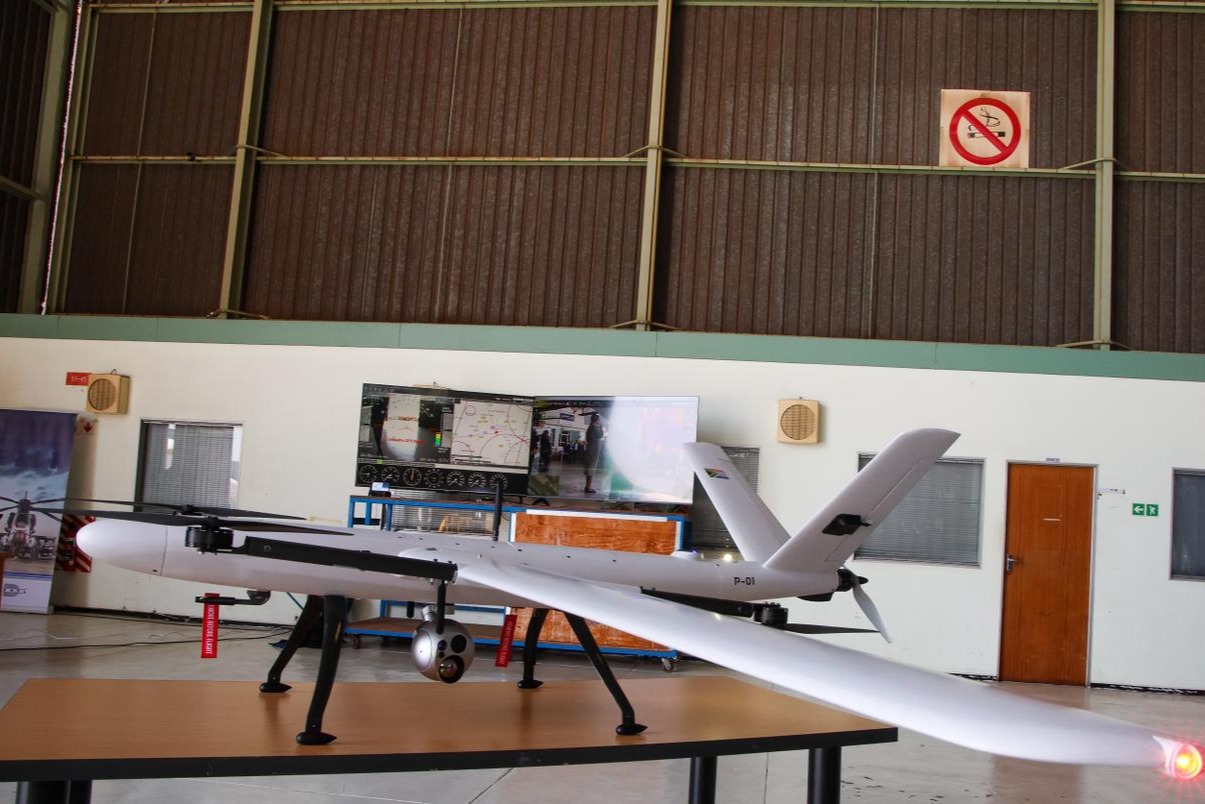
Denel and Sparcx Team Up on Skyler Drone for Public Safety
Denel Aerospace and South African engineering company Sparcx have signed a memorandum of understanding (MoU) to explore collaboration in aerospace engineering, research and development, industrialisation, customisation and technology commercialisation. The agreement, revealed at the Africa Aerospace and Defence (AAD) 2026 exhibition at Air Force Base Waterkloof in September, centres on Denel’s Fixed-Wing Vertical Take-off and Landing (FW-VTOL) unmanned aerial vehicle (UAV), the aircraft Denel showed publicly for the first time at the same event under its new name, Skyler.
The MoU sets up a framework for the two companies to identify and evaluate opportunities rather than committing either to a specific programme. Among the options under study is integrating the drone into Sparcx’s public-safety offering and approaching each other’s customers jointly. The companies will also look at knowledge exchange in research and development, industrialisation, customisation and the commercialisation of intellectual property, which could extend to jointly developing or customising subsystems for future manned and unmanned aircraft.
The Aircraft at the Centre of the Deal
Skyler takes off and lands vertically on four lift rotors and cruises on a rear pusher propeller, giving it up to 150 minutes of low-noise forward flight and a ceiling of about 3,000 metres, according to Denel. It carries a stabilised gimbal with a 30 times optical zoom camera, a thermal imager and a laser rangefinder, plus a locally developed artificial intelligence system that can automatically track vehicles and people. Denel describes it as a close-range “first line of recon” aircraft working out to about 25 kilometres from its operators, and says it is in flight testing and qualification, with two prototypes built and a third planned.
The drone already has a link to Sparcx. In an interview with DefenceWeb at AAD, Denel’s Dr Lindokuhle Mpanza said Skyler sends live video and tactical data to command centres through FUSUS, a secure, cloud-based real-time intelligence platform, and that the integration was developed with Sparcx as FUSUS’s local distributor. FUSUS began as a real-time crime centre system used by US police departments and was acquired by Axon, the maker of police body-worn cameras and TASER devices. The platform pulls feeds from fixed cameras, body-worn cameras and drones into a single operating picture. The MoU formalises that working relationship and widens it beyond a single software link.
Why Public Safety
Denel Group Chief Executive Tsepo Monaheng said the collaboration “reflects the importance of bringing together South African aerospace and engineering capabilities to explore new opportunities in a rapidly evolving technology environment.”
Sparcx Managing Director Sujo Mulamattathil made a more specific case. He said there is considerable value in combining South African aerospace capability with the integrated technologies now used in public safety and security. “Unmanned aerial systems can provide valuable situational awareness, but their real value grows exponentially when the information gathered forms part of the operational and more importantly, evidence ecosystem,” he said.
That point about evidence matters. A drone feed that only informs a commander in the moment has a short shelf life. One that is recorded, time-stamped and stored in a secure chain of custody can support arrests and prosecutions, which is where police forces tend to see the most return on surveillance technology.
Mulamattathil also linked the work to the wider economy, saying: “Improving public safety in South Africa is the fastest way to increase GDP and consequently create jobs across ALL sectors.” That is his argument rather than an established finding, though crime is widely cited as a constraint on investment in South Africa.
He said the collaboration gives Sparcx a chance to explore how locally developed aerospace capability can be used alongside modern public-safety technology while supporting South African engineering, skills development and industrialisation, and that it “opens up the opportunity to take domestic products to global customers.”
The Domestic Deployment Factor
Mulamattathil tied the timing to the South African National Defence Force’s (SANDF) domestic role. AAD, he said, was an important place to start the conversation with defence, law-enforcement and other users “in light of the recent developments of the South African National Defence Force being deployed domestically to support the South African Police Service and Border Management Authority.”
That deployment is substantial. President Cyril Ramaphosa announced in his February 2026 State of the Nation Address that the SANDF would support police against gang violence and illegal mining. In March, the Presidency confirmed 2,200 soldiers would deploy across five provinces, the Eastern Cape, Free State, Gauteng, North West and Western Cape, from 1 March 2026 to 31 March 2027, operating under police command. According to the Mail & Guardian, the government set aside R1 billion each for the police and the SANDF to support the effort against organised crime.
Joint operations of this kind create a practical need for shared situational awareness. Soldiers and police working the same area need to see the same picture, and a drone feed delivered through a common platform is one way to provide it. Mpanza’s example at AAD made the point directly: Skyler could stream images of a crowd that looked likely to turn violent to a security agency’s control centre so that response teams could be sent before the situation escalated. The SANDF has also rehearsed police cooperation in training, with crowd and riot control scenarios featuring in its annual Exercise Vuk’uhlome.
A Fit With Denel’s Recovery
For Denel, the MoU offers a route to market beyond its traditional military customers. The state-owned group is in the middle of a turnaround, and AAD 2026 was its first exhibition with the Department of Defence as shareholder. Government figures show its 2025/26 revenue rose 15 percent to R1.473 billion, according to SAnews. Denel has said the SANDF is in advanced discussions about Skyler and that the South African Air Force’s new drone squadron is expected to receive it, but no contract has been announced. A civil and policing market, reached through a partner already selling to those customers, would spread the programme’s costs across more users.
The deal also fits a pattern at AAD 2026, where South African firms pushed hard into unmanned systems. Paramount unveiled its reusable V-Raven, ShadowfaxUAS launched its SF45 and Incomar debuted a new drone and avionics portfolio, as Military Africa’s review of the show records.
Meanwhile, Denel showed its new Skyler unmanned aerial vehicle (UAV) in public for the first time at the Africa Aerospace and Defence (AAD) 2026 exhibition at Air Force Base Waterkloof, two weeks after presenting it to President Cyril Ramaphosa during an oversight tour of the company. The aircraft, developed until recently under the working name FW-VTOL (Fixed-Wing Vertical Take-Off and Landing), is a short-range reconnaissance drone that Denel says is now in flight testing and qualification. Two prototypes have been built and a third is planned.
