
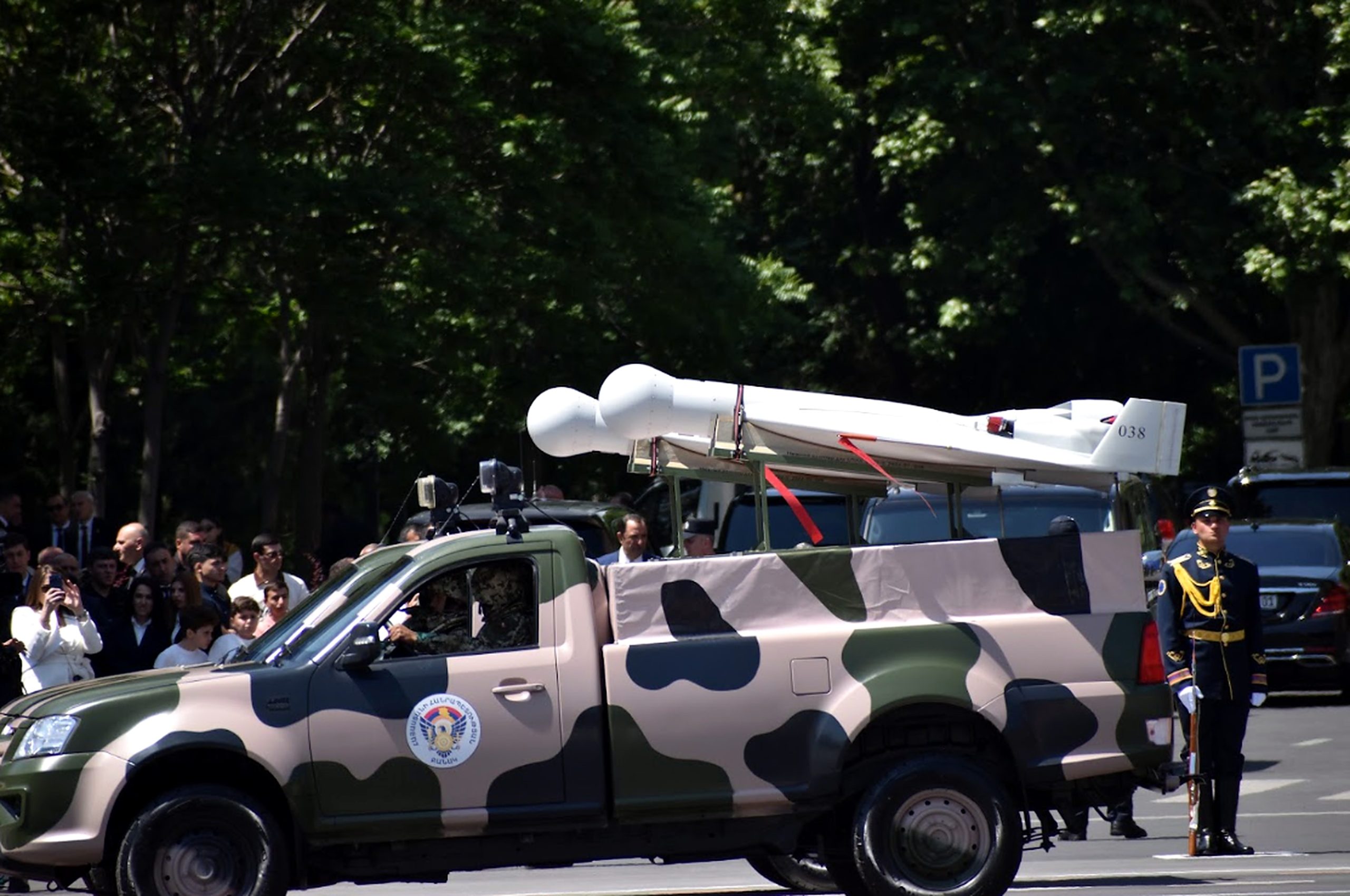
Egypt holds 34 of ASN Technology Group’s 46 African drones
Xi’an’s ASN Technology Group is China’s fourth-largest drone supplier to Africa by units recorded, and almost all of its business runs through Egypt. The Africa Drone Intelligence database credits the company with 46 drones for three buyers. Egypt holds 34 of them: 18 ASN-209 reconnaissance aircraft recorded in 2012 and 16 ASN-301 loitering munitions recorded in 2024. Algeria and Namibia each have six ASN-209s, recorded in 2015 and 2021.
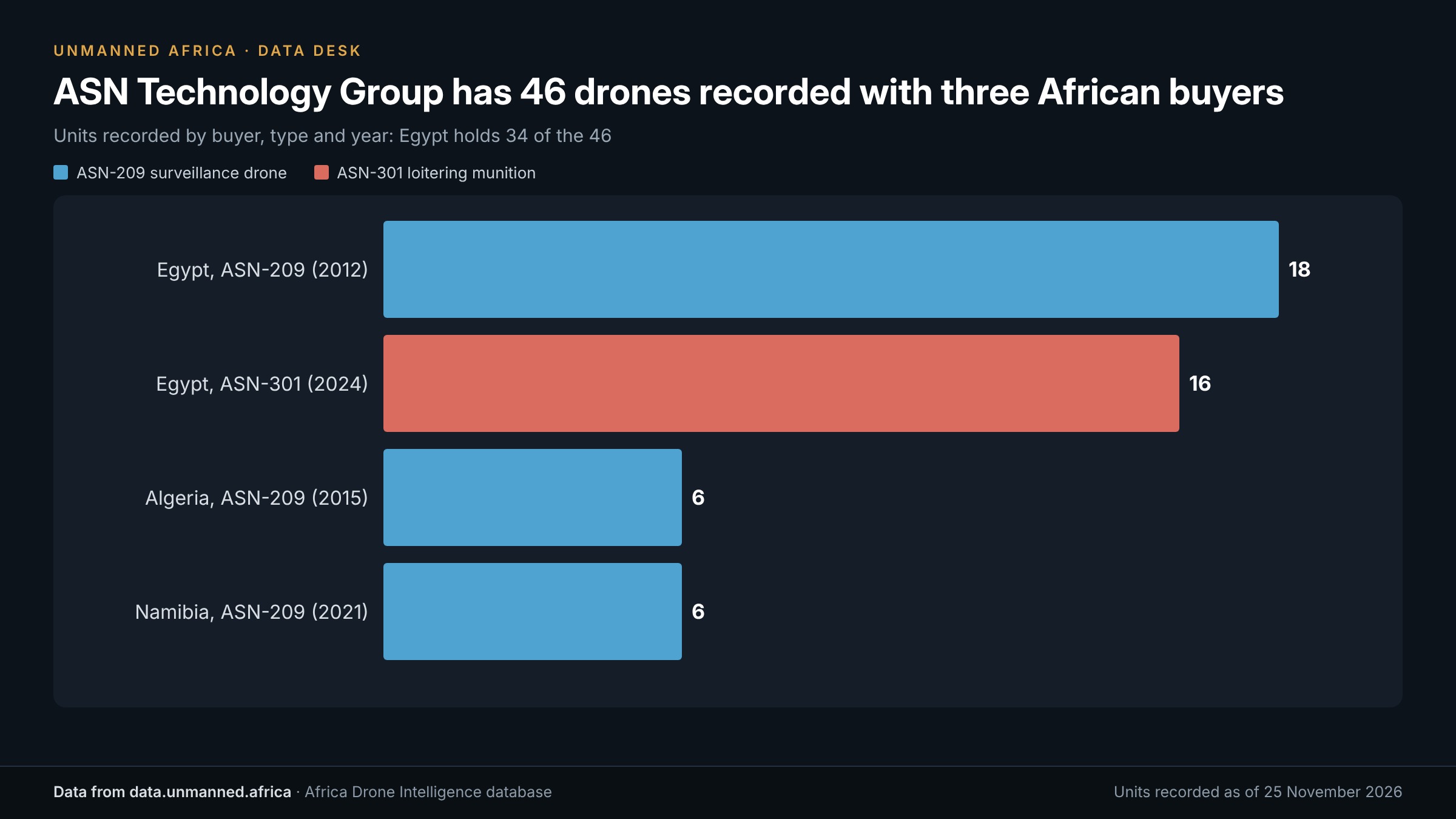
The company sits behind AVIC (169 units), CASC (99) and DJI (80) among the 603 Chinese-made drones in the database, and ahead of CASIC (24). It is a smaller name than the Wing Loong and Rainbow makers, but its African record is unusual. Its first African customer built the aircraft under licence, and its latest African entry is a radar-hunting munition.
Who ASN is
ASN Technology Group grew out of the Northwestern Polytechnical University UAV Research Institute in Xi’an, also known as the 365th Institute, founded in 1984. Its main products are tactical reconnaissance drones. Janes describes the ASN-206, the ASN-209’s predecessor, as typically used by the Chinese army to support artillery units.
The ASN-209 is a twin-boom tactical aircraft, 4.27 m long with a 7.5 m wingspan and a maximum take-off weight of 320 kg, according to the published specifications. It carries a 50 kg payload, cruises at 140 km/h, flies for about 10 hours up to 5,000 m and works out to a radius of about 200 km. It is launched by rocket booster from a 6×6 truck and recovered by parachute, so it needs no runway. That makes it a Class 2 aircraft in the database, heavier than a hand-launched drone and far lighter than a Wing Loong.
Egypt built it under licence
Egypt’s ASN-209 programme was an early drone technology-transfer deal for an African state. Egypt and China agreed to build twelve ASN-209s with technology transfer, and in June 2012 Hamdy Weheba, chairman of the Arab Organization for Industrialization (AOI), said six aircraft from a first phase were already operational with the Egyptian armed forces, Army Recognition reported. He claimed that 99.5 percent of the components were made locally. Egypt later named its locally produced version Nut, after the sky goddess, and showed it at EDEX, where EDR Magazine described it as produced under licence from China.
The line has not stopped. At EDEX on 1 December 2025, AOI signed an agreement with China’s Norinco to co-produce the Hamza-2 armed drone, which Army Recognition reported is based on the ASN-209 that Egypt has assembled for more than a decade. At EIAS 2026, AOI again exhibited a locally made ASN-209, according to Quwa.
The database records the 18 ASN-209s under 2012 and the Nut separately, as three AOI-built units in 2020. Read together, the two entries suggest Egypt’s ASN-derived fleet may be larger than either line alone, though neither figure has been publicly confirmed by Cairo. ASN’s 34 units make up just over a quarter of Egypt’s 126 Chinese-made drones. The rest come mainly from AVIC’s Wing Loong I and II and CASC’s Rainbow CH-4, part of the shift traced in our Egypt fleet profile.
The ASN-301 entry
The 16 ASN-301s recorded for Egypt in 2024 are the only Chinese anti-radiation loitering munitions in the database. The ASN-301 is a delta-wing munition with a pusher propeller, close in layout to Israel’s Harpy, and is designed to loiter until it detects an air defence radar and then dive onto it. Army Recognition reported that it was shown at the World Defense Show in Riyadh in February 2024 and that it targets radar frequencies from 2 to 16 GHz. Chinese army footage has since shown it fired from truck-mounted launchers carrying six canisters.
Unmanned Africa found no public Egyptian or Chinese statement confirming an ASN-301 sale to Egypt, so the 2024 entry should be read as the database’s assessment, not a confirmed contract. If accurate, it gives Egypt a suppression-of-air-defence weapon alongside the loitering munitions its own industry is now developing, including the Hamza-3 and the Tornex Jabbar family covered in our El Alamein report. The entry also makes Egypt one of only a handful of African states with recorded anti-radiation munitions, alongside the Israeli Harpy and Harop types recorded for Tripoli and Morocco, discussed in our loitering munition review.
Algeria and Namibia: dates that run ahead of the evidence
The two smaller customers show how procurement dates in open databases can run ahead of public evidence. The database dates Algeria’s six ASN-209s to 2015. The first public sign of the type in Algerian service was a crash on 12 September 2022 in M’sila province, about 233 km south-east of Algiers, reported by Military Africa, which the French-language site Mena Défense described as the type’s first appearance with the Algerian army. Mena Défense, quoted by Le360, said the aircraft is optimised for artillery target designation and surveillance of large areas. Algeria’s ASN-209s are a small part of a fleet that also includes 24 Wing Loong II and Turkish ANKA-S and Aksungur aircraft. Algeria’s mix of Chinese, Turkish and Emirati drones is set out in our Algeria profile.
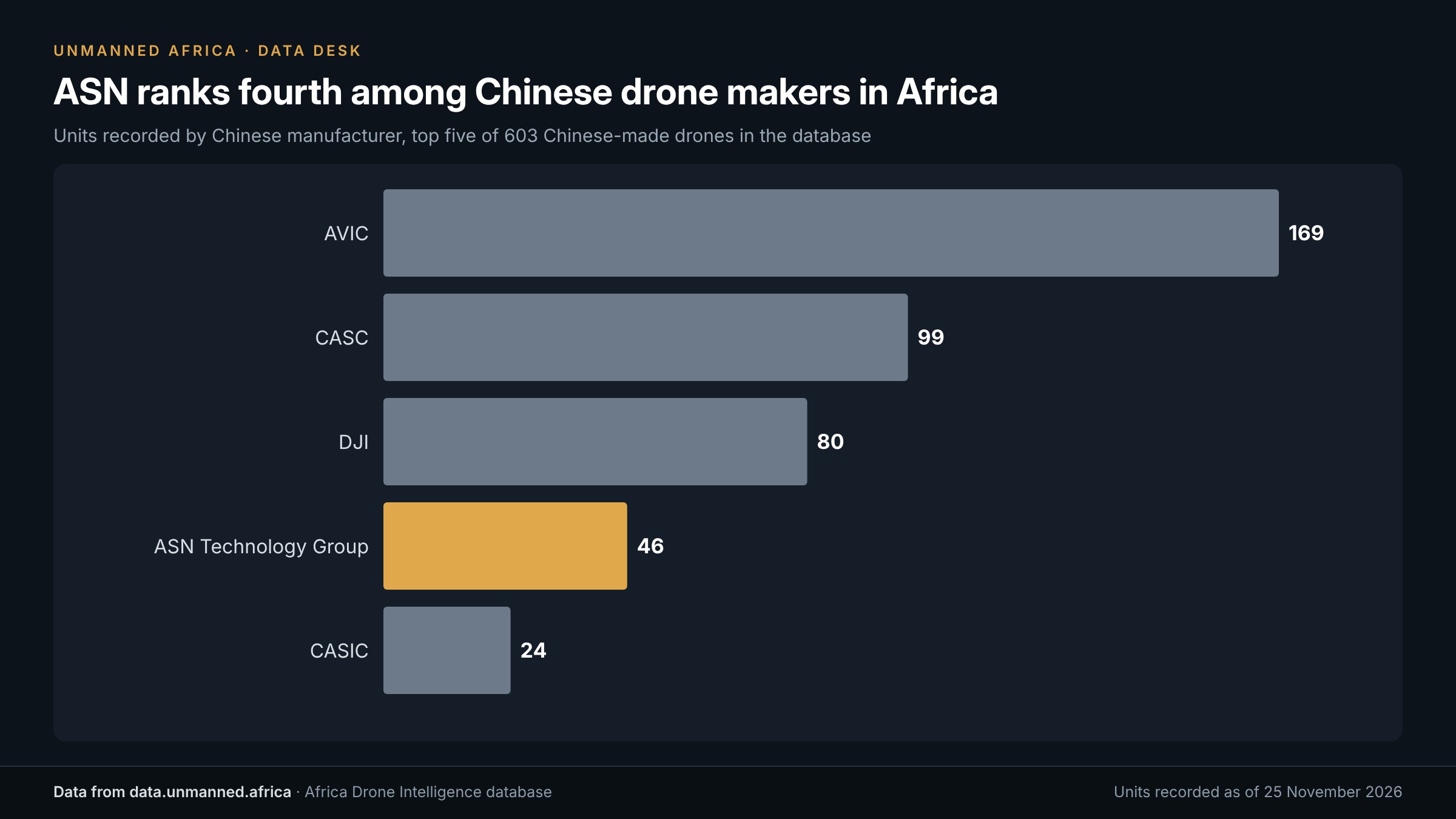
Namibia’s six are recorded in 2021, but the first public sighting came at the Namibian Defence Force’s anniversary parade at Grootfontein on 2 June 2025, where Janes identified a probable ASN-209 on a truck launcher. Janes noted that the aircraft may be one of the later developments of the design, known by names such as KVD-001 and BZK-006. The drone fits an air arm that is equipped almost entirely from China, from F-7 fighters to the Y-9 transports that Namibia received in December 2024 as the type’s first export customer, according to an order-of-battle summary citing defenceWeb. Namibia’s drones sit within a Southern African picture dominated by South African industry and Israeli imports, covered in our regional survey.
A licence model, not a volume model
ASN’s African record differs from that of the larger Chinese firms. AVIC and CASC sell finished armed aircraft that buyers fly as delivered, and DJI’s numbers come from commercial quadcopters bought off the shelf. ASN’s anchor customer, by contrast, turned the ASN-209 into a domestic production line and is now using it as the base for an armed derivative. That fits a wider change in a market now split across 46 recent suppliers, where buyers increasingly ask for production work as well as aircraft.
China’s wider sales push in Africa, from Wing Loong II to air defence, is examined in our report on Beijing’s shift from rifles to drones. ASN is a small part of that total, but its Egyptian partnership is one of the longest-running drone industrial links between China and an African state.
What to watch
The next signs will come from Egypt. Production of the Norinco-backed Hamza-2 would show whether the ASN-209 line is moving from surveillance to strike. Any public confirmation of the ASN-301 would settle the 2024 entry, and a sale of the munition to a second African buyer would make ASN a supplier of strike weapons in Africa, not only reconnaissance aircraft. In Namibia and Algeria, the open question is whether the aircraft on parade and in the M’sila field are the original ASN-209 or newer variants, which would change how the database should record them.
