
Egypt’s Tornex Shows Jabbar Drone Family at El Alamein Airshow
Egyptian firm Tornex displayed its Jabbar 200 piston-engine drone at the second El Alamein International Airshow, held 8 to 10 September 2026 at El Alamein International Airport on Egypt’s Mediterranean coast. The company markets the 200 kg aircraft as a target drone that could also serve as a long-range loitering munition, a weapon that circles an area before it strikes.
Also displayed, is the Jabbar 150 at 150 kg maximum takeoff weight (MTOW), with a piston engine and 10 hours of endurance. Its camera gimbal lets an operator pick a target, though Tornex advertised it for air-defence training.
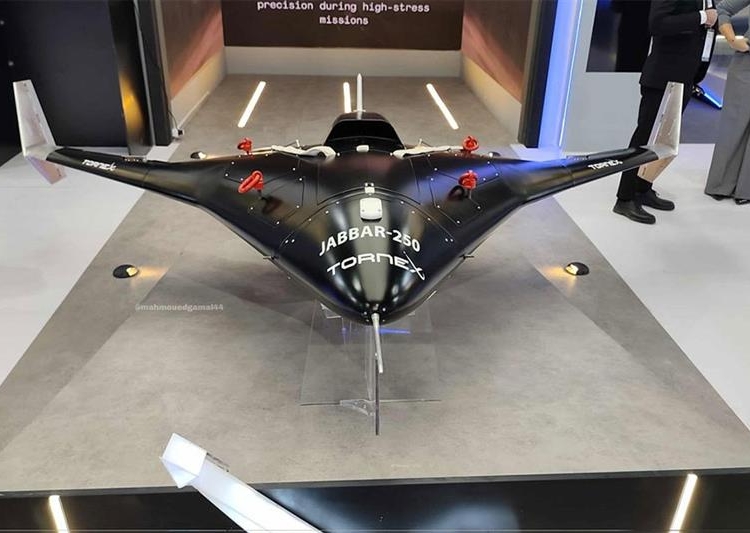
The Jabbar 250 weighs 250 kg and uses a small turbojet. Jane’s gave it a speed of 576 km/h, a 3.45 metre wingspan, a 50 kg payload, a 1,500 km range and 2.5 hours of endurance. Quwa photographed physical hardware of the 250 at the El Alamein stand. A smaller Jabbar 50 appeared only as rendered imagery.
Tornex lists a top speed of 200 km/h, endurance of up to 14 hours and a payload of up to 50 kg. Material supplied with the show coverage also claims a maximum range of 2,500 km, said to be the longest of any drone in the region.
The drone was not shown by Tornex alone. Amstone International Group, a private Egyptian defence company, exhibited the Jabbar 150 and Jabbar 200 and called them long-endurance, strike-related unmanned aerial systems, according to a Defensehere report dated 23 September 2026. Quwa, a defence analysis site, lists both Tornex and Amstone as suppliers.
According to reporte the Jabbar 200 and Jabbar 250 on the show floor next to the Hamza-1 and Hamza-3 drones from the state-owned Arab Organization for Industrialization (AOI). President Abdel Fattah Al-Sisi opened the show on Tuesday 8 September. Daily News Egypt counted more than 260 exhibitors from about 80 countries.
Where the Jabbar fits
The Jabbar 200 is one of four sizes in a family. Jane’s reported the Jabbar 150 at 150 kg maximum takeoff weight (MTOW), with a piston engine and 10 hours of endurance. Its camera gimbal lets an operator pick a target, though Tornex advertised it for air-defence training.
The Jabbar 250 weighs 250 kg and uses a small turbojet. Jane’s gave it a speed of 576 km/h, a 3.45 metre wingspan, a 50 kg payload, a 1,500 km range and 2.5 hours of endurance. Quwa photographed physical hardware of the 250 at the El Alamein stand. A smaller Jabbar 50 appeared only as rendered imagery, and Quwa could not confirm that any airframe exists.
The two engine choices show the basic trade-off. A piston engine burns less fuel and flies slowly, so it stays aloft for hours. A turbojet flies faster but drains its tank quickly. The Jabbar 200 sits firmly on the endurance side.
Jane’s noted that the 200 looks similar to the Iranian Shahed-136, a long-range one-way attack drone. A one-way attack drone is built to be expended on its target. Jane’s also described the Jabbar line as designed to fill the gap between Egypt’s ballistic missiles and its medium-altitude, long-endurance (MALE) drones, which are larger reusable aircraft.
The 50 kg payload figure matters for both roles. As a target, it can carry radar reflectors, tow bodies or scoring equipment. As a munition, it sets the warhead size, which at that weight is far smaller than a cruise missile warhead.
Tornex frames the whole range as training equipment. Its marketing material said the Jabbar 200’s endurance supports “training scenarios that rely on long-duration missions and adaptive flight patterns,” Jane’s reported. That wording fits a target drone. The dual-use label on the show-floor listings suggests the strike option is deliberate, not accidental.
Tornex also sells smaller systems. Jane’s listed the electric Voltex-10 fixed-wing drone, with 120 minutes of endurance, a 400 km range and a 10 kg payload. The Voltex-5 loitering munition, which resembles the US Switchblade, flies for 60 minutes with the same range and payload. The company also showed two bomb guidance kits, the GK-10 and the GK-6, with stated circular error probable (CEP, the radius within which half of munitions land) of under 30 metres and 2 metres.
What it means for Egypt
A cheap target drone that flies for 14 hours is useful to any air-defence force. Gunners and missile crews can practise against slow, persistent tracks of the kind they would meet in a real drone raid. Egypt gains a local supplier for that need and may reduce its reliance on imported targets.
The same airframe could also carry a warhead, which would give Egyptian planners a long-reach strike option well below the cost of a missile. Ayman Abdel Mohsen, a military and strategic expert quoted by Daily News Egypt, said the Egyptian systems on show included the locally made ASN-209 reconnaissance drone and the Hafez glide-bomb family. He did not address the Jabbar series in detail in the reporting reviewed.
The drones also fit a wider push to build weapons at home. Minister of State for Military Production Mohamed Salah El-Din said at EDEX 2025 that Egypt had doubled its armoured steel production capacity, part of an effort to localise key components.
Egypt is building the other half of the picture at the same time. AOI showed its UDJAT and WEDJAT interceptor drones and the Haris 2 counter-drone system, according to Quwa. UDJAT is advertised with a 1 km engagement range, and WEDJAT with 15 km. Quwa found no published test data for either.
No customer for the Jabbar 200 has been announced, and no Egyptian Armed Forces order has been verified. Tornex has not published flight-test results or confirmed the 2,500 km range. The next sign of progress would be a documented long-range flight or a contract, and either would show whether the Jabbar 200 is a training aid or a fielded weapon.
