
Africa’s drone market splinters across 46 manufacturers
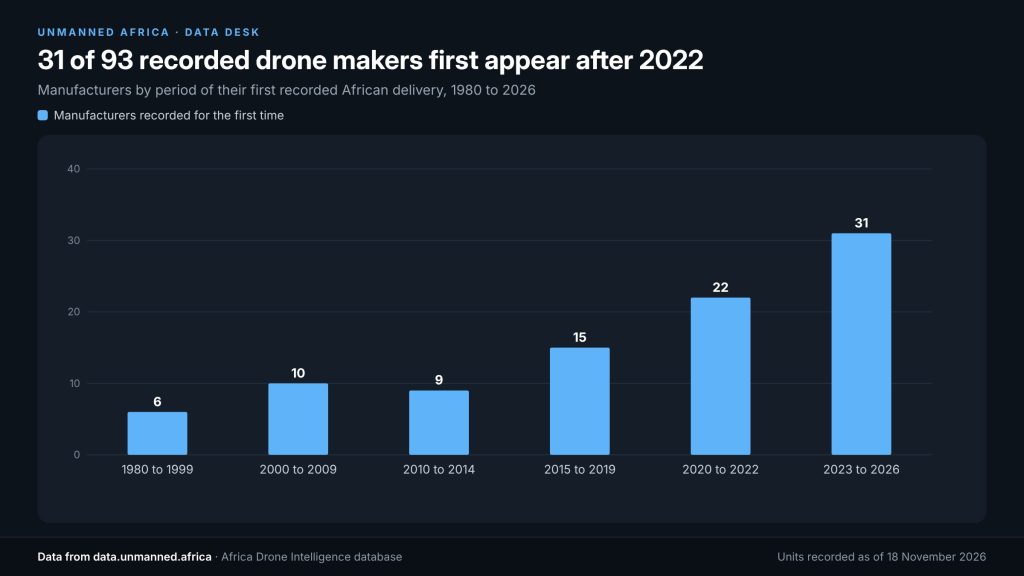
Forty-six manufacturers delivered military drones to African buyers in 2023 to 2026, more than in any earlier period, and 31 of them had never before appeared in the Africa Drone Intelligence database. Those newcomers supplied 223 of the 503 drones recorded for the period, or 44.3%.
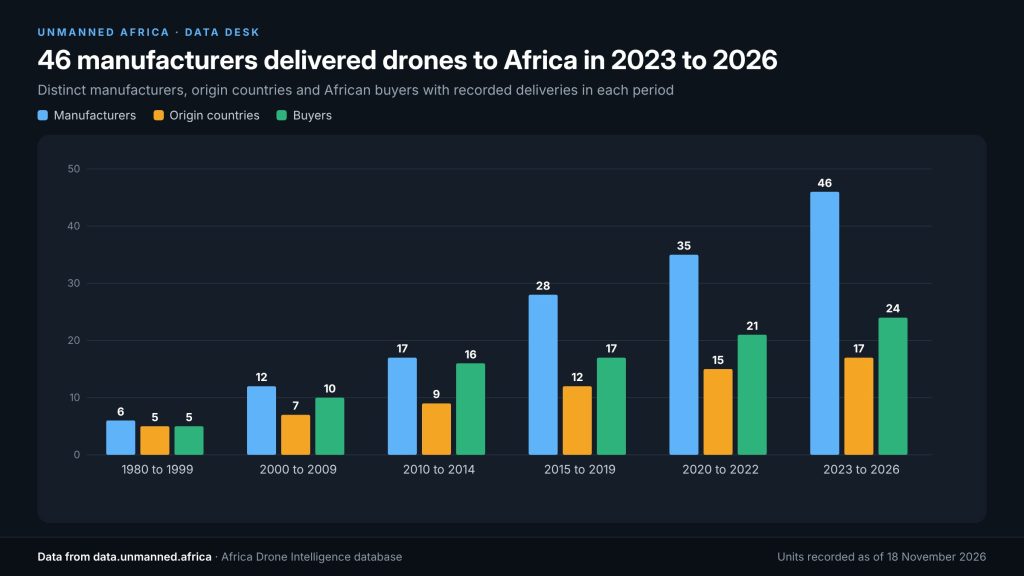
The supplier base has widened in every period since 2010 to 2014, when 17 manufacturers from nine countries delivered to 16 African buyers. The count rose to 28 makers from 12 countries for 17 buyers in 2015 to 2019, then to 35 makers from 15 countries for 21 buyers in 2020 to 2022. The latest period has 46 makers from 17 countries selling to 24 buyers.
Market power has thinned out at the same time. In 2020 to 2022 the three largest suppliers, BlueBird Aerosystems (150 units), Baykar (104) and AVIC (81), delivered 53.1% of Africa’s recorded drones. In 2023 to 2026 the top three, Baykar (81), CASC (40) and Russia’s ZALA (22), delivered 28.4%.
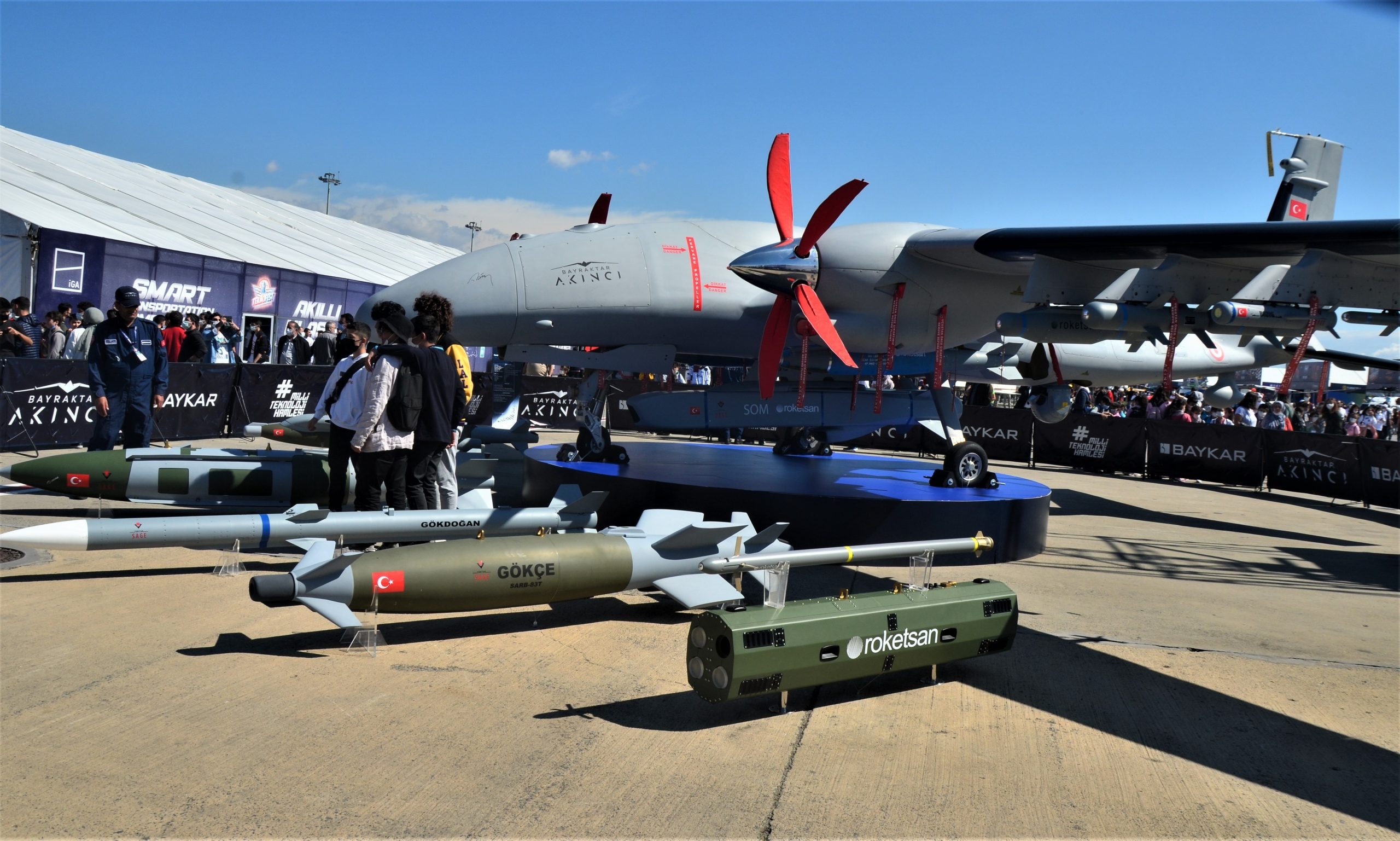
Baykar still leads, and its Akinci now flies with eight African operators, but in a far more crowded market.
New supplier countries have joined too. Latvia and Spain first appear in 2023, Belarus, Morocco and Ghana in 2025 and Cyprus in 2026. Seventeen countries delivered drones to Africa in 2023 to 2026, against nine in 2010 to 2014.
The buyer side has grown more slowly. Twenty-four of the 35 buyers in the database took at least one delivery in 2023 to 2026, up from 21 in 2020 to 2022. The number of makers per buyer keeps rising.
Who the newcomers are
Chinese firms make up the largest group: 11 new manufacturers and 81 units. Most are commercial or semi-commercial makers rather than the state aerospace groups. Haftar’s Libyan National Army alone took 12 aircraft each from Foxtech, Airmobi UAV and Aerobot Avionics Technologies, as covered in Haftar’s LNA bought 60 Chinese VTOL drones in three years. DR Congo took 12 from Autel Robotics, Nigeria six from Shenzhen Yangda Security and Morocco five from Sichuan Tengden. Norinco and Poly Technologies also appear for the first time, selling to Benin and to Sudan’s Rapid Support Forces.
French firms come next, with five new makers and 30 units. Milton Innovations sold seven Long Range Observer drones each to Chad and Mauritania. Cavok UAS sold five CK 23s to Ghana, and two small makers sold rotary drones to Ivory Coast. Unmanned Africa tracked this trend in French small drones return to African armies.
Russia added two makers and 27 units: 22 ZALA loitering munitions for Mali and five Orion-E drones from Kronshtadt for Ethiopia. Belarus entered the records for the first time with two makers and 24 units, all for non-state or rival forces: 14 Mirotvorets jet drones for Haftar’s LNA and 10 Berkut-BM drones for the M23 rebels in eastern Congo. Spain’s Embention sold 17 M600WP rotary drones to Senegal, one of the largest single deals by a newcomer.
African makers join the list
Five African manufacturers in four countries also make their first appearance, with 20 units between them. Ghana’s Aerius UAS supplied six AeriusPro drones to its own army. Morocco’s Aerodrive Engineering delivered five ATLAS ISTAR aircraft, Algeria’s MDN three Sakr Al Jazair 1 rotary drones, and Nigeria’s Proforce Defence and Briech UAS four and two.
The numbers are small. Together the African newcomers supplied 4.0% of the period’s deliveries. They still matter for what they show: Ghana, Morocco and Nigeria all now count home-built drones in their recorded fleets, a point Unmanned Africa examined in Africa’s drone indigenisation numbers.
Turkey added two new names, Havelsan for Nigeria and Vestel for Niger. The UAE’s ANAVIA sold six HT-100 rotary drones to Angola, Latvia’s Fixar five aircraft to Ghana and Cyprus’s Swarmly Aero three Poseidon H6 VTOL drones to Nigeria.
Why buyers are spreading their orders
The database shows the pattern, not the motive, but the deals point to three drivers. Cheap VTOL and rotary aircraft from commercial makers have lowered the cost of entry, and vertical take-off and rotary types rose to 35.2% of deliveries in 2023 to 2026, as Unmanned Africa reported. Buyers such as Nigeria and Ghana appear to spread orders on purpose. And forces under arms embargoes, such as the LNA and M23, appear in the records with Belarusian and smaller Chinese suppliers.
American suppliers have meanwhile faded. US makers’ share of deliveries fell to 0.8% in 2023 to 2026, down from 72% before 2000.
SIPRI’s figures on major arms tell a different story because they measure something different. Africa’s imports of major arms fell by 41% between 2016 to 2020 and 2021 to 2025 and made up 4.3% of the world total, with the United States, China and Russia the leading suppliers, according to SIPRI’s March 2026 fact sheet. The drone records here count units of every size, most of them far smaller than the systems SIPRI’s trend-indicator values are built around.
A wider supplier list has costs for the buyers. Every new maker brings its own training, spares and ground control software, and a fleet of small batches from many vendors is harder to keep flying than a fleet built around one or two types. Ghana, with six types from six countries in 30 aircraft, shows the trade-off at small scale, as Unmanned Africa’s Ghana fleet profile sets out.
Data limits
Newcomers tend to sell in small lots. Their median deal in 2023 to 2026 was five units, against six for all deals in the period, and several of their aircraft lack database pages, among them the Mirotvorets, the Berkut-BM, the Poseidon H6 and the CK 23. The M23’s country page exists but is missing from the site’s sitemap. Some batch sizes look estimated, such as the LNA’s five Chinese VTOL deals of exactly 12 aircraft each.
What to watch
The test is whether the newcomers become repeat suppliers. A second order would turn a one-off sale into a supply relationship, with spares, training and upgrades. African armed forces had received 73 recorded drones in 14 deals by mid-November 2026, Unmanned Africa’s 2026 delivery tracker shows. Ghana’s talks with Ukraine and the growth of Nigerian and Moroccan makers will show whether the market keeps splintering or settles around a smaller group of proven suppliers.
