
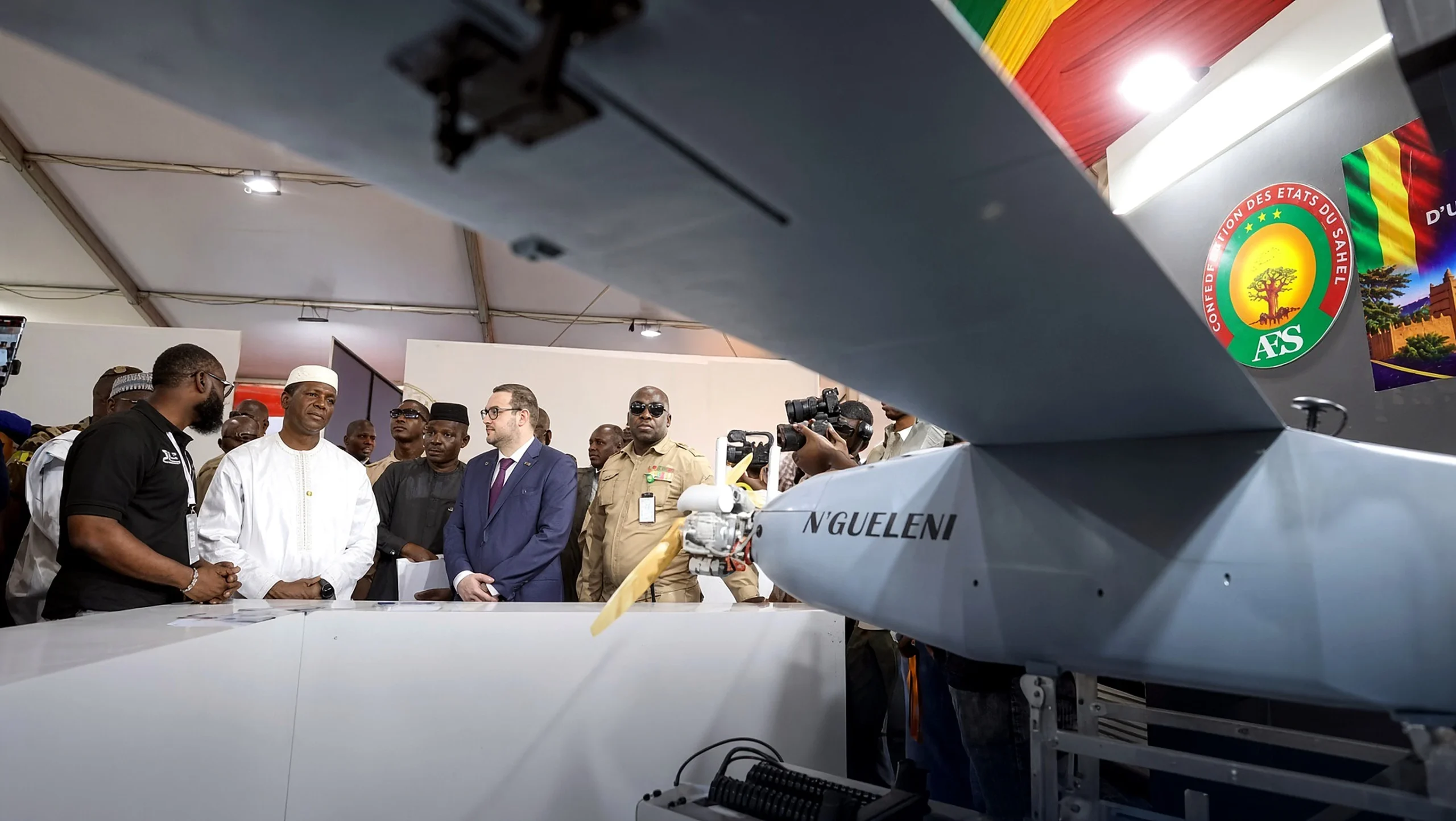
Mali shows home-built N’Gelèni drone at BAMEX 2026
Mali has put a drone of its own design on public display for the first time. The N’Gelèni, a petrol-engined fixed-wing aircraft described as designed and built in Mali, sat on the Confederation of Sahel States (AES) stand at the second Bamako International Defence and Security Exhibition (BAMEX), which ran from 9 to 13 November 2026. Malian daily L’Indicateur du Renouveau, in a report carried by Bamada.net on 12 November, said it was being shown to the general public for the first time and drew crowds of visitors.
Very little else is public. No builder, institution or programme has been named in the reports Unmanned Africa has seen, and no figures for endurance, range, payload, wingspan or ceiling have been released. Russian state broadcaster RT, in its account of the show’s closing on 13 November, called it Mali’s first locally designed drone, “entirely conceived, assembled and developed” by Malian engineers, and repeated local press praise for its endurance and payload without giving numbers. RT also said Malian media see civilian and commercial uses for the aircraft alongside military ones. Neither the Malian Armed Forces (FAMa) nor the AES secretariat has issued a statement on it.
What the photographs show
The display images released by the organisers fill in some of the gaps. The airframe is grey, with “N’GUELENI” painted on the forward fuselage, a straight wing and a two-bladed propeller driven by a piston engine at the rear in pusher configuration. That is the usual layout for tactical surveillance drones: the engine sits behind the fuselage, leaving the nose clear for a camera. No sensor turret or weapon pylon is visible in the published pictures, so whether the N’Gelèni is meant for reconnaissance only, or could carry munitions, cannot be judged from them. The aircraft was shown on a stand frame. Nothing released so far shows it flying, and BAMEX’s live demonstration day at Tanabougou has not been reported to have included it.
Petrol propulsion matters in the Sahel. Battery-powered small drones of the kind Malian units already use rarely stay up for more than an hour or two, while a two-stroke or four-stroke engine can keep a light airframe on station for several hours over terrain where bases are hundreds of kilometres apart. That is presumably what the local press meant by an autonomy “adapted” to the size of Malian territory. Until flight data is published, the claim stays a claim.
An imported fleet, a local prototype
Every armed drone Mali flies today was bought abroad. The Africa Drone Intelligence database records 62 military drones for the country: 17 Bayraktar TB2 and seven Akinci from Baykar, 12 Kub-BLA and 10 Lancet loitering munitions from Russia’s ZALA, 10 Iranian Shahed-131 one-way attack drones, and six French Hawker Q800X multirotors bought in 2014. Unmanned Africa has reported how Russia’s Africa Corps runs the long-range part of that arsenal, and how Baykar used the same show to display a KIZILELMA jet drone in Malian markings.
A home-built surveillance aircraft would not change that balance on its own. What it would give Bamako is an airframe it can repair, modify and replace without an export licence, at a time when its relations with several suppliers and neighbours are strained. Malian makers have tried before. Student and start-up projects such as the battery-powered aircraft built by the Bamako innovation group Thinking Club were pitched at FAMa patrols in 2025, but none is known to have entered service. The N’Gelèni is the first such design to appear under the AES banner at a state-organised defence show.
The timing fits the government’s line. Foreign Minister Abdoulaye Diop told Anadolu Agency at BAMEX that Mali wants technology transfer, not just equipment. “We want to acquire advanced technology and equipment, but we also want technology transfer. We want to work with partners like Türkiye to develop our own capabilities,” he said, as Military Africa reported.
A crowded hall of foreign drones
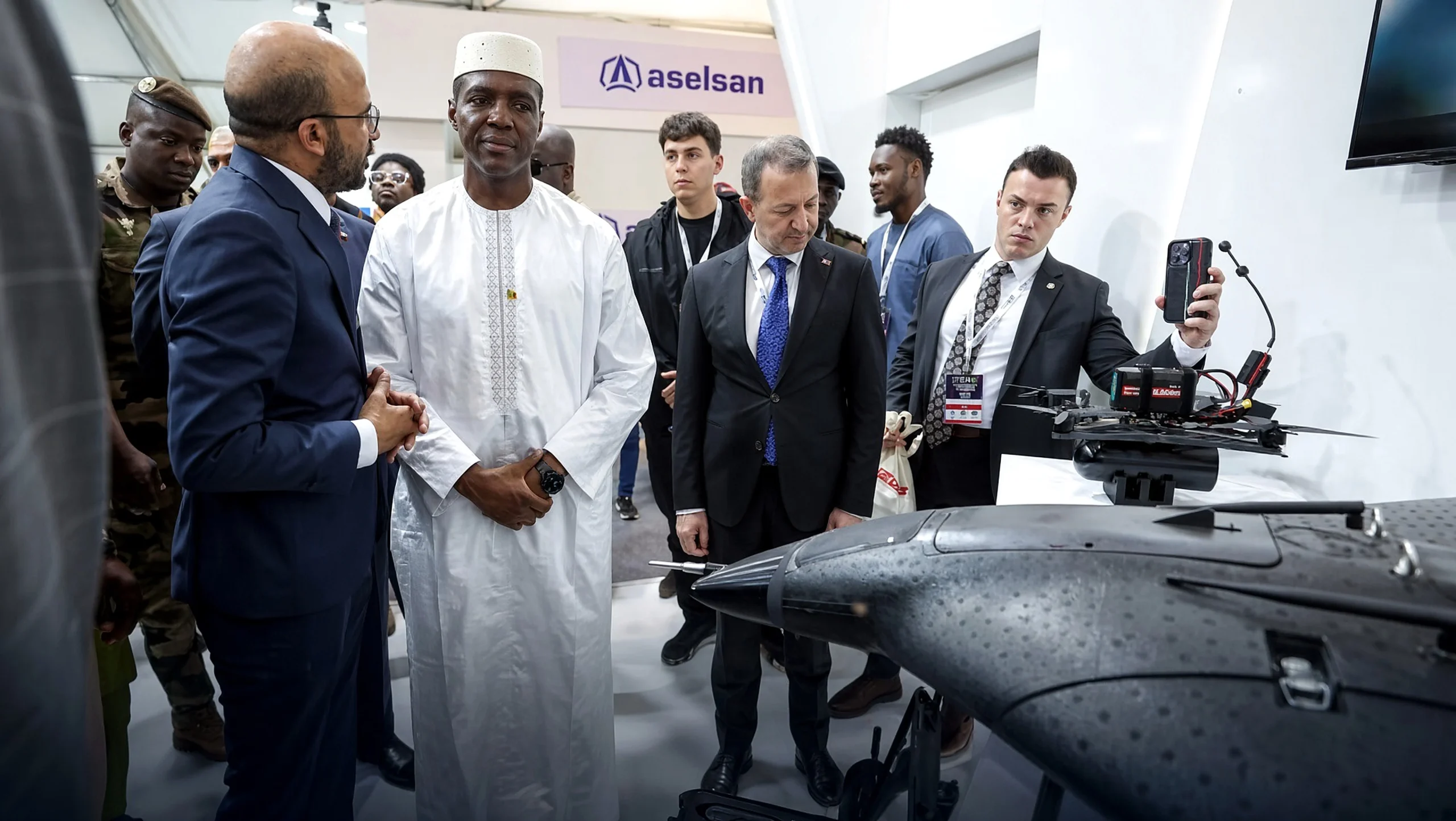
The Malian aircraft shared the hall with a large foreign line-up. Turkish firms dominated the indoor exhibition. Skydagger showed FPV strike drones, the TOYCA 05 loitering munition and the HUNTER interceptor, and Turaç brought its Drone Kalkanı counter-drone turret to Africa for the first time. BAMEX is organised by Mali’s Ministry of Defence with the Turkish company The Peak Defense.
Attendance figures differ. Mali’s Ministry of Security and Civil Protection said in its closing statement, published on 14 November, that the show brought together official delegations from 19 countries and 24 exhibiting companies. Military Africa reported at the opening that delegations from more than 40 African states had come to Bamako, and Broadcast Media Africa cited exhibitors and representatives from more than 40 countries. The gap probably reflects different counting, official delegations against all visiting countries, but the organisers have not reconciled it.
The minister, General Daoud Aly Mohammedine, closed the show at Koulikoro on 13 November. He announced that the BAMEX brand would be registered with the World Intellectual Property Organization and that the exhibition would become biennial, with the third edition set for 2028.
What would make it real
Three things would turn the N’Gelèni from an exhibit into a capability: a named developer and production site, published flight performance, and an order or trial with FAMa or another AES army. Nigeria‘s experience is the nearest regional guide. Its Air Force Institute of Technology took years to move the Tsaigumi from prototype to an inducted, if small, fleet, and did so with a foreign partner, Portugal’s UAVision. If Bamako wants the N’Gelèni to follow, the 2028 edition of BAMEX is the obvious deadline for showing it in the air.
