
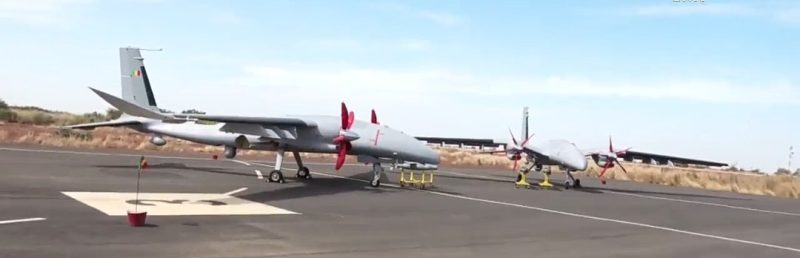
Mali security chief says Turkish drones must fill army’s manpower gap
Mali’s most senior security adviser has told Turkish state media that unmanned aircraft are the main way the country’s armed forces can cover their territory with the troops they have. Retired Major General Yamoussa Camara, permanent secretary of Mali‘s National Security Council, said securing 1.24 million square kilometres requires resources beyond what the budget-constrained military can field, and that Turkish UAVs and defence technology could raise its operational effectiveness while compensating for limited personnel. He spoke to Anadolu Agency on the sidelines of the BAMEX 2026 defence exhibition in Bamako, in remarks published on 11 November by Yeni Şafak and SSB Bülten.
Camara went further than Mali alone. Joint efforts within the Alliance of Sahel States (AES), which groups Mali, Burkina Faso and Niger, had proven insufficient for the size of the Liptako-Gourma region where the three share borders, he said, and the AES needed to pool resources and deepen its security cooperation with Türkiye.
A fleet already built on Baykar
The argument describes a force structure Mali has been assembling since 2022. The Malian Armed Forces (FAMa) showed their first two Bayraktar TB2 drones at Mopti-Sévaré in December 2022, received three more at Bamako in March 2023 and took a further batch on 4 January 2024, bringing the fleet to at least 17 aircraft, Military Africa has reported. The heavier Akinci followed from November 2024, with at least two more airframes handed over at Sévaré on 30 January 2026 and another batch on 30 July 2026, according to Military Africa. Both types come from Baykar, which at BAMEX displayed a KIZILELMA jet-powered combat drone in Malian flag markings. Unmanned Africa’s survey of Akinci operators in Africa counts Mali among eight.
Mali has also lost aircraft. Algeria said it shot down a Malian Akinci that crossed about two kilometres into its airspace near Tin Zaouatine on the night of 31 March to 1 April 2025, a claim Bamako disputed, and the incident led the AES states to recall their ambassadors from Algiers. The Turkish fleet is not the only one flying over northern Mali either: evidence compiled by Bellingcat, The Sentry and France 24 shows Russia’s Africa Corps running Mali’s long-range drone strikes with Russian Geran and Lancet munitions, a capability the Africa Defense Forum says reaches beyond the TB2’s range.
BAMEX as a Turkish sales floor
BAMEX ran from 9 to 13 November at the Bamako Exhibition Centre, organised by Mali’s Ministry of Defence with the Turkish firm The Peak Defense, and closed with equipment demonstrations at Tanabougou in the Koulikoro region on 12 and 13 November, West African Voice Network reported. Prime Minister Abdoulaye Maïga opened the show with a call for more diverse partnerships and investment in training and applied research. Exhibitors came from Türkiye, Russia, China, Germany and Sudan, but Turkish companies dominated the unmanned offer: alongside Baykar, Skydagger showed FPV strike drones, the TOYCA 05 and the HUNTER interceptor, and Turaç brought its Drone Kalkanı counter-drone turret. Skydagger told Anadolu it has delivered 75,000 kamikaze drones to more than 30 countries since 2024 and is working to set up factories in five countries, Türkiye Today reported; those figures are the company’s own and have not been independently verified.
No contract signed at the 2026 show had been announced by Saturday. Organisers had said they expected up to 500 million US dollars in business, against an estimated 150 million dollars of contracts at the first edition in 2025, according to Turdef.
What a joint AES drone effort would need
Camara’s call for pooled resources points at a gap the three juntas have not closed. Each AES member operates TB2s bought separately: Niger received six from 2022 and Burkina Faso took its first batch the same year, with a mixed TB2 and Akinci delivery reported in 2024. Operating them as a common Liptako-Gourma surveillance network would require shared ground control, intelligence fusion, maintenance and munitions stocks across three capitals, none of which has been announced. For Ankara, the message from Bamako is that the next orders are as likely to be for support, spares and integration as for more airframes, and that Turkish industry’s position in the Sahel now rests on keeping fleets it has already sold in the air.
