
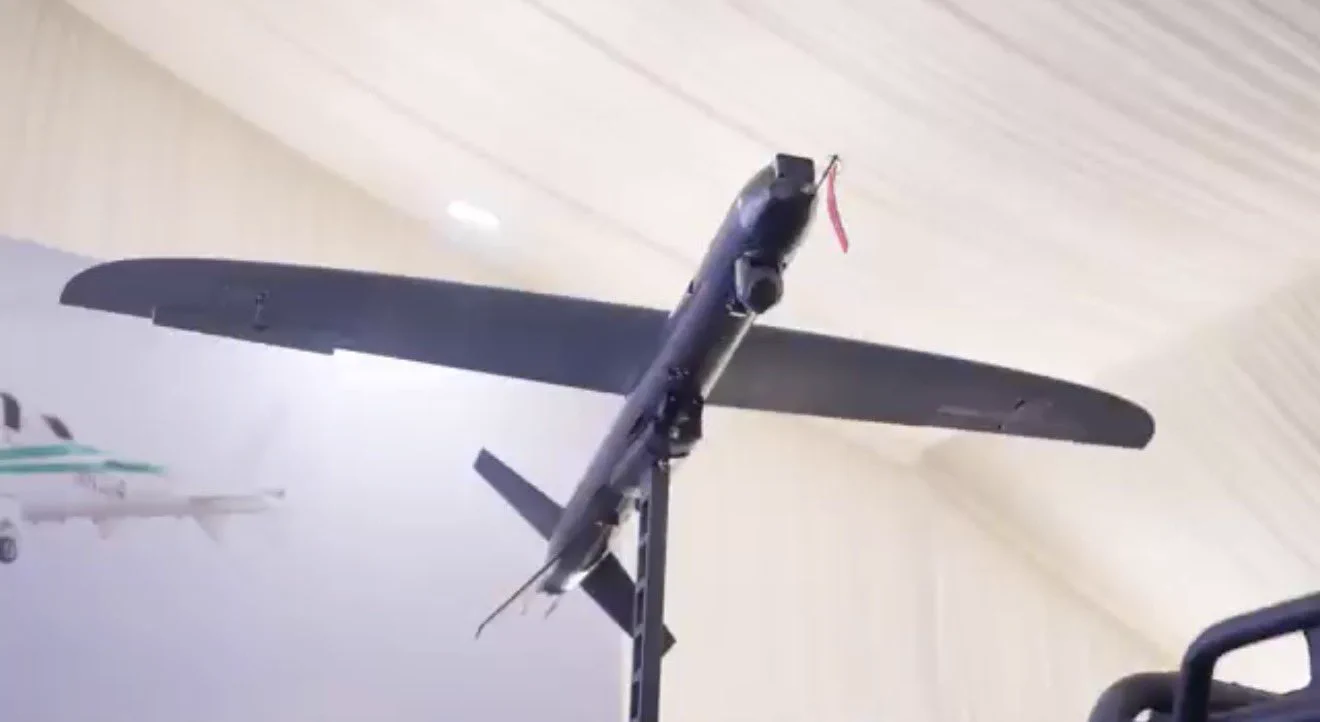
NIMASA shows BlueBird drones for Deep Blue Project at AFRIDEX
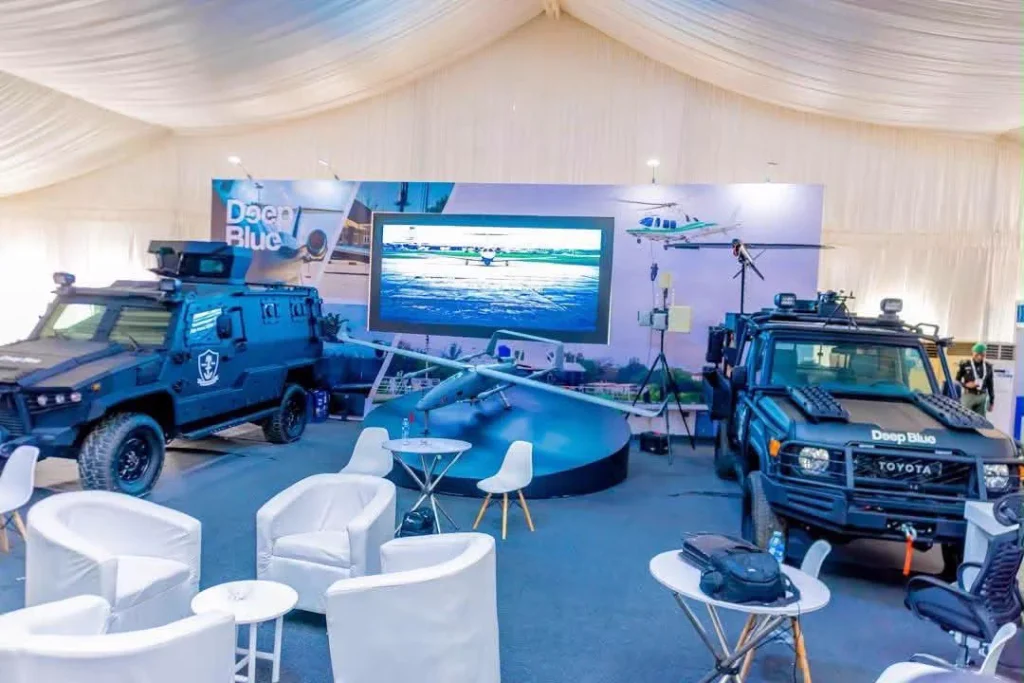
The Nigerian Maritime Administration and Safety Agency (NIMASA) showed ThunderB-VTOL and SpyX drones from Israeli manufacturer BlueBird Aero Systems at the Africa International Defence Exhibition (AFRIDEX) 2026 in Lagos, alongside newly delivered armoured vehicles and surveillance equipment for its Deep Blue Project. The ThunderB-VTOL can operate from vessels at sea and from land bases, giving the agency day and night maritime surveillance over Nigeria’s waters and the wider Gulf of Guinea.
The show, held at Eko Atlantic from 26 to 29 October, was the first public display of the new assets. The agency describes them as part of the Integrated National Security and Waterways Protection Infrastructure, better known as the Deep Blue Project, the country’s dedicated anti-piracy and maritime security programme.
ThunderB-VTOL: a drone that flies from ships
The ThunderB-VTOL is a hybrid fixed-wing drone that takes off and lands vertically like a multirotor and then flies on its wings for range and endurance. According to BlueBird Aero Systems, it can stay airborne for more than 12 hours and has a communications range of up to 150 kilometres using a digital data link and tracking antenna. It carries stabilised day and cooled infrared sensors for intelligence, surveillance, target acquisition and reconnaissance (ISTAR), with a modular payload bay that can also take mapping cameras. Industry listings give a maximum take-off weight of 45 kilograms and a top speed of 120 km/h.
Vertical take-off is what makes it useful at sea. The ThunderB-VTOL needs no runway, catapult or recovery net, so it can launch from a ship’s deck or from a confined patch of ground ashore. BlueBird says control can be handed from a shore station to a ship at sea, which lets a drone launched from the coast be taken over by a patrol vessel further out. For an agency that must watch oil platforms, anchorages and shipping lanes far offshore, a drone that can stay up for half a day and launch from a vessel extends what one ship can see.
SpyX loitering munition
NIMASA also displayed the SpyX, a small loitering munition that BlueBird unveiled at the Paris Air Show in 2023. The SpyX weighs about 10 kilograms at launch, is fired from a pneumatic catapult and can fly for up to 1.5 hours with a range of about 50 kilometres, according to European Defence Review. It carries a 2.5-kilogram warhead, either a shaped charge against armoured targets or a high-explosive fragmentation charge against personnel, which is fitted just before launch, and dives on its target at up to 250 km/h. It can loiter until a target is found, or work alongside a surveillance drone such as the ThunderB that finds and designates targets for it.
NIMASA has not said whether it has acquired the SpyX or how it would be used. Its presence on the stand points to a possible strike option against pirate craft or illegal bunkering boats, which would mark a new step for an agency whose drones have so far been used for surveillance. BlueBird, a subsidiary of Israel Aerospace Industries (IAI), already builds the SpyX in Morocco, where it opened a production line, giving the system an African foothold.
Armoured vehicles and a piracy drill
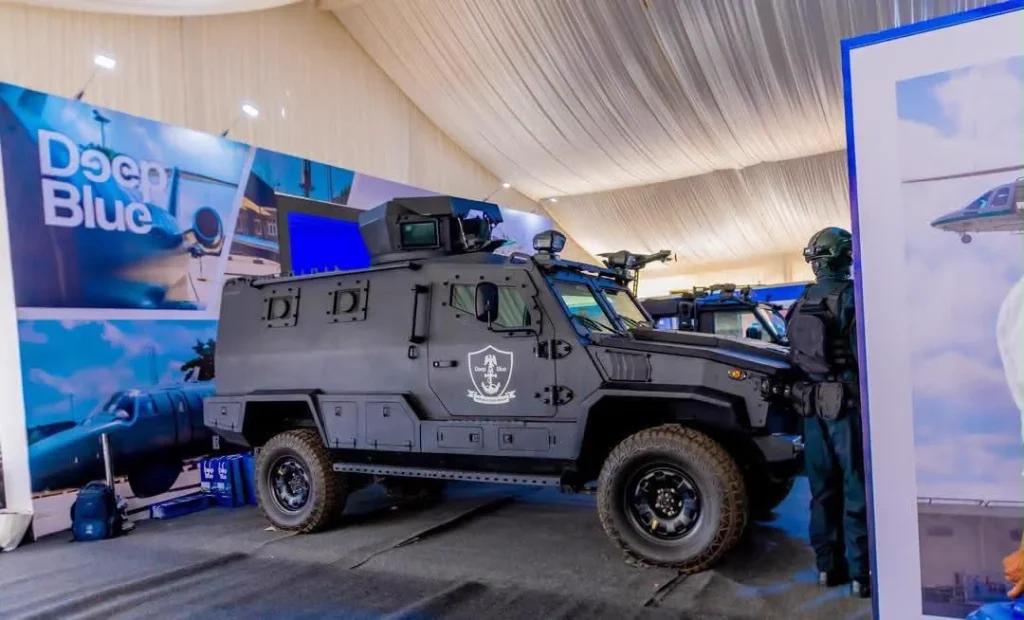
The stand also showed a new Deep Blue armoured vehicle carrying a roof-mounted remote surveillance turret, and a Toyota Land Cruiser patrol vehicle fitted with a mast-mounted sensor and a small drone, built for land-based operations along the coast and in the creeks. The project’s technical partner, Homeland Security International (HLSI), said the assets also include upgraded intelligence systems that improve cargo monitoring and information sharing between NIMASA and other agencies. HLSI chief executive Tal Spektor said the equipment must be upgraded regularly to keep pace with new threats, and that maritime security has to reach beyond the sea, because illegal activity offshore is often run from land.
On the sidelines of the show, NIMASA staged a simulated pirate attack and hostage rescue using Nigerian Navy Air Arm crews and Special Boat Service troops. In the scenario, the security vessel DB Abuja launched a drone as the first stage of its response, for aerial surveillance and threat assessment, before the boarding team moved in. Defence Minister General Christopher Musa (retd) visited the Deep Blue stand and watched the simulation.
Five years of Deep Blue
President Muhammadu Buhari launched the Deep Blue Project in June 2021, with $195 million of equipment supplied through HLSI. The original package comprised two special mission vessels, 17 fast interceptor boats, two special mission aircraft, three special mission helicopters, four unmanned aerial vehicles and 16 armoured vehicles, run from a command and control centre in Lagos and crewed by a 600-strong Maritime Security Unit drawn from the armed forces and police.
The new drones and vehicles are the first major refresh of that fleet. NIMASA Director-General Dr Dayo Mobereola, represented by the head of the Deep Blue Unit, Aisha Yakubu Idris, said the assets would strengthen the project’s sustainability and give deployed personnel the equipment they need to fight piracy. Idris said Nigeria “would not rest on its oars in sustaining zero tolerance for illegal activities in its waters”.
The Minister of Defence, General Christopher Gwabin Musa (rtd) was one of the dignitaries who visited the NIMASA Deep Blue Stand and also took time to witness the tactical simulation of piracy attack in Nigeria waters by the Deep Blue Project.
The Director-General, NIMASA Dr Dayo Mobereola, noted that these newly acquired assets are to strengthen the sustainability of the Deep Blue project and ensure that the military personnel deployed under the project have enough equipment to sustain the fight against piracy in Nigerian waters.
The Director-General, who was represented by the Head of the Deep Blue Unit, Aisha Yakubu Idris, noted that Nigeria would not rest on its oars in sustaining zero tolerance for illegal activities in its waters.
On his part, Tal Spektor, CEO HLS International, who are the technical partners of the Deep Blue Project, stressed the need for regular upgrades of assets to tackle evolving maritime threats. He added that maritime security must extend beyond the sea, noting that illegal offshore activities often have links to land-based operations
Keeping pirates off the Gulf of Guinea
The Gulf of Guinea was once the world’s worst piracy hotspot, and reported attacks off Nigeria have fallen sharply since Deep Blue entered service, alongside a stronger Nigerian Navy and regional cooperation under the Yaoundé Code of Conduct. Persistent drone cover is what keeps that pressure on: a ThunderB-VTOL launched from a patrol vessel can watch a wide stretch of sea through the night and cue interceptor boats before pirates reach a ship. How many ThunderB-VTOLs NIMASA has received, whether the SpyX is on order, and how quickly the new assets are integrated with the Navy’s own drones will show how far the second phase of Deep Blue extends Nigeria’s reach offshore.
