
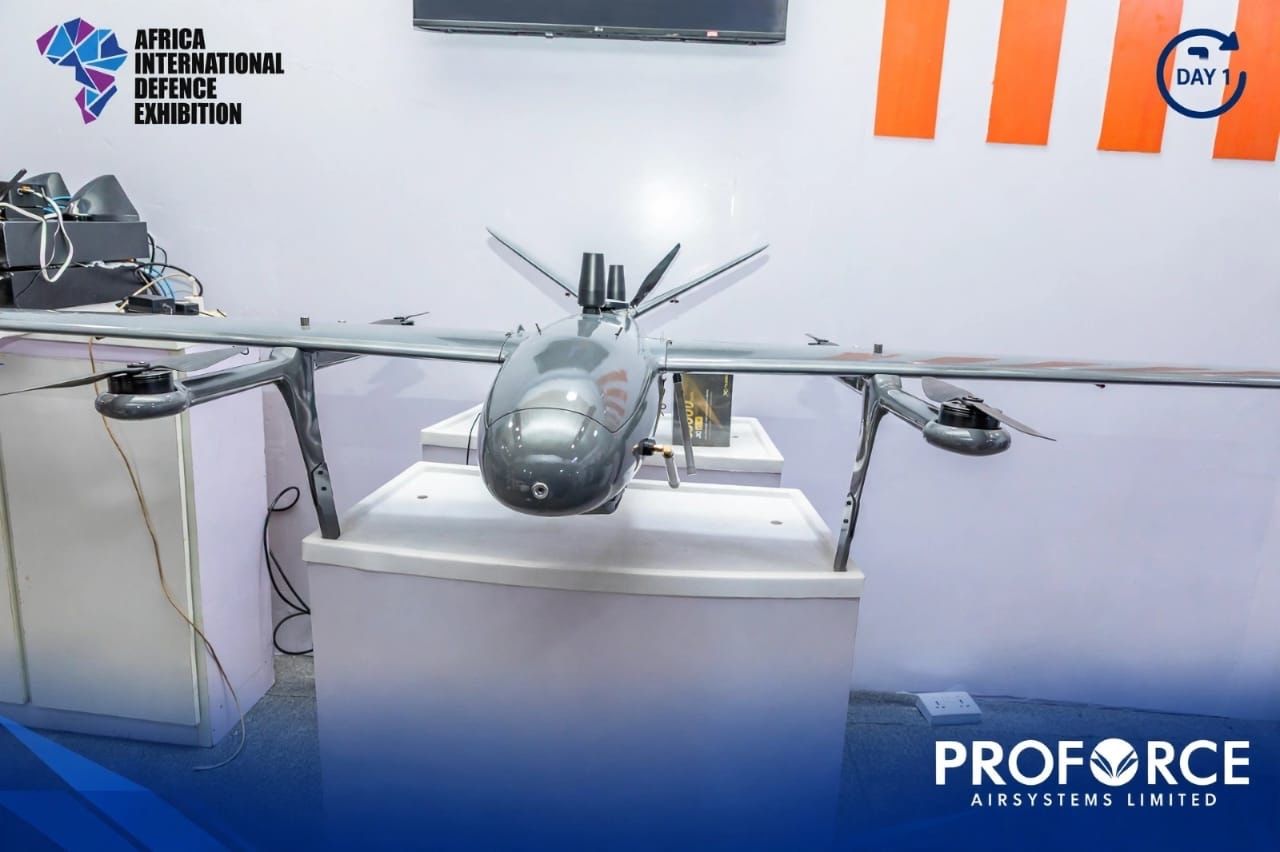
Proforce Air Systems shows drone line-up at AFRIDEX 2026
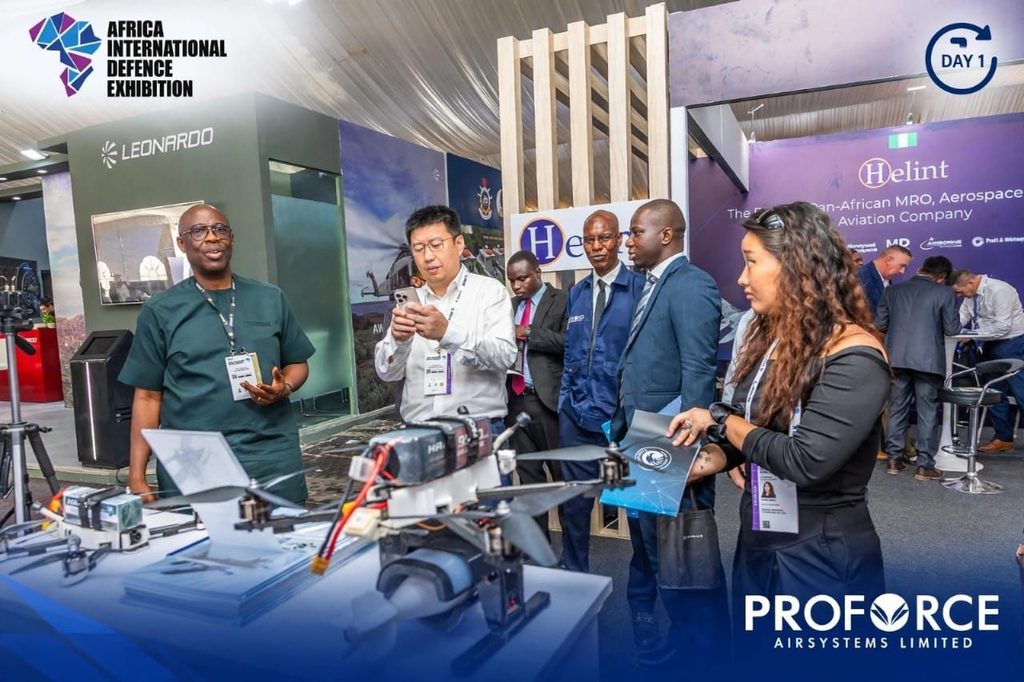
Nigerian drone maker Proforce Air Systems showed its unmanned aircraft at the Africa International Defence Exhibition (AFRIDEX) 2026, held at Eko Atlantic, Lagos, from 26 to 29 October. The company presented the PF Hornet intelligence, surveillance and reconnaissance (ISR) drone, the PF Meteor 2 attack drone and the PF Echo mine detection drone, together with the Oculus, a stabilised camera payload for drones.
Proforce Air Systems is the aviation arm of Proforce Limited, the Ogun State-based defence manufacturer incorporated in 2008 as a subsidiary of O’la-Kleen Holdings. The group’s other subsidiaries include Proforce Land Systems, Proforce Intelligence Systems, Deto Shipyards, WMO Gadgets and Proforce Galaxies, with facilities in Nigeria, Dubai and India. At AFRIDEX the drones sat alongside the group’s new PF Terminator mine-resistant ambush-protected (MRAP) vehicle and WMO Gadgets body armour.
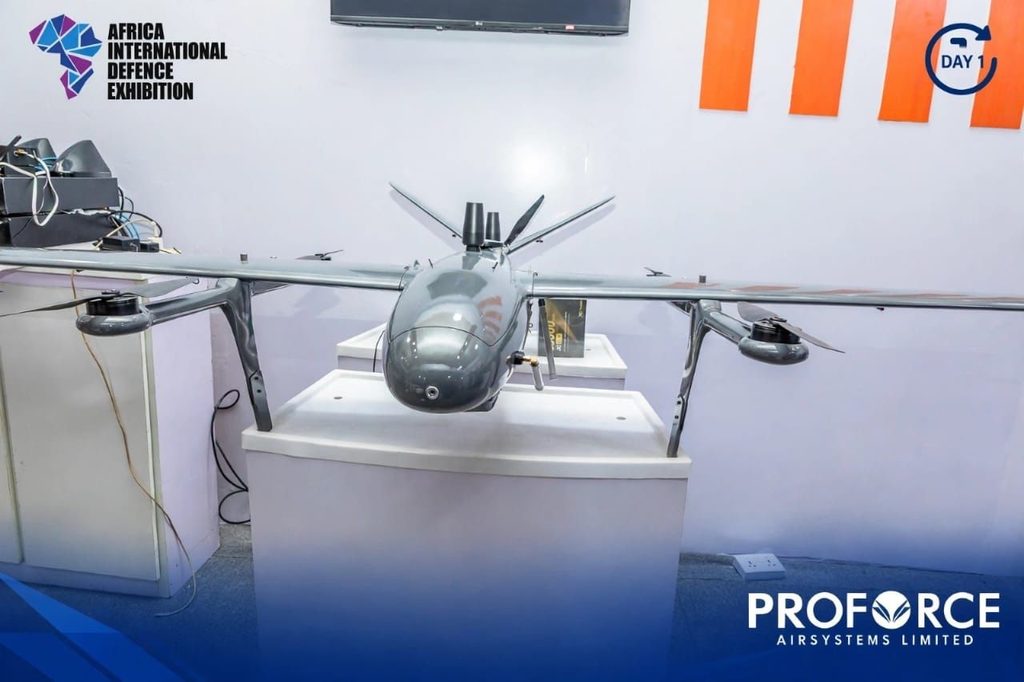
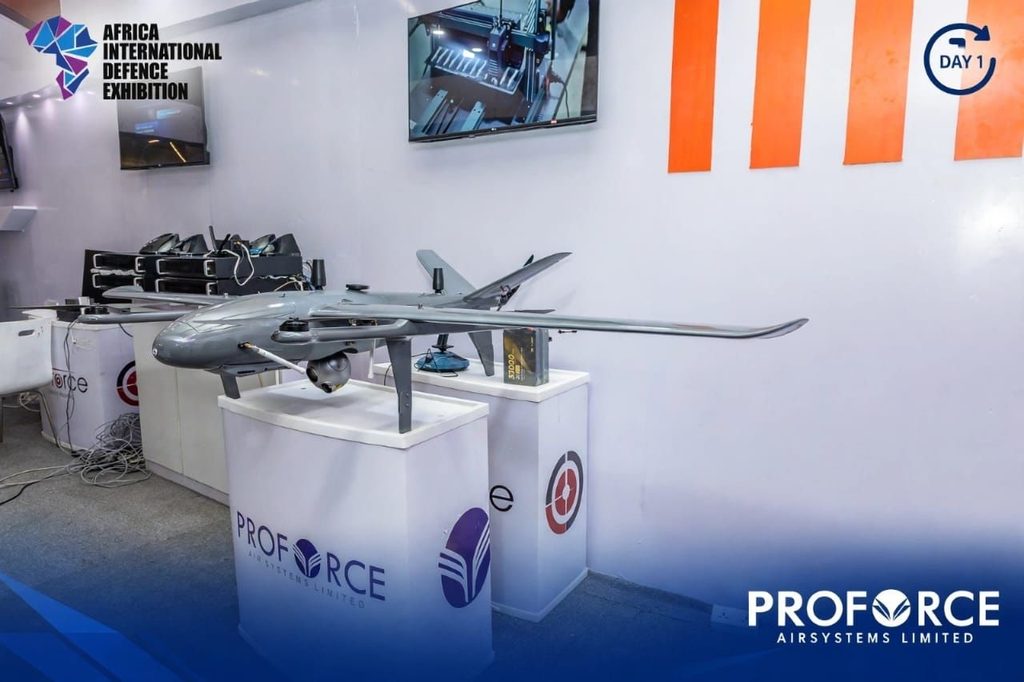
PF Hornet: fixed-wing reconnaissance
The PF Hornet is an electrically powered fixed-wing drone for tactical reconnaissance and surveillance, border and perimeter monitoring, long-range intelligence gathering and the protection of infrastructure and critical assets. According to Proforce Air Systems’ specifications, it has a wingspan of 3.91 metres, a length of 1.92 metres and a maximum take-off weight of 34 kilograms, of which the airframe without batteries or payload accounts for 16 kilograms.
Endurance depends on the load carried: the company quotes 3.5 hours with a 2-kilogram payload, two hours with 6 kilograms and 90 minutes with the suggested maximum payload of 10 kilograms. Power comes from three or four 12S 33Ah lithium battery packs, depending on payload. The Hornet cruises at 75 to 90 kilometres per hour, has a top speed of 120 km/h and a stall speed of 57.6 km/h, can fly in winds of up to 43.2 km/h and operates up to 4,500 metres above sea level, high enough for the Jos Plateau and the mountainous borderlands of East and Central Africa.
PF Meteor 2: a first-person-view strike drone
The PF Meteor 2 is a 10-inch first-person-view (FPV) drone, the larger sibling of the 7-inch PF Meteor 1. Proforce Air Systems lists a load capacity of 4.5 kilograms, a top speed of 100 km/h, a flight time of 35 minutes, a range of 40 kilometres and a flight ceiling of 3,000 metres. It runs on a six-cell (6S) lithium polymer battery and uses an ExpressLRS (ELRS) control receiver, GPS and horizontal stabilisation, with HD video and what the company describes as protection against electronic warfare equipment.
Proforce markets the Meteor 2 as an attack drone. Cheap FPV drones carrying explosive charges have become one of the defining weapons of the war in Ukraine, and they are now spreading to African battlefields, used by state forces and armed groups alike. A locally built FPV platform gives Nigerian units an option that does not depend on imported kits. Its range figure is well beyond what most FPV drones achieve on direct radio links, and how it holds up against jamming will be the main test for buyers.
PF Echo and the Oculus camera
The PF Echo is a mine detection drone. Proforce has not published its specifications, but airborne mine and improvised explosive device (IED) detection lets troops survey a route or area from above before vehicles or foot patrols enter it. Roadside IEDs have long been a threat to Nigerian troops and civilians in the North-East, and to forces across the Sahel and Lake Chad Basin.
The Oculus is Proforce’s precision camera payload for drones, which the company says sees farther, tracks smarter and keeps every mission safer. It weighs 1.39 kilograms and combines a 30x optical zoom day camera with infrared (IR) vision for night and low-visibility work, a laser rangefinder that measures distance out to 3 kilometres, and object tracking that locks the camera onto a selected target. A laser rangefinder lets an operator work out a target’s position as well as see it, which matters for directing fire or handing a target to another unit.
A wider range built in Nigeria
The four products shown in Lagos are part of a broader catalogue. Proforce Air Systems also lists the PF Eagle 3 hybrid vertical take-off and landing (VTOL) drone with 3 hours 20 minutes of endurance, which secured a local customer in 2024, as well as the PF Maximus and PF Warhawk heavy-lift drones, the PF Mantis and PF Archer multirotors, the PF Arkanos hybrid drone and the 7-inch PF Meteor 1 FPV drone.
The parent group has built its reputation on armoured vehicles, from the Ara MRAP sold to Nigeria and Chad to the PF Hulk bought by the Nigerian Army, and the Nigerian Army holds a 15 per cent stake in the company. It is now looking beyond Nigeria: earlier this month Proforce proposed a defence manufacturing and assembly facility in the Central African Republic. Proforce was one of several Nigerian firms offering unmanned systems at AFRIDEX, where the Arridex Group unveiled its ADX-Barra 200 unmanned boats.
Locally built drones for the North-East and beyond
Drones are now part of the threat as well as the response in Nigeria. Islamic State West Africa Province (ISWAP) first used armed drones against a Nigerian Army base at Wajiroko, Borno State, in December 2024, as Military Africa set out in Africa’s counter-drone imperative. A domestic supplier that can offer reconnaissance, strike and route-clearance drones, maintain them in-country and adapt them to feedback from the units using them fits the self-reliance message President Bola Tinubu delivered at the show. Whether the Hornet, Meteor 2 and Echo win orders from the Nigerian Armed Forces or from export customers such as Chad and the Central African Republic will show how far Proforce can carry its armoured vehicle success into the air.
