
Sudan’s Drone War Between the SAF and RSF
Few African wars have produced a shootdown record as detailed as Sudan’s. The Sudanese Armed Forces (SAF) and the Rapid Support Forces (RSF) have traded claims of downed drones from January 2024, when a Mohajer-6 fell to a shoulder-fired missile, to July 2026, when a purpose-built air-to-air loitering munition caught a strategic drone. Put together, that record shows how the war has changed. An improvised response to an unfamiliar threat has become, on both sides, a dedicated counter-drone effort with its own tactics, losses and disputed claims.
The war behind the shootdowns
Now in its fourth year, the war between the SAF under General Abdel Fattah al-Burhan and the RSF under Mohamed Hamdan Dagalo, known as Hemedti, cost the army Khartoum until it retook the capital in 2025. It cost the people of El Fasher an atrocity that a UN-mandated inquiry said bore the hallmarks of genocide, after the city fell to the RSF in October 2025 at the end of an 18-month siege. A Sudanese court sentenced Hemedti to death in absentia in July 2026. Fighting has continued across the Kordofan states and, in August, into Blue Nile state.
Unmanned Africa has covered the spread of long-range strike drones on both sides separately, along with the FPV kamikaze drones both armies increasingly use at close range. This piece looks at the other side: what has been shot down, by whom, and what the losses say about how the air war is fought.
Who is flying what
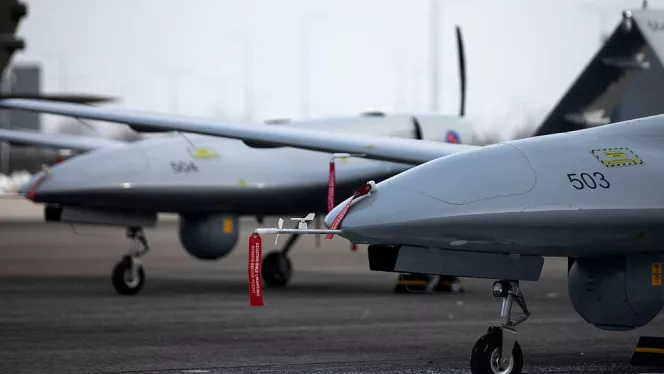
Sudan’s drones come from an unusually wide range of suppliers. The SAF flies Iranian Mohajer-6s, first confirmed by satellite imagery at Wadi Sayyidna air base north of Khartoum in January 2024, along with Turkish Bayraktar and AKINCI aircraft and its own locally assembled Safrouq loitering munition. The RSF, backed financially and materially by the United Arab Emirates according to UN reporting, flies Chinese systems: the CH-95, also sold as the FH-95, a medium-altitude long-endurance drone from Aerospace Times Feihong Technology, and Sunflower-200 and ZT-180 loitering munitions.
Both sides have also bought ground-based air defence aimed at the other’s aircraft. The RSF has Chinese FK-2000 gun-missile systems and FB-10A short-range missiles. The SAF has a Turkish HISAR-A radar and Roketsan EREN interceptor munitions.
The RSF’s claims, 2024 to 2026
The RSF started claiming kills almost as soon as the SAF’s Iranian drones arrived. On 6 January 2024, RSF-linked fighters posted photographs on Telegram of wreckage they said came from a Mohajer-6 downed over Khartoum with man-portable air defence systems (MANPADS). Human Rights Watch later reviewed the imagery and found it consistent with Mohajer-6 debris. A second claim followed within days and a third, over Omdurman, by late January, just as satellite images confirmed Mohajer-6 airframes and a ground control vehicle at Wadi Sayyidna. The losses did not neutralise the type. Radio Dabanga’s sources credited Iranian drones as a “decisive factor” when the SAF retook Omdurman’s national radio and television headquarters that April.
The claims picked up again in the second half of 2025, now against Turkish drones. RSF units said they downed an AKINCI over El Fasher, North Darfur, on 10 July 2025; two more over Nyala, South Darfur, on 24 and 26 August; a fourth over Marshang, South Darfur, on 4 September; a fifth over Al Khoei, West Kordofan, on 13 September; a sixth near El Fasher on 7 October; and a Bayraktar of unspecified type over Abu Quaoud, West Kordofan, on 10 December. The RSF’s 46th Group claimed another AKINCI near Dilling, South Kordofan, on 24 January 2026.
Open-source trackers urge caution. Several of these kills were probably made by Chinese FK-2000 or FB-10A systems, not the rifle and machine-gun fire RSF fighters are so often filmed aiming at falling drones for the cameras. Some losses may also reflect SAF crews still learning a new aircraft rather than any RSF breakthrough.
The SAF’s kills: purpose-built interceptors
The SAF’s confirmed kills are more recent, mostly in 2026, and increasingly credited to dedicated interceptors. Sudanese officials say army air defences used Roketsan EREN high-speed loitering munitions, 35-kilogram weapons with a 100-kilometre range built to catch slower aircraft, to down at least three RSF drones earlier in 2026: two AKINCIs the army says the RSF flew with UAE backing from Bahir Dar airport in neighbouring Ethiopia, and one CH-95.
On 2 July 2026, SAF air defences downed an FH-95 over Tendalti in White Nile State and released footage of the kill. Five days later, the SAF used a Bayraktar AKINCI as an air-to-air platform to shoot down another CH-95 on the export road between Bara and Omdurman, its fourth confirmed drone-on-drone kill of the year. In August the pace rose again: officials reported two more FH-95s downed on 17 August alone, over Jureijikh and near Bara in North Kordofan. The army says that makes seven RSF drones destroyed in the wider Kordofan region since June.
Going after the air defences
The shootdowns are only part of a wider fight over air defence itself, and that fight may have mattered more. According to ACLED’s tracking of the air war, the SAF went after the RSF’s deployed FK-2000 batteries, destroying at least seven between August 2025 and February 2026 and weakening the RSF’s ability to hit army aircraft.
The RSF found a gap of its own. Having worked out that the army’s Turkish HISAR-A radar could not reliably detect high-flying drones, it destroyed a HISAR-A in North Kordofan on 21 May 2026, then struck Khartoum ten times that month, hitting the airport and destroying SAF air defence positions there. Each side has put as much effort into wrecking the other’s ability to shoot down drones as into shooting drones down.
The civilian cost
The UN has started to put numbers on what this costs civilians. The UN High Commissioner for Human Rights condemned a “sharp increase” in drone warfare in June 2026 and estimated that drone attacks killed more than 1,000 civilians in the first five months of the year. In February 2026, an RSF drone strike on a convoy of displaced families near Rahad, North Kordofan, killed at least 24 people, eight of them children, according to the Sudan Doctors Network, which called the attack on a clearly marked aid convoy a breach of international humanitarian law.
In late January 2026, a day after the SAF said it had broken a nearly two-year RSF siege of Dilling in South Kordofan, an RSF drone strike hit the town’s market and the headquarters of the SAF’s 54th Brigade, killing dozens. The drones doing most of the damage are the ones that get through, not the ones shot down.
No air superiority, but a doctrine
Neither side is anywhere near air superiority. The tally above, compiled from RSF and SAF statements, open-source trackers and monitors including ACLED and Human Rights Watch, almost certainly undercounts, since so much of this war happens far from independent eyes. Both sides have had about three and a half years to adapt, and both have turned an improvised response into something close to a counter-drone doctrine. They are shooting down more aircraft than ever. The number in the sky is still rising faster.
