
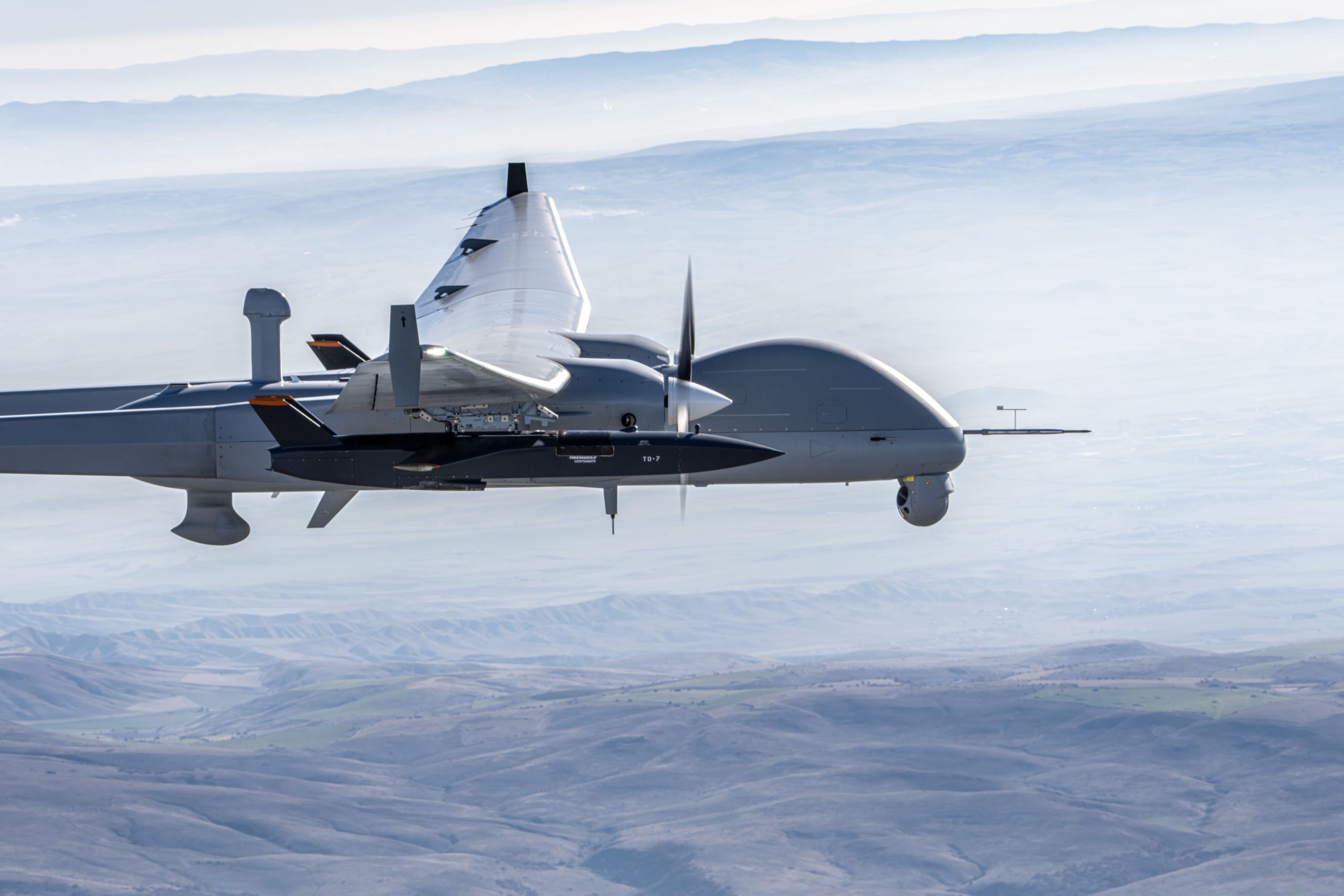
Turkish Aerospace’s ANKA and Aksungur reach six African air forces
Turkish Aerospace Industries, the state-owned maker known as TAI or TUSAŞ, has sold 34 drones to six African buyers in eight deals since 2020, the Africa Drone Intelligence database shows. Twenty-two are the ANKA-S, the satellite-linked version of its Anka, and 12 are the larger twin-engine Aksungur.
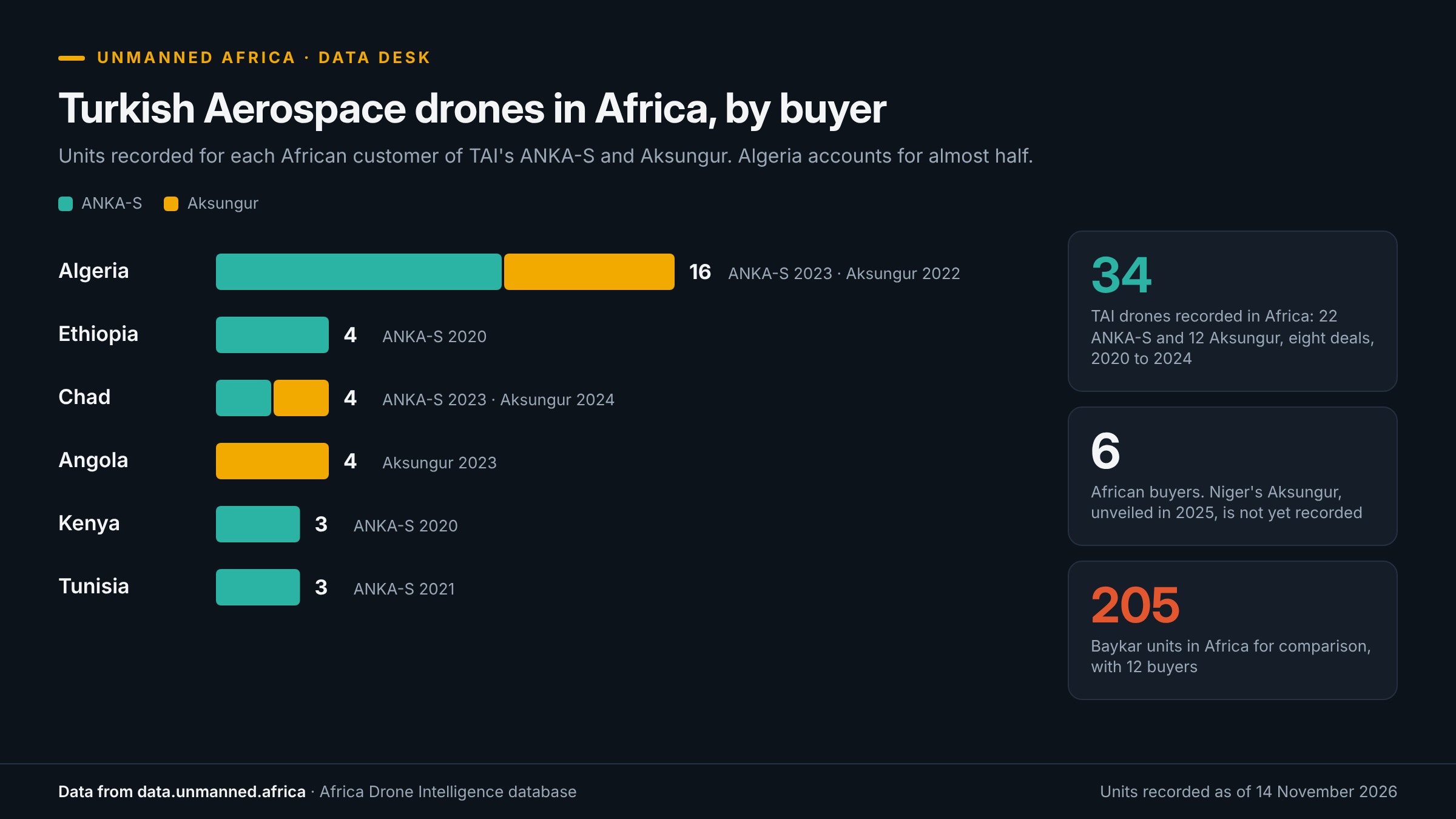
The buyers are Algeria, Tunisia, Chad, Angola, Ethiopia and Kenya. Algeria is by far the largest, with 16 units: six Aksungur in 2022 and 10 ANKA-S in 2023. No other customer has more than four.
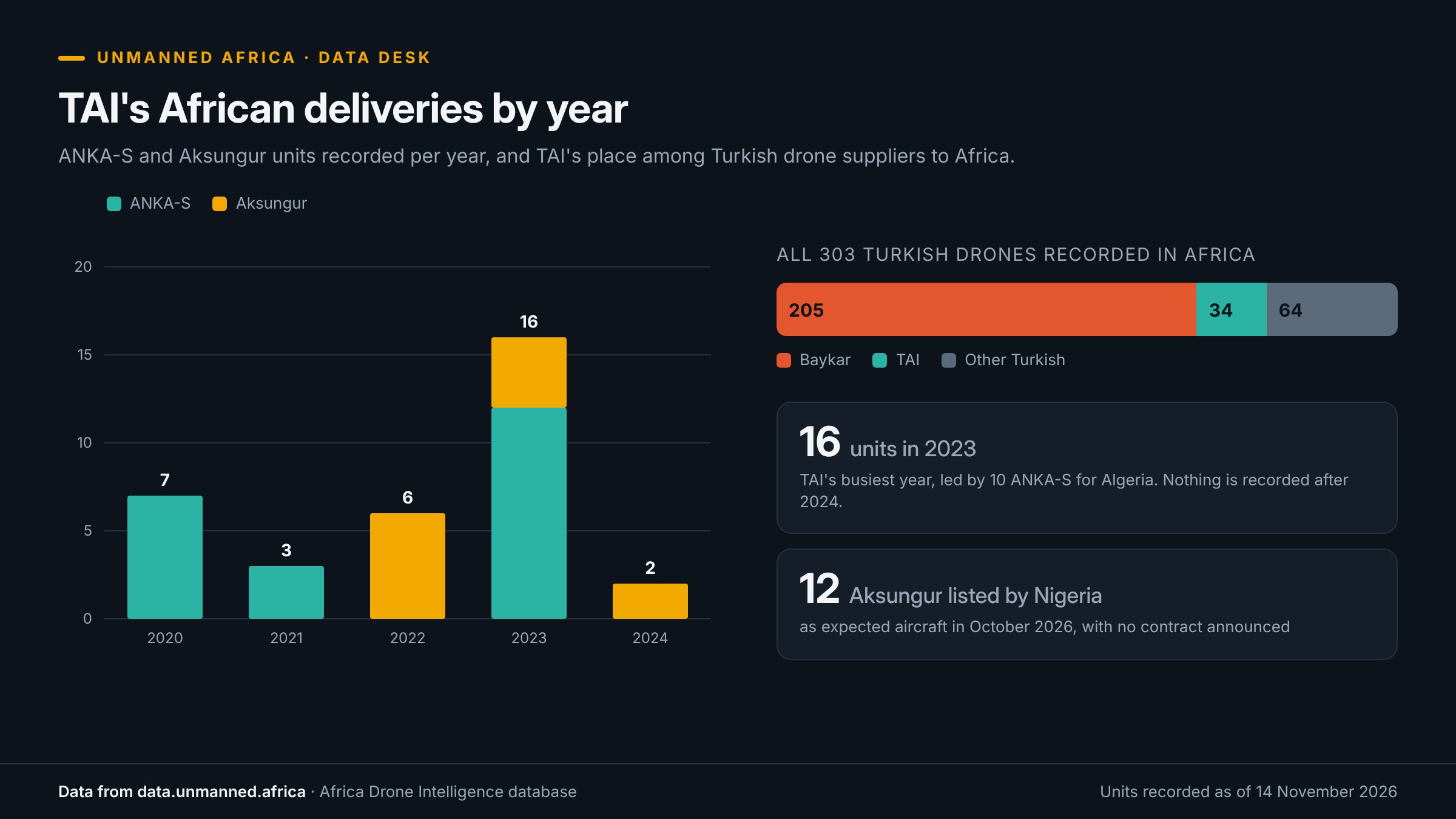
Set against Baykar the numbers are modest. Baykar has 205 recorded African units across 20 deals and 12 buyers, six times TAI’s volume. Together the two firms account for 239 of the 303 Turkish drones in the database. TAI’s share is about one in nine.
Six buyers, uneven paper trails
The order book came in a burst. Seven units in 2020, three in 2021, six in 2022, then 16 in 2023, the busiest year, and two in 2024. Nothing is recorded since.
Tunisia is widely reported as the ANKA’s first export customer, which sits awkwardly with the database’s earlier 2020 entries for Ethiopia and Kenya. Its deal is also the most confused. Defense News reported in March 2020 that Tunisia was buying six ANKA-S with three ground stations for about $240 million, citing industry sources. Overt Defense later put the original order at three drones for about $80 million, with training for 52 Tunisian personnel, and said two more were confirmed in 2023, for five in all. The database now records three, dated 2021, after cutting the entry from six in its latest update. Unmanned Africa has not been able to confirm the two later aircraft independently.
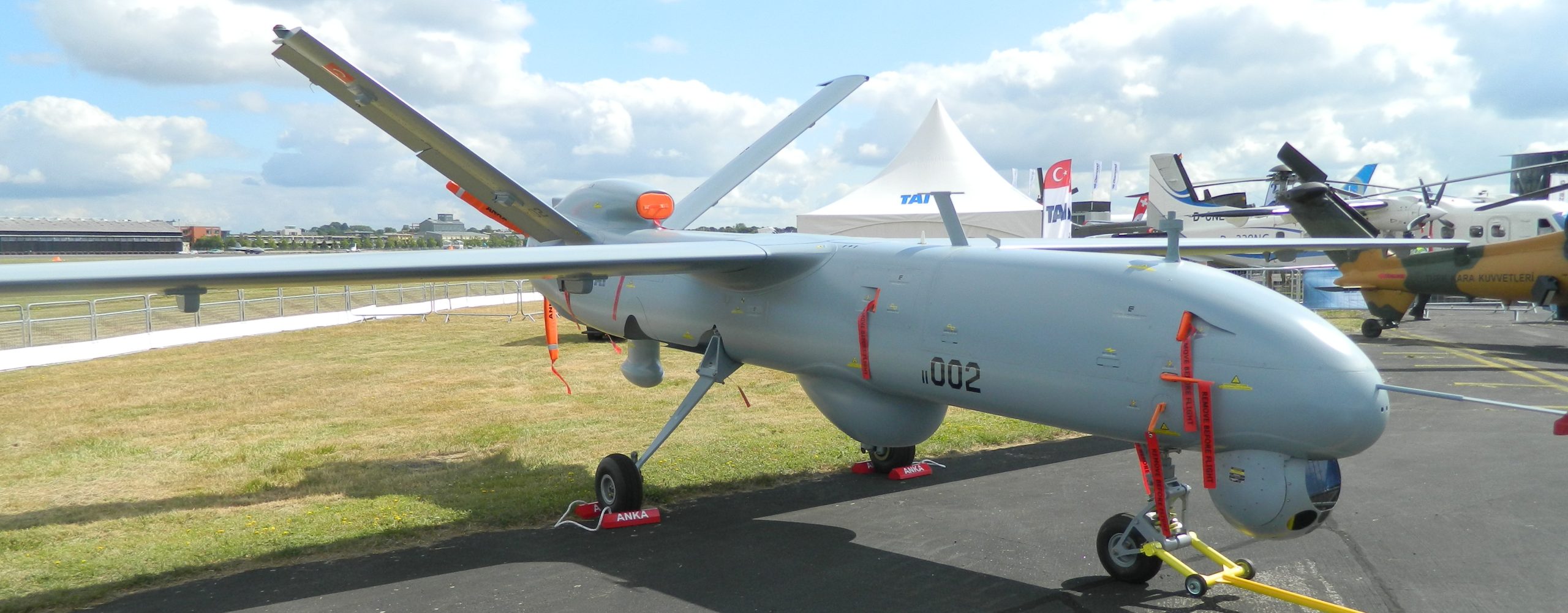
Algeria and Chad bought together. MilDefin reported on 25 February 2023 that Algeria had ordered 10 ANKA and Chad two after IDEX 2023 in Abu Dhabi, alongside 12 for Indonesia, a package it valued at more than $500 million. Both figures match the database. Algeria’s six Aksungur were first reported by Algerian media in October 2022, Shephard said at the time. Algeria has not confirmed them.
Rivalry shapes the choice. Algeria went to TAI, not Baykar, while its neighbour Morocco holds 13 TB2s and 12 Akincis from Baykar, according to the database. The two governments have built their fleets from largely separate supplier lists, and TAI gave Algiers a Turkish option that its rival was not flying.
Chad is the best documented operator. It displayed two ANKA drones alongside three Hürkuş-C light attack aircraft at Adji Kossei air base in N’Djamena in 2023, Overt Defense reported, and unveiled an Aksungur armed with MAM-L munitions in April 2024. The database records two of each. Timing helped. Chad ended its defence cooperation agreement with France in late 2024, and French forces handed over their last base in January 2025, leaving N’Djamena to replace French air support with aircraft of its own. Chad has since added Chinese Rainbow CH-4 drones, first seen at Abéché, as Unmanned Africa reported in Chinese CH-4 Drones spotted in Abéché, Chad.
Angola is the furthest south. Its interest surfaced during President João Lourenço’s talks with Recep Tayyip Erdoğan in October 2021, and the database records four Aksungur for 2023. Unmanned Africa reported in October that a 2022 presidential order authorised about $93.1 million for Turkish drones through the state importer Simportex, but that public information does not conclusively show the aircraft in Angolan service. Angola is better described as a buyer than a confirmed operator.
The two East African entries are the thinnest. The database lists four ANKA-S for Ethiopia and three for Kenya, both in 2020. Unmanned Africa found no official confirmation of either, and both countries are better known for Baykar aircraft: Ethiopia for its TB2 and Akinci, Kenya for the five TB2s it took in 2024, covered in Kenya’s drone fleet turns from American to Turkish suppliers.
The Aksungur’s niche
The Aksungur is the bigger aircraft and the one gaining customers. TAI lists a wingspan of about 24 metres, a maximum take-off weight of 3,300 kg, more than 750 kg of payload and up to 50 hours aloft without weapons, falling to about 12 hours with a full load at 25,000 feet. Two PD-170 diesel engines drive it. That puts it well above the Bayraktar TB2, which carries about 150 kg, though below Baykar’s Akinci, which now flies with eight African operators according to Unmanned Africa’s survey.
Algeria pairs it with Chinese Wing Loong II and Emirati Yabhon drones. Price and conditions help, too. Turkish suppliers have sold armed aircraft to African governments with fewer strings than Western rivals, a pattern Unmanned Africa examined in Dominance of China and Turkey in Africa’s military UAV market.
Customers the database has not caught
The list is already out of date. Niger unveiled an Aksungur at a ceremony at Niamey airport on 29 September 2025, led by the defence minister, General Salifou Mody, after 12 personnel trained in Turkey, Army Recognition reported. The acquisition was first made public in April 2025. Human Rights Watch, investigating a drone strike in Niger, said in February 2026 that the military had reportedly acquired the TB2, the Karayel-SU and the Aksungur, and that it could not identify which type carried out the strike. The database’s Niger page shows a TB2, a Karayel-SU and French Delair drones, but no Aksungur. Add Niger and TAI has seven African customers.
Nigeria may be next. The Nigerian Air Force listed 12 Aksungur among its “additional expected aircraft” on 25 October 2026, with no contract or delivery date announced. Twelve aircraft would make Nigeria TAI’s largest Aksungur customer in Africa by a wide margin, and would sit on top of the 43 TB2s the database already credits to it.
What to watch
Whether TAI closes the gap with Baykar depends on a signed Nigerian contract for the 12 Aksungur, a database entry and a count for Niger’s aircraft, and a straight answer on Tunisia’s fleet, where three, five and six aircraft have all been reported for one programme. For now Baykar has sold six drones in Africa for every one of TAI’s. Unmanned Africa follows the type on its Aksungur tag.
