
Sudan’s army traded Iranian drones for Turkish as RSF bought Chinese
Sudan’s two warring forces have armed themselves from opposite ends of the drone market. The Africa Drone Intelligence database records 63 drones for the Sudanese Armed Forces in 12 deals between 2008 and 2025, and 39 for the Rapid Support Forces in four deals. The army’s fleet started Iranian and is now mostly Turkish. The RSF’s is almost entirely Chinese.
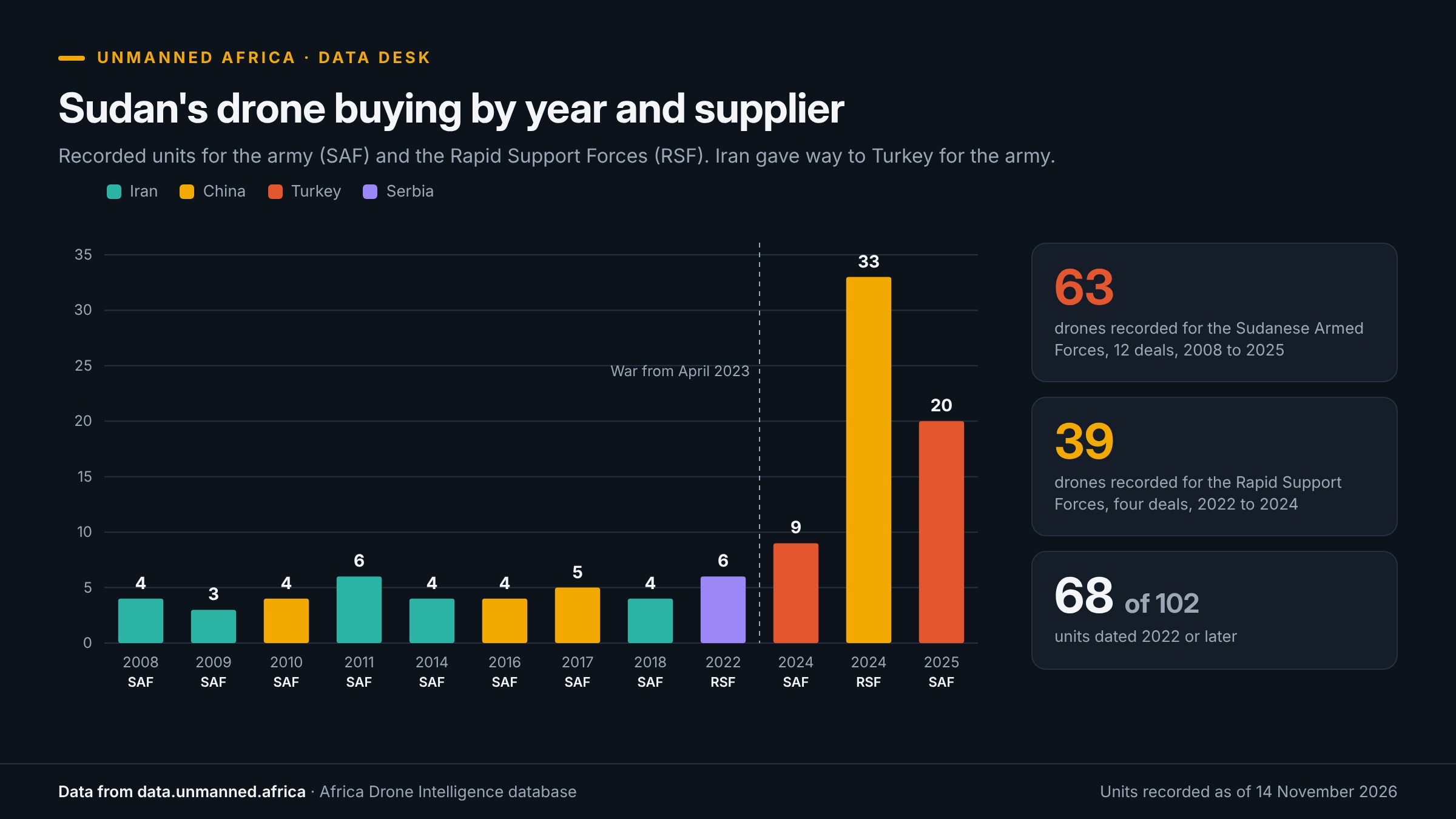
Two thirds of all those units are dated 2022 or later: 68 of 102. Before the war began in April 2023, the database shows the army adding a handful of aircraft every year or two. Since then both sides have bought in bulk.
Iran first
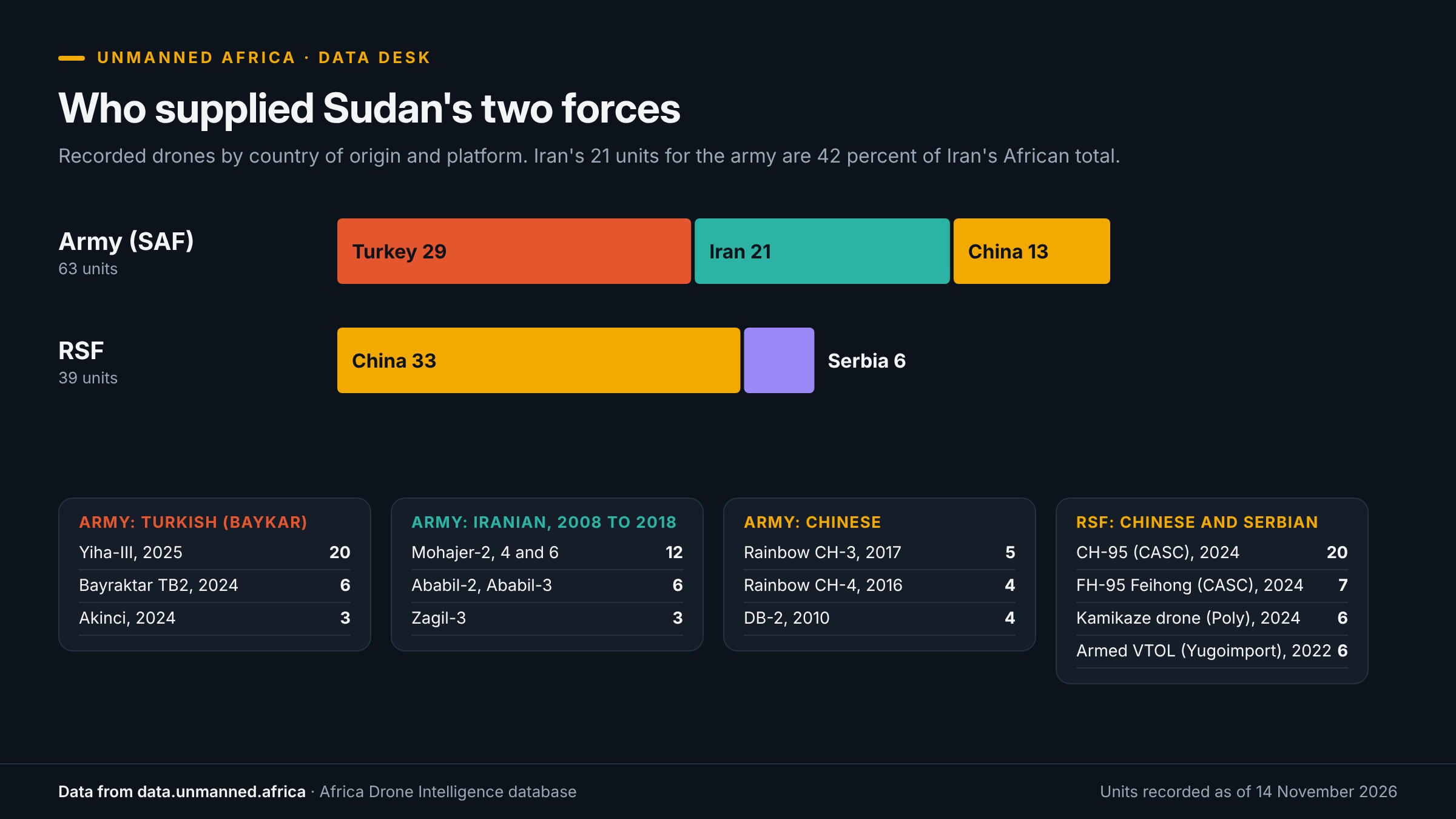
For a decade Tehran was the army’s main supplier. The database lists four Mohajer-2 in 2008, three Zagil-3 from HESA in 2009, two Ababil-2 and four Mohajer-4 in 2011, four Ababil-3 in 2014 and four Mohajer-6 from Quds Air Industries in 2018. That is 21 Iranian drones.
Small numbers, but a large share of Iran’s African business. Iran has 50 recorded units on the continent, so Sudan’s army alone accounts for 42 percent of them. The rest went to Haftar’s Libyan National Army, Mali, Ethiopia and South Sudan, a network Unmanned Africa traced in How Tehran built its African drone supply network.
China filled gaps in between: four DB-2 in 2010, four Rainbow CH-4 in 2016 and five Rainbow CH-3 in 2017, all but the DB-2 from CASC.
The database stops its Iranian entries in 2018. Outside reporting does not. Semafor reported in February 2024, citing US and Arab officials, that Iran had been sending Mohajer-6 attack drones to the army in the preceding months, after Bloomberg reported the first shipments. Al Jazeera’s analysis of ACLED data dates the Mohajer-6’s arrival to late 2023. None of those wartime deliveries appear in the database yet, so the Iranian total is a floor.
Turkey takes over
The army’s newer drones are Turkish, and all of them come from Baykar. The database records six Bayraktar TB2 and three Akinci in 2024, then 20 Yiha-III loitering munitions in 2025, 29 units in all. That makes the Sudanese army Turkey’s third-largest African drone customer on record, behind Nigeria with 99 and Libya’s Government of National Accord side with 30.
The paper trail is better than for most African buys. The Washington Post reported in March 2025, according to Turkish Minute’s account of the investigation, that Baykar supplied about $120 million in drones and warheads, including at least eight TB2s and 600 warheads, through intermediaries. Military Africa, drawing on the same documents, put the contract at €110.7 million, signed on 16 November 2023, for six TB2s, three ground control stations, 600 warheads and 48 Baykar staff in the country, with the army’s TB2 count reaching eight after a second batch in October 2023, as it reported in April 2025. The database’s six TB2s, dated 2024, sit at the low end of that range.
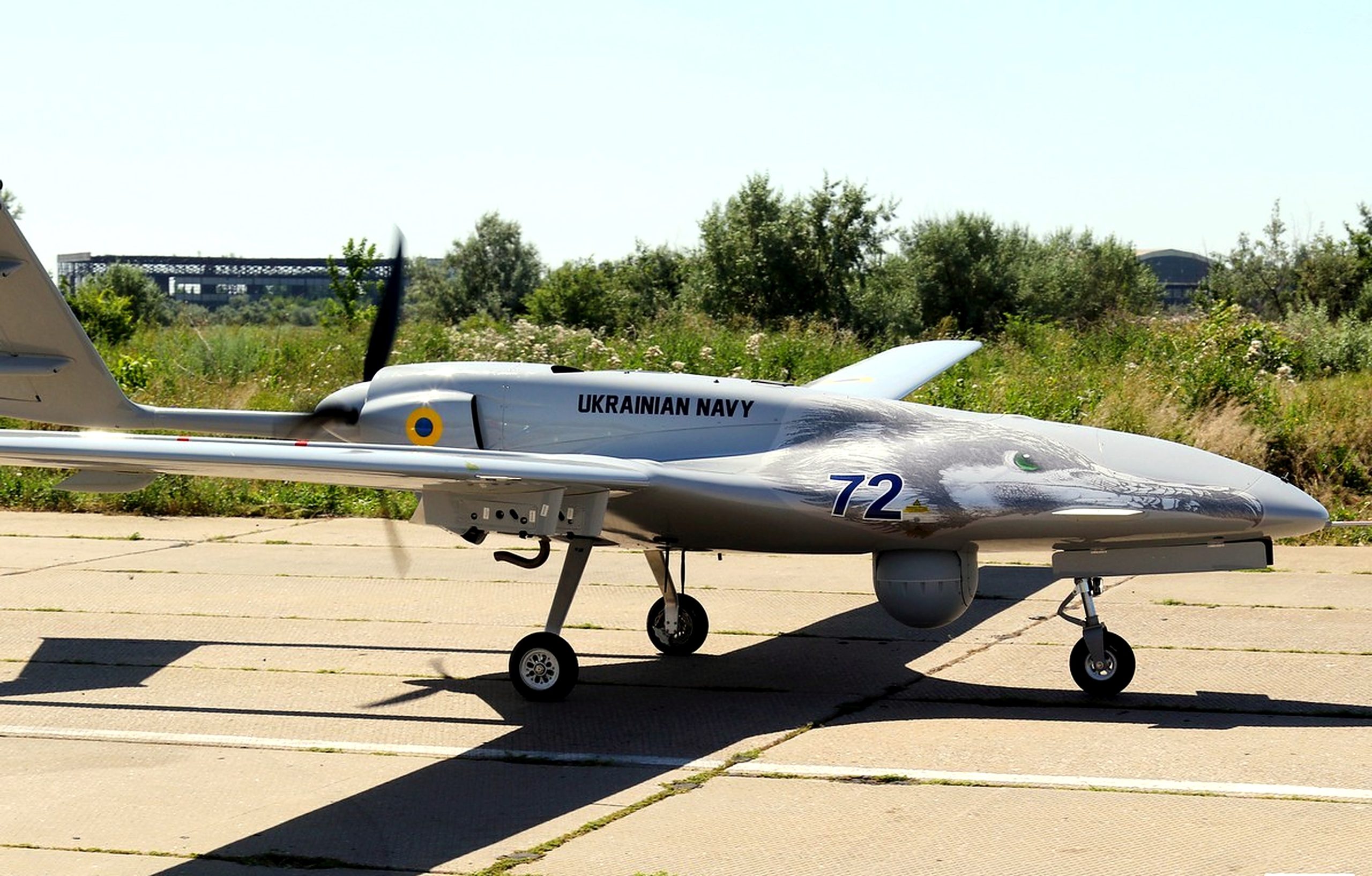
The TB2s were used against RSF supply convoys and artillery, in the push on Khartoum State in late 2024 and in the drive to lift the siege of El Obeid. Al Jazeera, citing the Critical Threats project, says some of the Turkish aircraft reached the army through Egypt. The Akinci followed in late 2024. It has been costly. Military Africa counted three Akinci losses claimed in 2025, over El Fasher on 10 July, Mershing in South Darfur on 4 September and West Kordofan on 13 September, mostly on RSF claims. Three losses against three recorded aircraft means either the army has more Akincis than the database shows or none left. Unmanned Africa has followed the type’s use against Chinese drones in Turkish Akinci armed with Eren munition continues to decimate Chinese drones in Sudan.
The Yiha-III is the newest piece. The 20 units are the largest single loitering munition entry for any African buyer in the database, as Unmanned Africa noted in Loitering munitions in African arsenals. Images of the munition in Sudan surfaced in June 2026, and the RSF claimed one shot down on the Kazgeil axis in North Kordofan on 12 April 2026, Military Africa reported.
The RSF buys Chinese
The RSF has no Iranian or Turkish entries at all. Its first recorded drones were six Armed VTOL rotary drones from Serbia’s Yugoimport in 2022, a quadcopter Al Jazeera describes as modified to drop mortar shells. Everything since is Chinese and dated 2024: 20 CH-95 and seven FH-95 Feihong from CASC, and six kamikaze drones from Poly Technologies. Thirty-three Chinese units, 85 percent of the RSF’s recorded fleet. The FH-95 is the heavier of the two CASC types. Al Jazeera puts its payload at 200 to 250 kg and says it can drop laser-guided bombs, and it was spotted at Nyala airport in late 2024.
China is not recorded selling these to the RSF directly. Amnesty International said in May 2025 that Chinese GB50A guided bombs and AH-4 howitzers used by the RSF had been re-exported by the United Arab Emirates, in breach of the UN arms embargo on Darfur. The UAE denies arming the RSF.
The long-range drones changed the shape of the war. Reuters, working with the Yale Humanitarian Research Lab, identified 13 delta-wing kamikaze drones and 16 launch platforms near Nyala airport in Darfur on 6 May 2025, during the week the RSF struck Port Sudan, about 1,600 km away. Experts consulted put their range at about 2,000 km. Reuters had earlier found three CH-95s at the same airport. Unmanned Africa covered the wider spread of these aircraft in The Proliferation of Long-Range Delta-Wing Drones in Sudan.
Two fleets, one war
Put side by side, the army holds 63 recorded drones and ranks eighth of 35 African buyers in the database. The RSF, with 39, ranks 15th, just ahead of Kenya. No other non-state force on the continent comes close except Haftar’s LNA.
The killing has been uneven. Al Jazeera counted at least 1,003 drone strikes in Sudan between April 2023 and January 2026 from ACLED data. Strikes attributed to the army killed more than 1,800 people, and those attributed to the RSF more than 780. Unmanned Africa’s record of downings on both sides is in Sudan’s Drone War Between the SAF and RSF.
The database also misses what Sudan builds itself. The army’s Military Industry Corporation has fielded the Safaroog loitering munition, and Sudan’s government told the UN Security Council that 187 drones launched from Ethiopian territory hit its infrastructure between February and October 2026. Neither the homegrown munitions nor the drones flown into Sudan from outside count in the procurement totals.
What to watch
Three gaps will decide how far these numbers move. The wartime Mohajer-6 deliveries reported since late 2023 have yet to be entered. The Akinci count of three cannot survive the losses already claimed. And the RSF’s Chinese fleet has no 2025 or 2026 entries despite continued long-range strikes, which points to resupply the records have not caught. Expect both columns of the Sudan ledger to grow.

