
Armed drones now make up most of Africa’s recorded deliveries
Armed drones now make up most of what African forces receive. Combat drones and loitering munitions accounted for 298 of the 509 drones delivered to African buyers in 2023 to 2026, or 58.5%, according to the Africa Drone Intelligence database. That is up from 42.9% in 2020 to 2022 and 29.0% in 2015 to 2019. Before 2000, every one of the 169 drones on record was a surveillance aircraft.
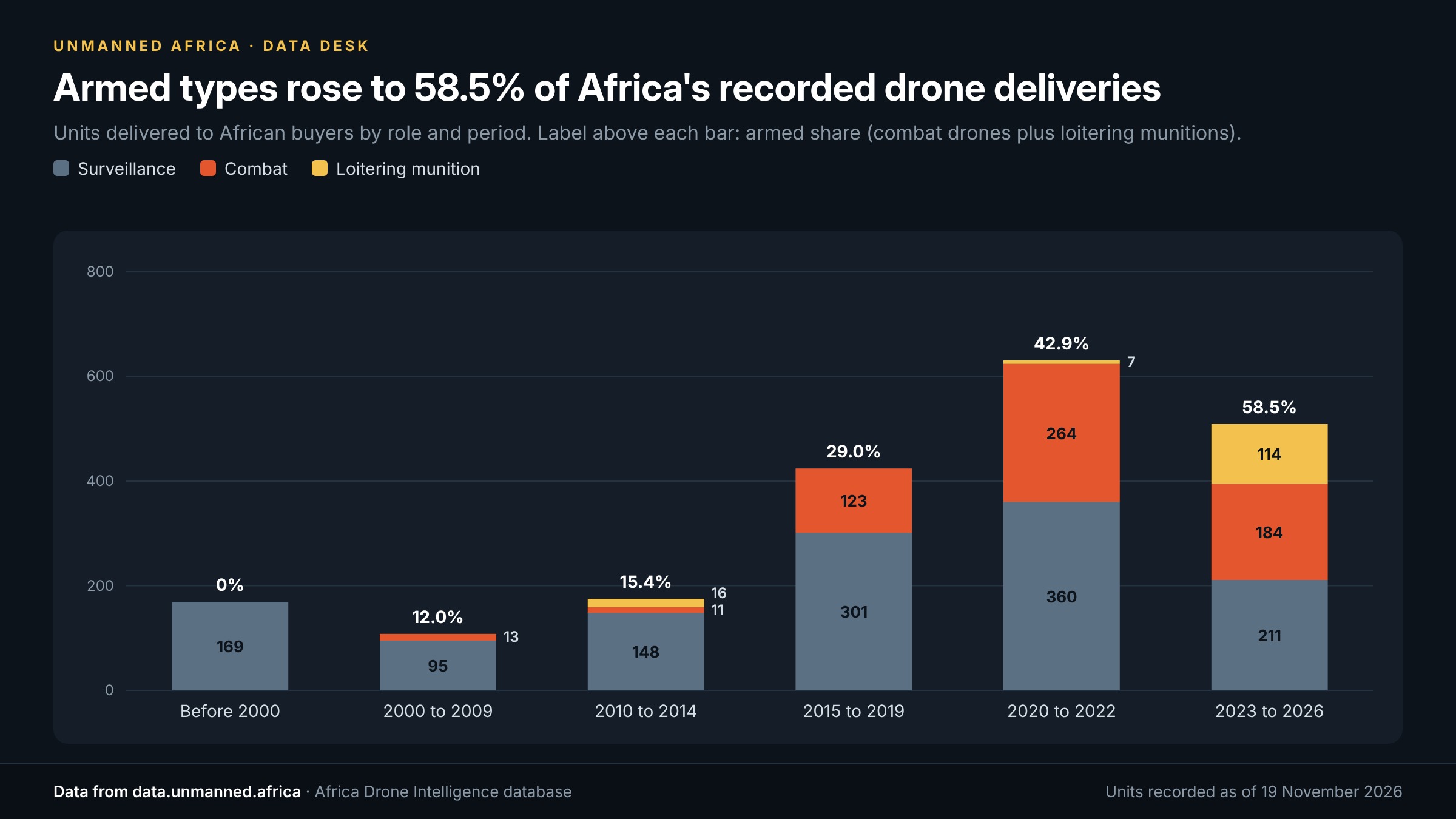
The change came in steps. The first armed type on record is the American MQ-1 Predator: four went to Morocco in 2001 and four to Tunisia in 2010. Armed aircraft made up 12.0% of deliveries in 2000 to 2009 and 15.4% in 2010 to 2014, a figure lifted by eight Harop and eight Harpy loitering munitions recorded for the authorities in Tripoli, listed in the database as Libya (GNA), in 2013.
Chinese medium-altitude aircraft then changed the mix. Egypt received 42 Wing Loong I drones from AVIC in 2016, the second-largest single armed order on record, and CASC‘s Rainbow CH-4 and Rainbow CH-3 spread across the continent. By 2020 to 2022 the Turkish Bayraktar TB2 had arrived in numbers, led by 43 aircraft for Nigeria in 2022. That year armed types made up 77.6% of the 219 drones delivered. In 2024 the share was 74.0% of 215.
The armed share of the whole record, all years included, is 36.3%: 732 of 2,016 units. Twenty-seven of the 35 forces in the database now hold at least one armed type.
Loitering munitions grow fastest
The newest growth is in one-way attack weapons. The database records 114 loitering munitions delivered in 2023 to 2026, against 23 in every earlier year combined. They now make up 22.4% of deliveries, up from 1.1% in 2020 to 2022. Unmanned Africa first set out the holdings in Loitering munitions in African arsenals: what the records show.
Mali leads with 32: 12 Kub-BLA and 10 Lancet munitions from Russia’s ZALA, and 10 Shahed-type drones. Sudan‘s army has 20 Yiha-III munitions from Baykar, recorded for 2025. Morocco has 16 SpyX from Israel’s BlueBird Aerosystems, Egypt 16 Chinese ASN-301 anti-radiation drones, Haftar’s Libya (LNA) 14 Belarusian Mirotvorets jet drones and the M23 rebels in eastern Congo 10 Belarusian Berkut-BM drones. Sudan (RSF) has six Chinese kamikaze drones from Poly Technologies.
Outside reporting confirms most of these weapons are in use, if not always the numbers or the owner. Bellingcat, working with Jeune Afrique, geolocated Shahed-136-type strikes on Inafarak and Talahandak in northern Mali on 12 and 17 July 2026 and judged the drones likely to be Russian-made, it reported. Congolese forces downed two Yiha-III munitions flown by the M23 near Mikenge, North Kivu, on 10 March 2026, and Janes assessed Rwanda as the likely supplier, Janes reported. Sister site Military Africa documented Sudanese army use of the same Turkish weapon against the RSF.
Cost is the likely draw. A loitering munition is lost in a single attack, but it costs far less than a medium-altitude drone and needs no runway. A force that struggles to keep TB2s or Wing Loongs in the air can still buy a batch and use it.
Two suppliers deliver most of the weapons
Turkey and China supplied 207 of the 298 armed drones delivered in 2023 to 2026, or 69.5%. Turkish makers delivered 104 and Chinese makers 103. Russia followed with 27, Belarus with 24 and Israel with 23. Iran is credited with 10, the United States with four and Algeria with three.
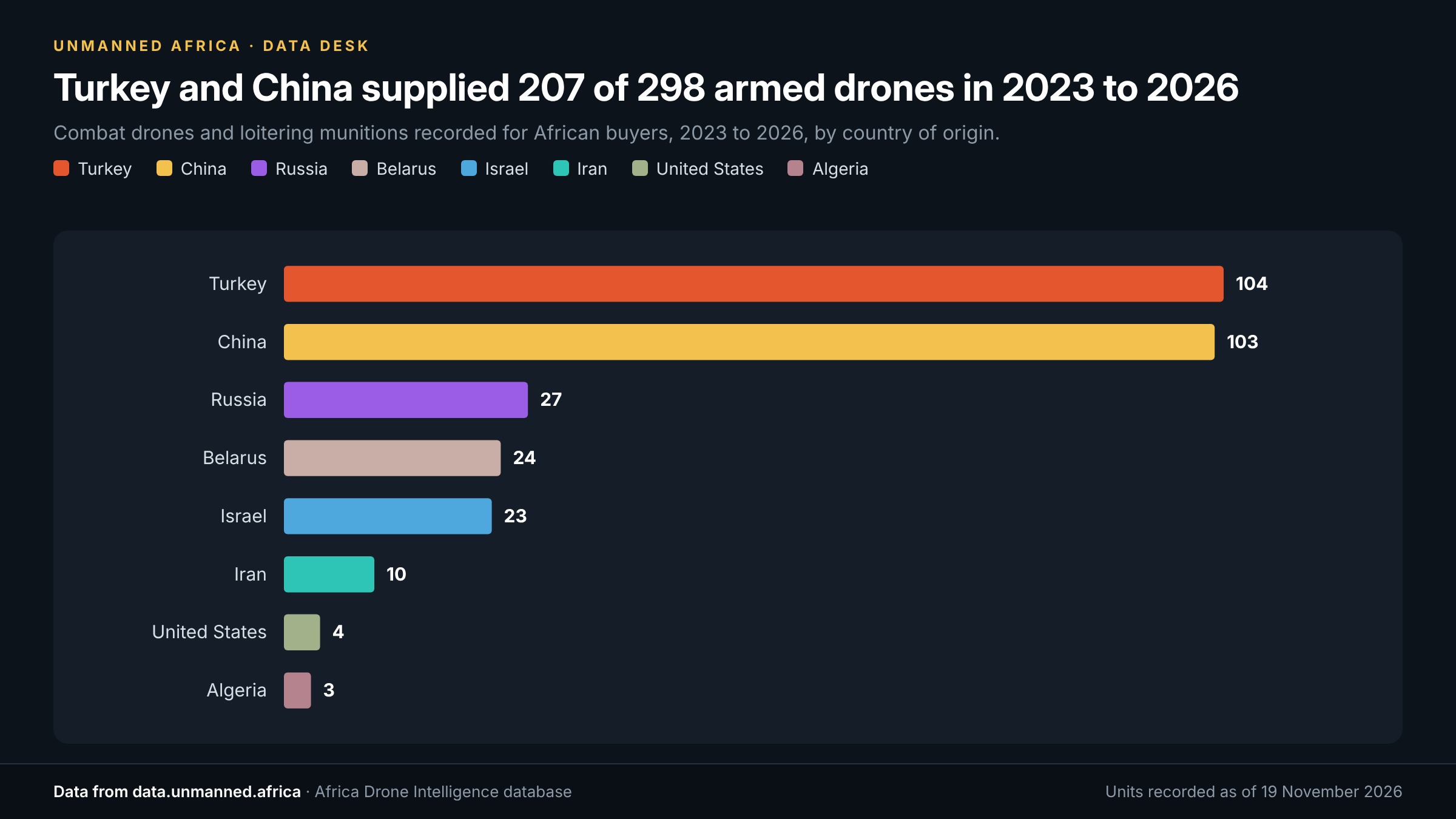
The balance between the two leaders has moved. In 2020 to 2022 Turkey supplied 134 of 271 armed drones, 49.4%, against China’s 96. In the latest period China has drawn level, helped by 20 CH-95 and seven FH-95 Feihong drones for the RSF and by Wing Loong II deliveries, while Turkey’s total includes Baykar’s Akinci, now with eight African operators. Over all years China leads with 297 armed drones to Turkey’s 258.
The global data point the same way. Turkey made 65% of armed drone sales worldwide from 2018 and China 26%, with the United States at 8%, the Center for a New American Security found in its drone proliferation dataset. The same dataset counted 51 drone transfers to Africa from 2020 to September 2023, nearly 13 a year, against about two a year from 1995 to 2019. American makers, once dominant, supplied 0.8% of all African deliveries in 2023 to 2026, as Unmanned Africa reported.
Fourteen new armed operators since 2020
Fourteen of the 27 armed forces in the database received their first armed drone in 2020 or later. Ethiopia and Kenya took Turkish ANKA-S aircraft in 2020. In 2022 came the TB2 wave: Burkina Faso, Djibouti, Mali, Niger and Togo, plus Serbian Armed VTOL aircraft for the RSF. Chad, Angola and DR Congo followed in 2023, Somalia in 2024, the M23 in 2025 and Ivory Coast in 2026.
Most of those dates match outside reporting. Chad confirmed delivery of ANKA-S aircraft in July 2023, Overt Defense reported, and Angola bought Aksungur drones that March. Ivory Coast’s armed forces confirmed two Wing Loong IIs in August 2026, as Military Africa reported. Somalia is the exception. The database records six Akinci for 2024, but the first documented delivery was two Akinci on 18 March 2025, Turkish Minute reported. TB2 strikes did take place in Somalia in 2024, but who owned and flew those aircraft is disputed.
The armed fleets are concentrated. Egypt holds 108 armed drones, Nigeria 90, Morocco 89 and Algeria 72, together 359 of the 732 armed drones on record. In proportion to fleet size the leaders are different. Every one of the RSF’s 39 recorded drones is armed, as are 90.3% of Mali’s 62 and 86.8% of the Tripoli government’s 53. Unmanned Africa counted the medium-altitude part of this picture in Africa’s medium-altitude drone club.
The cost on the ground
Strikes have risen with the fleets. The Africa Center for Strategic Studies counted at least 900 drone strikes in 15 African countries since the first confirmed one in 2011, 484 of them in 2024 alone, and more than 3,000 deaths. Six states, Sudan, Ethiopia, Burkina Faso, Mali, Libya and Somalia, accounted for 93% of strikes, the centre found. Drone Wars UK counted at least 943 civilians killed in at least 50 strikes in six countries between November 2021 and November 2024, in its Death on Delivery report.
A Nigerian Army drone strike on a religious gathering at Tudun Biri, Kaduna State, on 3 December 2023 killed 85 people by official count, and Amnesty International Nigeria cited 120, Al Jazeera reported. Human Rights Watch found that three Burkinabe TB2 strikes between August and November 2023 killed at least 60 civilians at markets and a funeral, in a January 2024 report. Amnesty International found that TB2 strikes in Lower Shabelle, Somalia, on 18 March 2024 killed 23 civilians, 14 of them children.
Sudan is the worst case. Drones killed more than 1,630 civilians between January and October 2026, nearly three quarters of the more than 2,230 civilian deaths the UN human rights office verified in that period, according to figures reported on 17 November. The war’s drone fleets are traced in Sudan’s army traded Iranian drones for Turkish as RSF bought Chinese.
What the records cannot show
The database counts deliveries, not fleets in service. Losses are not subtracted, so a buyer’s total can overstate what still flies. The role field also follows the type rather than its use: the Hermes 900, which most export customers fly unarmed, is classed as a combat drone, and so are aircraft such as Botswana’s four Hermes 900s, dated to 2009, the year the type first flew.
Several loitering munition entries rest on thin ground. Outside investigations describe Mali’s Lancet and Shahed-type drones as operated by Russia’s Africa Corps, not by the Malian army, and as Russian-made Shahed-136 types rather than the Iranian Shahed-131 the database lists. No public source confirms Egypt’s 16 ASN-301s, which account for 16 of the 114 munitions in the latest period. Without them the 2023 to 2026 armed share would be 57.2%. Deliveries for 2025 and 2026 are also likely to rise as reports catch up.
What to watch
Armed groups now fly drones of their own. ACLED counted more than 100 drone attacks by JNIM in the Sahel since 2023, and armed groups carried out nearly 60 drone attacks in 2025, about triple the 2024 total, according to Africa Defense Forum. That is pushing governments toward counter-drone systems, a turn Unmanned Africa examined in African militaries shifting from drone procurement to counter-UAS.
On the supply side, Morocco’s order for 500 home-built loitering munitions from Aerodrive Engineering, with a production line due in 2027, would on its own exceed every munition now on record, as Unmanned Africa reported. Reported talks between DR Congo and China over Wing Loong IIs, and Baykar’s planned factory in Morocco, will show whether the armed share keeps rising or settles as buyers fill their fleets. Deliveries recorded so far this year are tracked in What African armed forces have received so far in 2026.
