
Mali’s drone fleet: Turkish aircraft, Russian-flown munitions
Mali has one of the most heavily armed drone fleets on the continent. Fifty-six of the 62 drones recorded for Mali in the Africa Drone Intelligence database are combat drones or loitering munitions, 90.3%, the highest share of any government force with more than 20 drones on record. Its 32 loitering munitions are the most held by any African buyer. Outside reporting, though, says many of those munitions are flown by Russia’s Africa Corps, not by the Malian army.
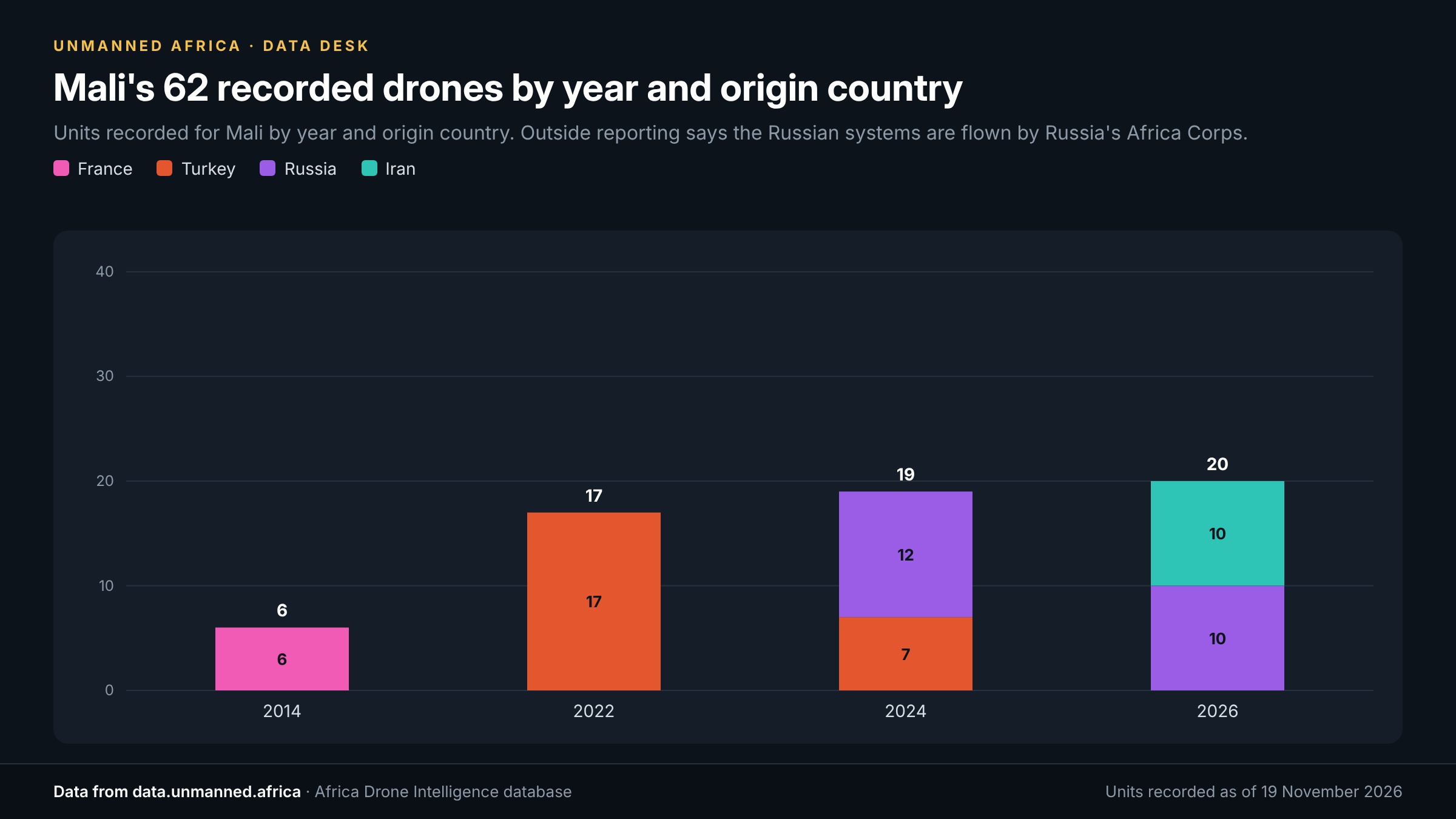
The records fall into three layers. Six Hawker Q800X rotary surveillance drones from France’s Aeracess are dated to 2014, when French forces were still fighting alongside the Malian army. Twenty-four Turkish strike aircraft from Baykar follow: 17 Bayraktar TB2 in 2022 and seven Akinci in 2024. The last layer is 32 one-way attack weapons: 12 Kub-BLA and 10 Lancet munitions from Russia’s ZALA in 2024 and 2026, and 10 drones listed as Iranian Shahed-131s from HESA in 2026.
On the database’s figures Mali holds 22 of the 37 Russian drones recorded in Africa, and is the only African buyer of Russian loitering munitions. Its 24 Turkish aircraft are 7.9% of Turkey’s 303 drones on the continent. Within the Alliance of Sahel States, Mali, Burkina Faso and Niger hold 96 recorded drones between them, and Turkey supplied 51 of them. Burkina Faso’s 16 are all Turkish, as are 11 of Niger’s 18.
The Turkish backbone
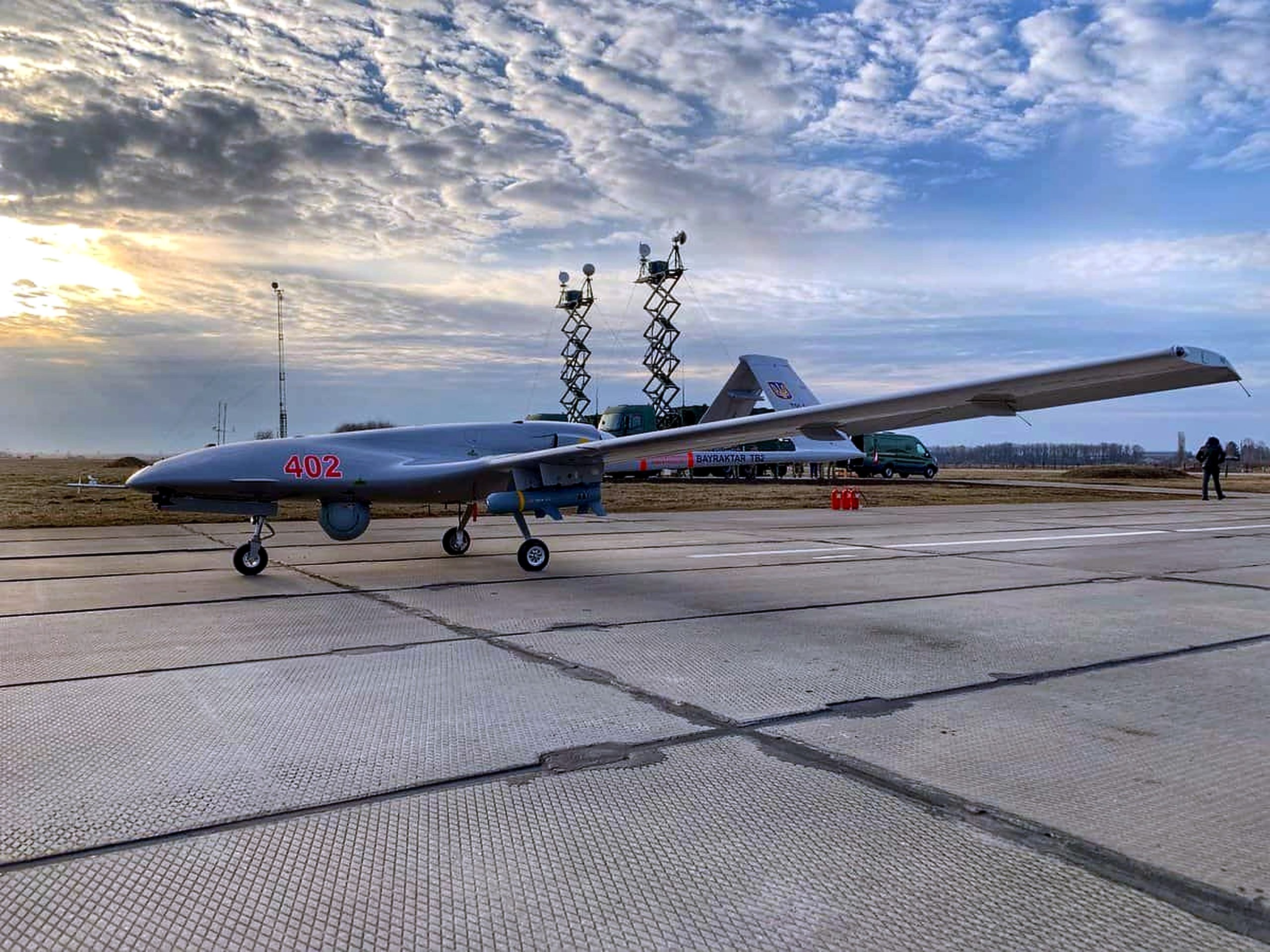
Mali’s TB2s arrived in batches. The first two reached an air base in Mopti on 20 December 2022, three more were handed over in Bamako in March 2023, and six more were presented at Modibo Keita airport on 4 January 2024, Military Africa reported, putting the fleet at no fewer than 17. The database’s 17 matches that count, though it dates all of them to 2022. One TB2 was destroyed at Gao airport on 22 May 2023, according to the Aviation Safety Network.
The TB2 weighs up to 700 kg at take-off, carries 150 kg of munitions and flies for more than 18 hours, according to Baykar. Drones led the November 2023 campaign to retake Kidal. Strikes on the town on 7 November killed at least 14 people, including the deputy mayor, its mayor told the Associated Press, a week before the army and Wagner fighters took it.
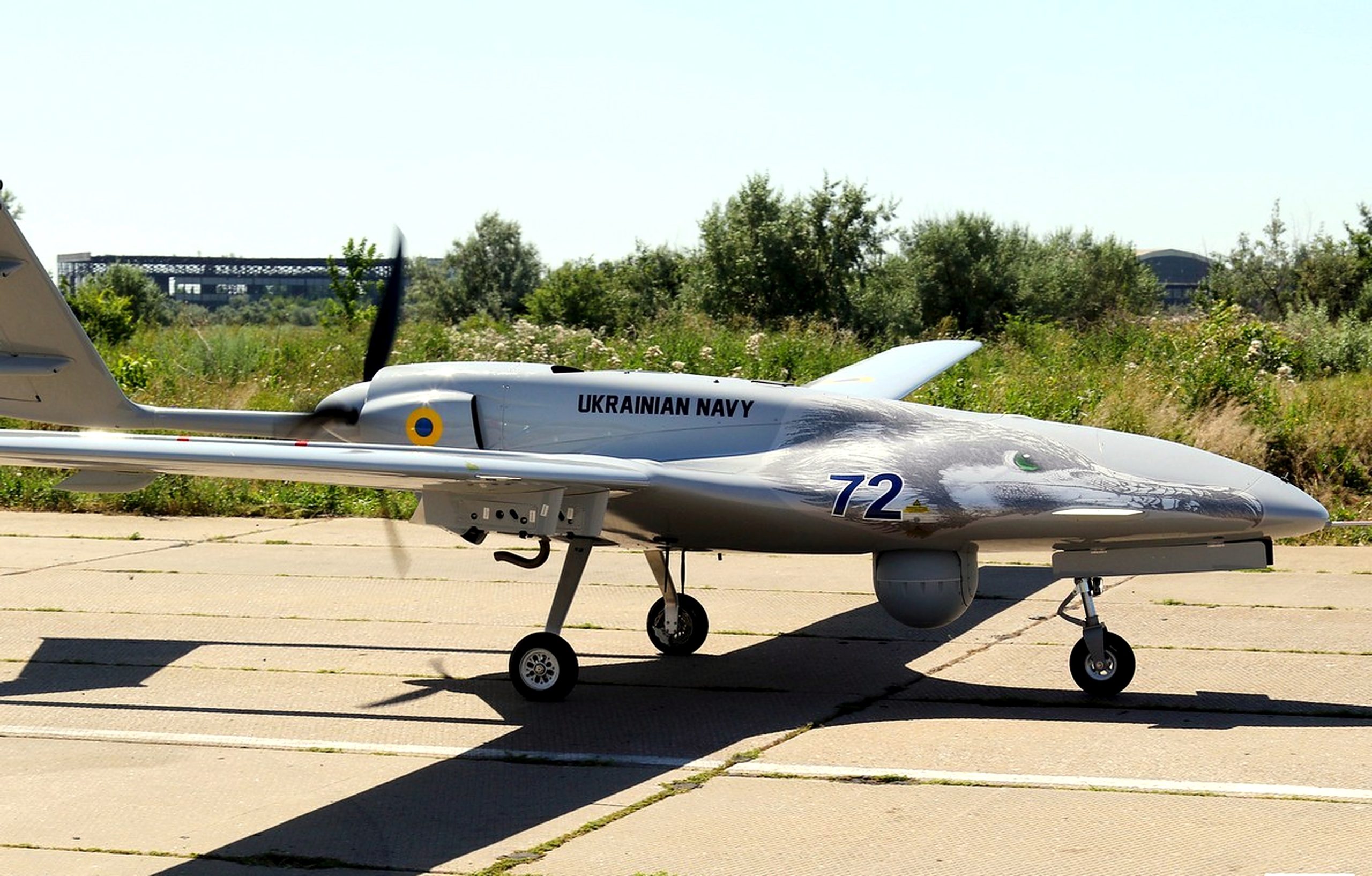
The Akinci is a different class of aircraft, with a 6,000 kg take-off weight and a 1,500 kg payload. Mali’s contract was for six aircraft, worth $210 million, signed on 15 August 2024 by Colonel Modibo Koné, head of the state security agency ANSE, rather than by the defence ministry, according to research by The Sentry reported by RFI. The first were presented in Bamako in December 2024. More arrived at Sévaré on 30 January 2026 and again on 30 July 2026, Military Africa reported, and Militarnyi estimated eight delivered in all from serial numbers. Unmanned Africa covered an earlier delivery in Mali receives additional Bayraktar Akinci UCAVs.
Two of those aircraft were lost in 2025. One crashed in January. Algeria said it shot down another about two kilometres inside its airspace near Tinzaouaten on the night of 31 March. Mali said the drone suffered a technical failure inside Malian territory and recalled its ambassador. The database’s seven, all dated to 2024, sits between the six on contract and the eight Militarnyi counted, and does not subtract the losses.
Russian munitions, Russian operators
Outside sources describe the loitering munitions differently. Military Africa reported in October 2024 that Wagner was fielding ZALA’s Kub, after two airframes were found abandoned at Inazarraf, in its report. ZALA itself says Lancet operators of the Africa Corps, the Russian defence ministry force that replaced Wagner, first used the weapon in Africa on 24 June 2026, and it has published their strike footage on its website. No public source shows either type handed to the Malian army, or gives the quantities of 12 and 10 in the database.
The Shahed entry has the same problem and one more. Bellingcat and Jeune Afrique geolocated Shahed-136-type strikes on Inafarak on 12 July 2026 and Talahandak on 17 July, Bellingcat reported, and assessed the drones as likely Russian-made. Ukrainian officials had earlier described wreckage downed in May as a Russian Shahed-136 built with Chinese and European parts. None of these reports mentions the smaller Shahed-131 or an Iranian supplier, and none gives a quantity. Unmanned Africa reported the first use in Mali deploys Shahed-136-type drones for first time in conflict.
The weapons differ widely in reach. The Lancet weighs about 12 kg, carries a warhead of up to 5 kg and has a range of about 40 km in its standard form. The Kub carries up to 3 kg and flies for about 30 minutes. The Shahed-136 weighs about 200 kg and is credited with a range of 1,000 to 2,500 km, according to the Center for Strategic and International Studies. In Mali that means a Shahed can reach almost anywhere in the north from a base in the centre.
Who decides on strikes is also contested. The Sentry found that Malian crews fly the Turkish drones but that strike approvals can go up to Russian commanders. “While Bamako describes a sovereign counterterrorism campaign, targets are in fact approved by a foreign power,” its researchers wrote, as quoted by Africa Defense Forum. Unmanned Africa has described how Africa Corps runs Mali’s long-range drone war with Russian munitions.
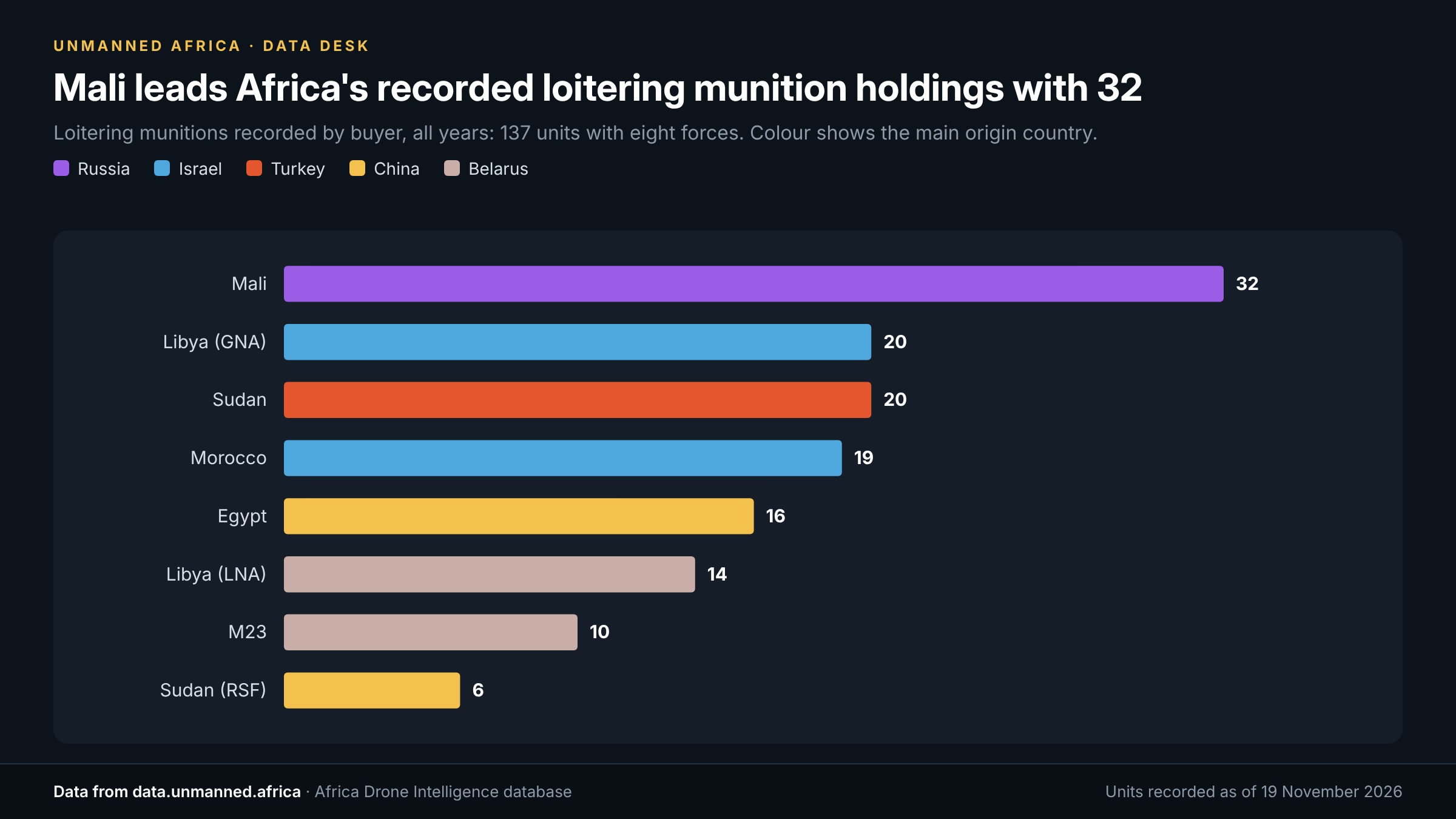
On the database’s count, Mali’s 32 munitions are 23.4% of the 137 on record in Africa, ahead of the 20 held by Libya (GNA) and the 20 Yiha-III munitions recorded for Sudan‘s army.
Strikes, civilians and a two-front war
The fleet has been used hard. On 25 August 2024 drone strikes on Tinzaouaten hit a pharmacy and killed 21 people, 11 of them children, according to the separatist coalition, Al Jazeera reported, a month after rebels defeated Malian troops and Wagner fighters there. The army called them precision strikes on terrorists. A Bellingcat and Jeune Afrique investigation published in September 2026 geolocated more than a dozen strikes and described a pattern of “guilt by location”. “What we have seen is a huge expansion in the way the Malian authorities define who is considered a legitimate target,” said Yvan Guichaoua of the Bonn International Centre for Conflict Studies.
ACLED counted 89 civilians killed in 49 air strikes by the Africa Corps and the junta between April and August 2026. Human Rights Watch reported that an apparent army drone strike in Guélédié, Mopti region, killed eight men on 16 September 2026, in an October report.
The strikes come in a war that turned sharply in 2026. On 25 April JNIM and the Azawad Liberation Front (FLA) launched coordinated attacks, Kidal fell and Defence Minister Sadio Camara was killed by a car bomb in Kati. Malian and Africa Corps forces re-entered Kidal on 6 October after the FLA withdrew. The rebels have drones of their own: the FLA brought down a Malian helicopter with an armed drone at Tessalit in February 2025 and claimed an attack with 25 kamikaze drones on a camp at Gao in March 2026, Africa Defense Forum reported. JNIM’s fuel blockade of Bamako, reimposed on 28 April, has added to the strain on the army. Unmanned Africa traced the rebels’ drone tactics in How cheap FPV drones helped Azawad rebels retake Kidal.
Data limits
Three of Mali’s six entries need correcting or qualifying. The Shahed row should read as a Russian-made Shahed-136 type, not an Iranian Shahed-131. The Kub and Lancet rows describe weapons operated by Russian forces in Mali rather than Malian procurement, with unconfirmed quantities. The Akinci row compresses deliveries from December 2024 to July 2026 into a single year. Counting only Malian-owned aircraft, Mali’s documented fleet is the 24 Turkish drones, less losses, plus the older French rotary drones.
What to watch
Bamako wants to build as well as buy. At the BAMEX exhibition in Bamako this month, Foreign Minister Abdoulaye Diop asked Turkey for technology transfer, as Unmanned Africa reported in Mali wants Turkish drone know-how, not just more drones. Baykar showed its KIZILELMA jet drone in Malian colours, though no order has been announced, and a home-built drone, the N’Gelèni, went on display. The questions now are whether more Akinci arrive to replace the 2025 losses, whether Russia hands any of its munitions to Malian crews, and how the drone campaign shapes the fight for the north after Kidal changed hands twice in six months.
