
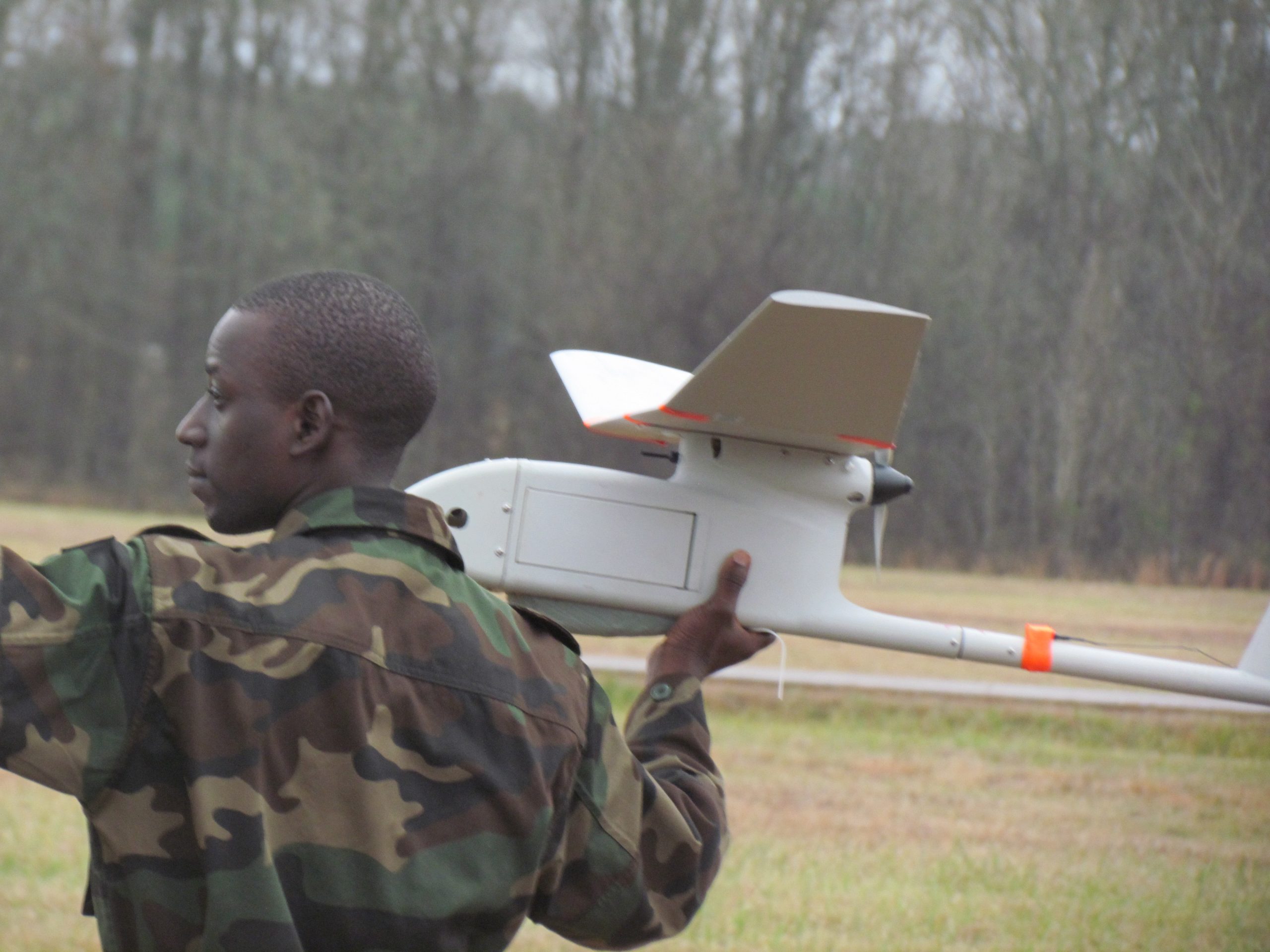
Small drones make up 42% of Africa’s recorded military fleet
Small drones make up the largest part of Africa’s recorded military fleets. The Africa Drone Intelligence database classes 844 of its 2,006 units as Class 1, the NATO category for aircraft under 150 kg, or 42.1%. That is more than the 656 Class 3 aircraft, the medium-altitude and strike types that draw most attention, and the 506 Class 2 tactical drones in between. Class 1 types appear in 91 deals for 28 of the 35 buyers in the database.
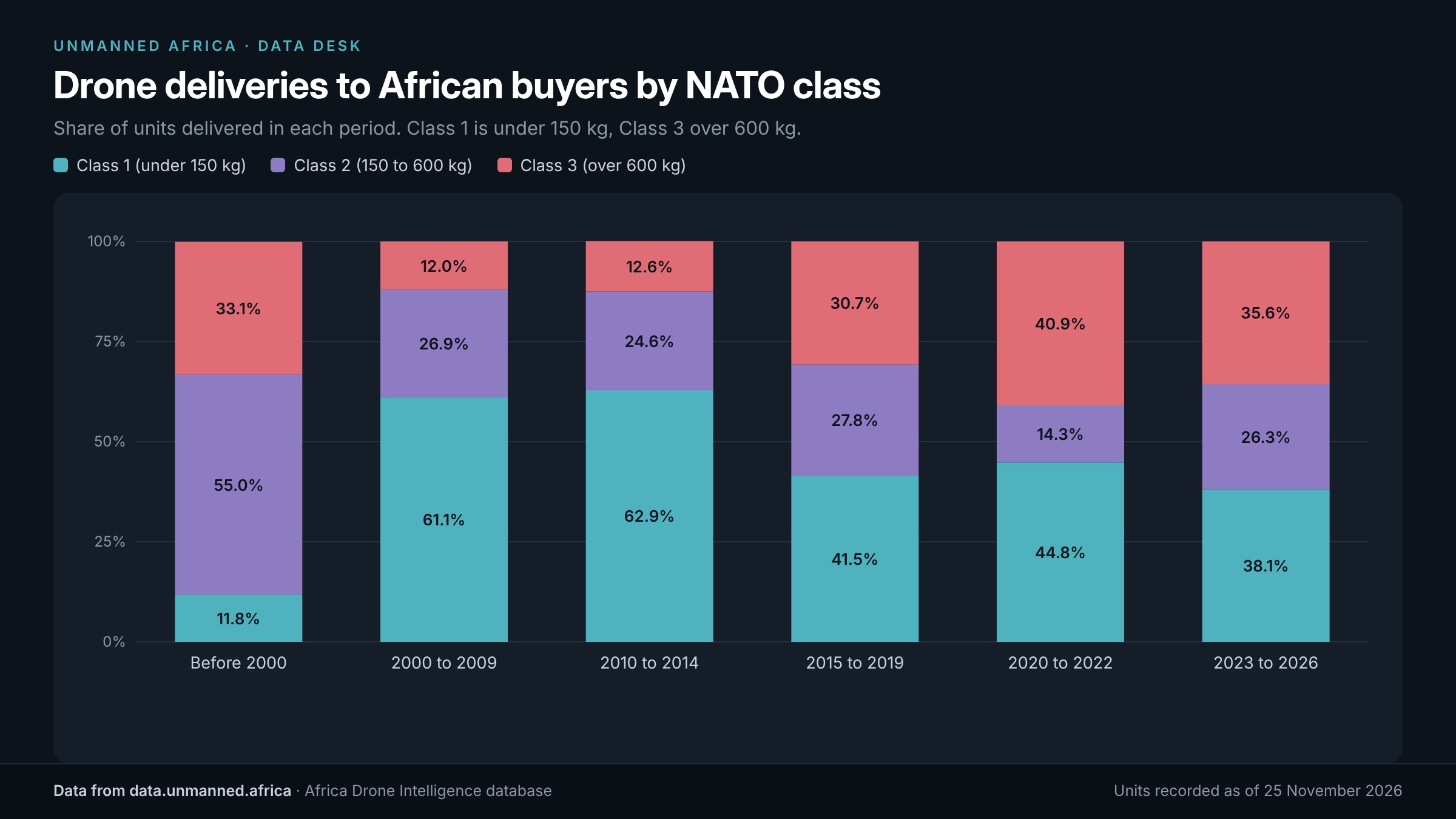
The class figures follow a revision this week, when the database moved several types, among them BlueBird’s Wander B and Thunder B and the SpyX loitering munition, into Class 1. NATO’s guide, set out by the Joint Air Power Competence Centre, divides Class 1 into micro drones under 2 kg, mini drones of 2 to 20 kg and small drones above 20 kg, flown at company or battalion level within about 50 km. Class 2 covers 150 to 600 kg and Class 3 everything heavier.
A share that has fallen, then held
Small drones dominated the record from 2000 to 2014, when they made up 61.1% and then 62.9% of units delivered. Their share fell to 41.5% in 2015 to 2019 as Chinese and Turkish armed aircraft arrived, then held at 44.8% in 2020 to 2022 and 38.1% in 2023 to 2026, when 194 Class 1 units were recorded. Before 2000 the pattern was reversed: only 11.8% of deliveries were Class 1, because the early buyers mostly took larger reconnaissance types such as the 324 Scarab and R4E-50 SkyEye, as set out in Africa’s first military drones: buyers and suppliers before 2000.
The buyers differ sharply in how much they depend on small aircraft. Cameroon‘s 49 recorded drones are all Class 1, and South Africa‘s share is 72.1%. Morocco holds the largest number, 175, which is 64.6% of its fleet, while Nigeria has 104, or 42.1%. Egypt, the largest buyer overall, has 60 small drones in a fleet of 313, 19.2%, because most of its record is made up of larger Chinese and American types.
Who sells small drones to Africa
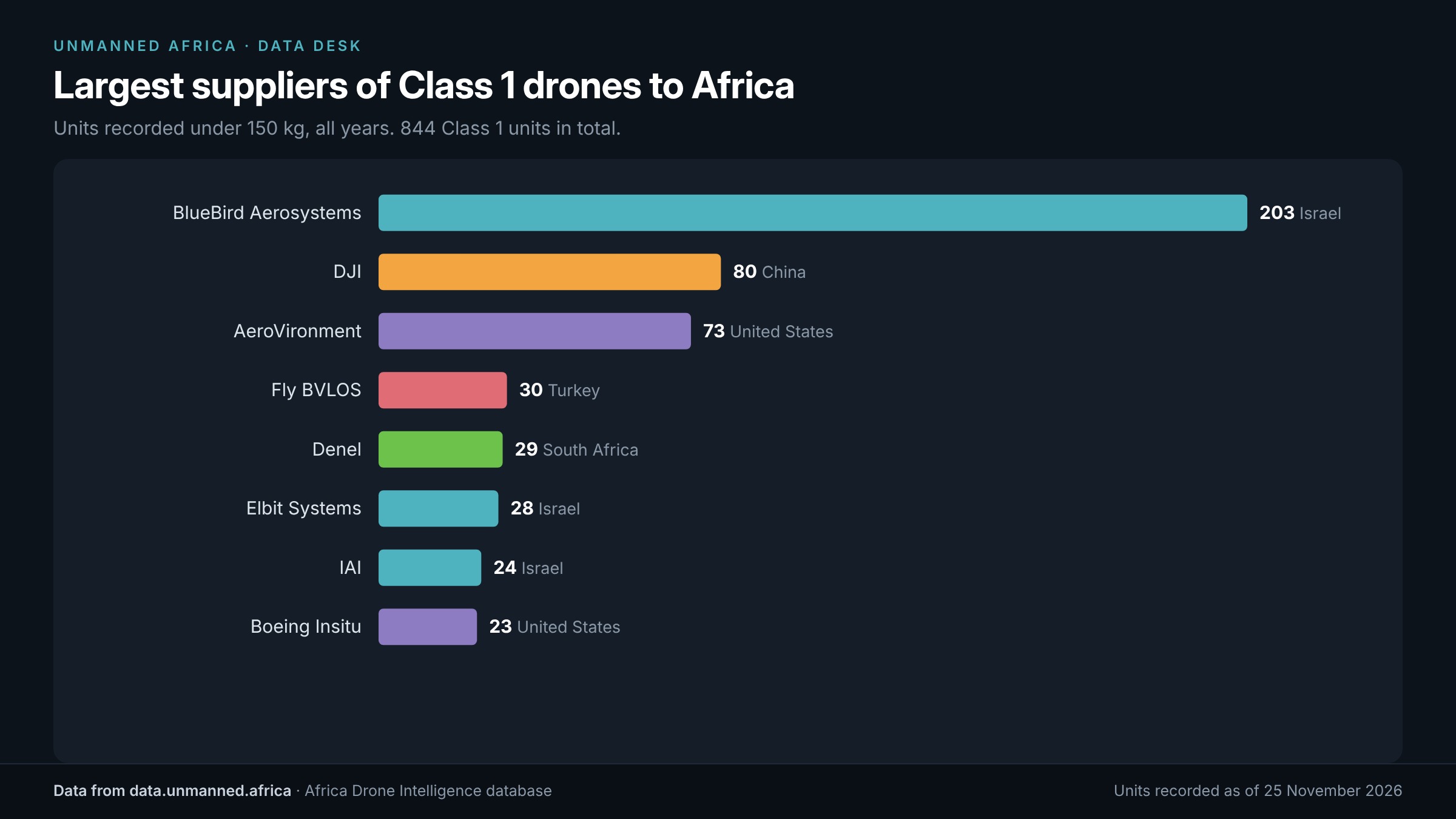
Israel is the largest source by origin, with 269 Class 1 units, followed by China with 135 and the United States with 108. One Israeli firm accounts for most of that lead. BlueBird Aero Systems has 203 Class 1 units on record, 24.1% of the total, almost all for Morocco, as Unmanned Africa reported in BlueBird closes on Baykar as Africa’s largest drone supplier by units. DJI follows with 80 commercial quadcopters for five forces, covered in DJI commercial drones fill gaps in five African armed forces, and AeroVironment with 73 Raven, Puma and Wasp aircraft, set out in AeroVironment’s small drones reached six African armies.
The American systems came largely through security assistance, and their cost explains why. The US Air Force gave the price of an RQ-11B Raven system, three aircraft and two ground stations, as about $260,000 in its Raven fact sheet, far below the cost of a single medium-altitude drone. The US Army awarded AeroVironment an $874.3 million contract in November 2025 for Puma and Raven systems running to 2030, Military Aerospace reported, though the award does not name foreign customers. No American Class 1 delivery to an African buyer is recorded after 2021.
The newest small drones are munitions
The make-up of recent purchases has changed. Of the 194 Class 1 units recorded for 2023 to 2026, 92 are loitering munitions, 47.4%, against 102 surveillance drones. In 2020 to 2022 Israel supplied 153 Class 1 units, nearly all BlueBird surveillance aircraft for Morocco. In 2023 to 2026 China leads with 42, France follows with 39 and Turkey with 30, and Belarus, Russia and Iran together account for 56, all of them one-way attack types. The mix of suppliers behind small drones is now wider than at any earlier point in the record, a pattern seen across the whole market in Africa’s drone market splinters across 46 manufacturers.
France’s return is mostly in small vertical take-off and rotary aircraft, often paid for by European programmes, as Unmanned Africa reported in French small drones return to African armies through VTOL deals. The EU’s European Peace Facility lists drone or surveillance packages of €75 million for Mauritania, €56 million for Benin, €40 million for Ivory Coast and €20 million for tactical drones in Kenya in its November 2026 factsheet, although those totals cover other equipment too. The EU said in February 2026 that it had delivered eight drones to the Multinational Joint Task Force in the Lake Chad Basin, with pilot and maintenance courses in Chad, according to the EU’s Foreign Policy Instruments service.
Building small drones at home
Small aircraft are also where African industry has the clearest opening. Of the 844 Class 1 units, 57 come from South African makers, including Denel‘s 29 Hungwe and Skua aircraft and the CSIR’s 20 Indiza. Terra Industries, the Nigerian start-up, is building a factory in Accra that it says will make up to 50,000 systems a year by 2028, TechCabal reported, and the US Army in Europe and Africa hosted a Ghanaian delegation in July 2026 to help the country set up small-drone production, according to the US Army. BlueBird’s SpyX line at Benslimane is the first of its kind in Morocco. The hurdles such firms face are set out in Africa’s drone start-ups face their own valley of death.
Component supply is the constraint to watch. China’s commerce ministry put export controls on some drone components from September 2024 and revised them on 19 October 2026, tightening rules on motors, communications and autonomy while easing licensing for some exports, with effect from 18 November, DroneLife reported. African assemblers and buyers of commercial quadcopters rely heavily on Chinese parts, as Unmanned Africa noted in China’s drone parts licensing takes effect, touching African buyers and builders.
Data limits
Small drones are the hardest category to count. Many are bought in batches that are never announced, issued to police or paramilitary forces, or lost and replaced without record, so the 844 units are a floor. The class field also follows the database’s own judgement: several types sit near the 150 kg line, and this week’s revision moved a number of entries between classes. Unit counts give a 5 kg quadcopter the same weight as a 4-tonne armed drone, so they measure volume, not spending or capability.
What to watch
The next marker is whether locally built small drones start to appear in the record as production orders, from Benslimane, Accra or Nigerian firms, rather than prototypes. The other is how far European-funded packages, now in delivery for Ivory Coast, Benin and Mauritania, shift the supplier mix of small surveillance aircraft away from China and Israel in the 2026 entries.
